
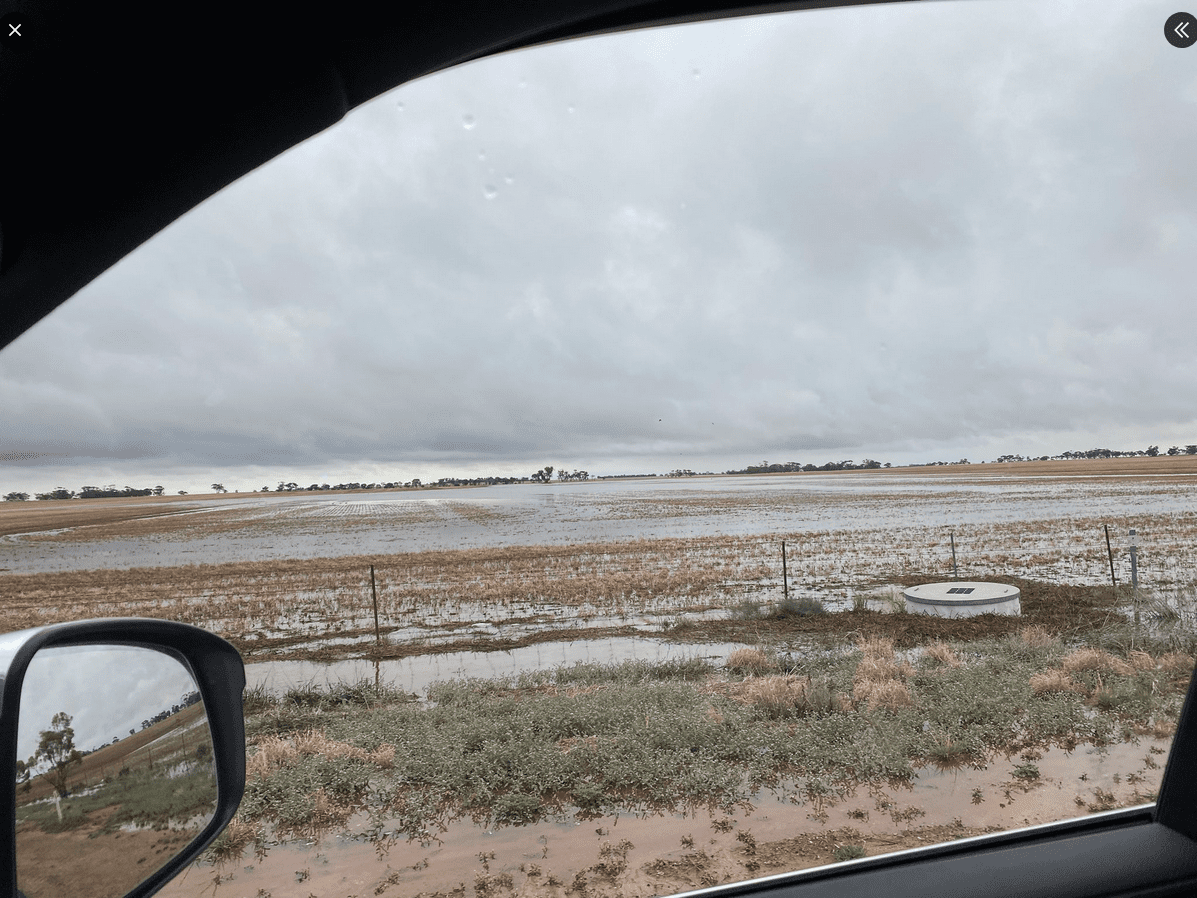
This farm at Normanville in the Vic Mallee has had 120-200mm of rain in the past week. Photo: Bec Marshall
BIG RAIN in South Australia and Victoria, now stretching into New South Wales, has set up parts of the grainbelt for a strong start to the winter-cropping season.
For graziers, it will generate a flush of feed and allow them to rebuild flock numbers after up to three very tough years.
On the cropping front, rain is germinating weeds, meaning growers will be able to clean up their paddocks ahead of winter-crop planting to help maximise yield potential.
The falls, of close to 200mm in places in the week to today, has filled or part-filled subsoil-moisture profiles, pointing to an early and strong start for canola, pulses, and cereals.
For mixed farmers, oats, vetch and red wheat are likely to be planted on this rain to bolster paddock feed into the winter months.
Flocks set to rebuild
Rain in SA’s pastoral country, and into NSW, will allow graziers to rebuild flock numbers after consecutive tough seasons.
With dams full and creeks flowing, the impediment of little to no surface water for stock is no longer a hindrance.
Above: AJ & PA McBride’s 131,210ha Braemar Station in received more than its annual average rainfall of 200mm in the recent event. Drone footage: Abby Sheridan, Braemar Station
AJ & PA McBride’s Braemar Station, 75km north-east of Burra, topped SA’s registrations with 225mm, and Yunta was not far behind on 182mm.
“It’s a game-changer for our pastoral guys,” Elders Burra-based state livestock manager Damien Webb said.
“It will enable people to retain numbers and build numbers; it’s been fantastic,” Mr Webb said of the rain.
He said restockers who look to the pastoral country for replacement ewes may be hard-pressed to find alternative sources as the flock rebuilds, particularly if lamb prices stay high.
“We’ve had pretty poor lambings in these poor seasons, and because the lamb job’s been so strong, rather than carrying them through to spring and selling them off shears, they’ve been getting their heads cut off.”
Mr Webb said some graziers may opt to send some of their latest drop the same way.
“That concerns me this year too; potentially where this lamb job could be at $11-$13/kg, a lot of ewe lambs will…go to processors.”
SA cropping brightens
Many SA croppers and mixed farmers had a drought-hit 2024, and a patchy season last year.
However, falls in the week to 9am today, point to a strong and early start for growers from Eyre Peninsula through to the South East.
While some missed the rain, most gauges in SA’s cropping zones got more than 30mm, with Karoonda getting 92mm; Melrose 104mm, Murray Bridge 68mm, and Paskeville 66mm.
Grain Producers SA chair John Gladigau lives in the Loxton district, where most farms got 60-150mm.
“It’s replenished a lot of subsoil moisture that hasn’t been there for the past couple of years,” Mr Gladigau said of the SA rain generally.
“It certainly does give some significant confidence going into the year because there’s moisture in the bank.”
Mr Gladigau said the rain was not expected to bring planting of cash crops forward, but would allow growers to “prepare paddocks properly” by getting on top of weeds now germinating ahead of the traditional break expected on Anzac Day.
“This is a fantastic opportunity to set crops up.
“It’s turned this season into what looks like a traditional cropping year.”
He said SA Government and Regional Investment Corporation loans will help growers whose cash flows have borne the brunt of the recent run of tough years.
“We’ve got a lot of the state coming off one, two or three drought years in a row.
“There’s never been a more important to maximise that help.”
Platinum Ag Loxton branch manager Corey Gilgen said ahead of the main planting window for winter crops opening next month, some growers may consider planting feed over the next week or two.
“It might be a bit early for the main crops,” Mr Gilgen said.
The rain will germinate weeds and self-sown crops, and promote pasture growth ahead of the winter months.
“It has definitely changed the tune and given some optimism for the upcoming season.”
Whether people buy in more stock to value-add pasture remains to be seen, but plenty in the Riverland have sheep in containment pens; this rain will allow at least some to go on to paddock feed.
“There are already more farmers feed-lotting sheep to combat lower-than-average cropping returns last season.”
Wet in Vic
In Victoria, Mallee registrations for the week include: Birchip 120mm; Mildura 154mm; Ouyen 197mm; Sea Lake 184mm, and Woomelang 118mm.
In the Wimmera, totals for the week include: Dimboola 78mm; Horsham 160mm; Rupanyup 100mm, and Warracknabeal 101mm.
Longerenong received 111mm, enough to see cancellation the first day of the Wimmera Machinery Field Days today; however, tomorrow and Thursday are scheduled to go ahead as planned.
In the southern Wimmera and into the Western District, AgVantage Agronomy director Tim Pohlner said rain has sparked mixed-farmer interest in sowing pasture, and early grazing or dual-purpose cereals, including red wheat, as well as vetch.
After two below-average rainfall seasons and “very little moisture in the soil”, Mr Pohlner said growers were now revising yield targets, and hay area could drop as a result.
“I can see the hay portion of the rotation potentially reducing slightly,” Mr Pohlner said.
“Oaten hay could go 8-10t/ha, and people don’t have shed space for that.”
Mr Pohlner said the rain may have turned a modest yield outlook for hay at 5t/ha into 7-8t/ha, enough of a boost to prompt a rethink on what they can store on-farm.
Concerns about the escalating Middle East conflict impacting urea supply and lifting prices are also playing on growers’ minds as they decide what to plant.
As with south-west NSW, and much of SA, Vic’s Mallee and Wimmera generally had an average-at-best 2025-26 season, which has left some nitrogen in the bank.
“North of Horsham, they’ve got a fair bit of nitrogen in the profile, and some would grow up to 3t/ha [of wheat] without putting N in.”
Mr Pohlner said Wimmera growers are likely to start their winter-crop seeding with canola from as early as April 10, with red wheat expected to kick off the Western District program.
Grain Central: Get our free news straight to your inbox – Click here
HAVE YOUR SAY