
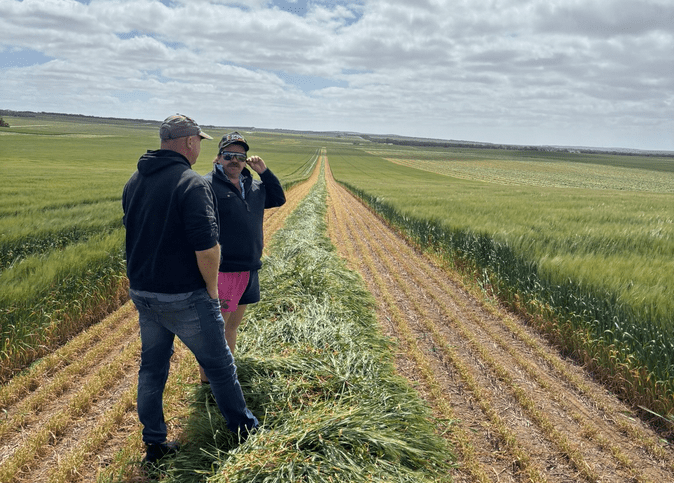
Barley in the Strathalbyn district cut for hay because of its higher gross margin than grain at current values. Photo: James Stacey
FAVOURABLE winter rainfall across most of South Australia’s cropping regions has lifted the Department of Primary Industries and Regions (PIRSA) estimate for the 2025-26 winter crop to 8.49 million tonnes (Mt).
The figure has come in PIRSA’s latest Crop and Pasture Report – Winter Crop Performance, and shows a lift from 7.59Mt estimated in the previous report released in July.
The winter reports shows yield potential has risen to average or slightly above average in many districts.
While still below the state’s five-year production average, this is welcome news for an industry that endured the lowest rainfall on record in the prior 18 months.
PIRSA now sees SA’s major crops, wheat at 4.65Mt, up from 4.11Mt seen in July, barley at 2.04Mt, up from 1.86Mt, and lentils at 717,364t, up from 632,514t.
Challenges remain in the Northern Mallee and eastern Lower Murray, where rainfall deficits and sandblasting have damaged crops and exposed sandy soils, raising erosion concerns.
Rootzone soil moisture is mostly average, but deeper layers remain well below average following the dry summer and autumn.
With crop development two to three weeks behind schedule, spring rainfall will be critical to supporting yield potential.
Pasture growth also varies across the state with cover remaining poor in the Northern Mallee, where supplementary and containment feeding are still required.
In contrast, the Southern Murray-Mallee, Lower North, Mid North, Upper North and Lower Murray are showing gradual recovery.
Many livestock producers have reduced stock numbers, prioritising the retention of breeding animals while offloading surplus or non-productive stock.
At present, no major pest, disease or weed threats have been identified, although recent flights of native budworm moths are likely to prompt insecticide applications to protect pulse crops in the coming weeks.
The SA Government continues to support producers through seasonal challenges, with its $73 million Drought Support Package available to primary industries and associated businesses.
The package includes the On-Farm Drought Infrastructure Rebate Scheme to help manage drought conditions and strengthen preparedness, and funds to assist charities with freight costs to deliver donated fodder to farmers.
Drought not over
Grain Producers SA chief executive officer Brad Perry said while the drought has yet to fully break across SA, it was encouraging to see rain in recent months providing a boost to crop growth.
“With very little subsoil moisture across many cropping regions, achieving an average crop this year will ultimately depend on spring rainfall and avoiding spells of extreme heat,” Mr Perry said.
“Crop development is still running four to six weeks behind in many regions, which means farmers are preparing for a much later start to harvest than usual and that brings its own set of challenges.
“The encouraging news is that most grain producers across the state have received more growing-season rainfall in 2025 than during last year’s record dry period.”
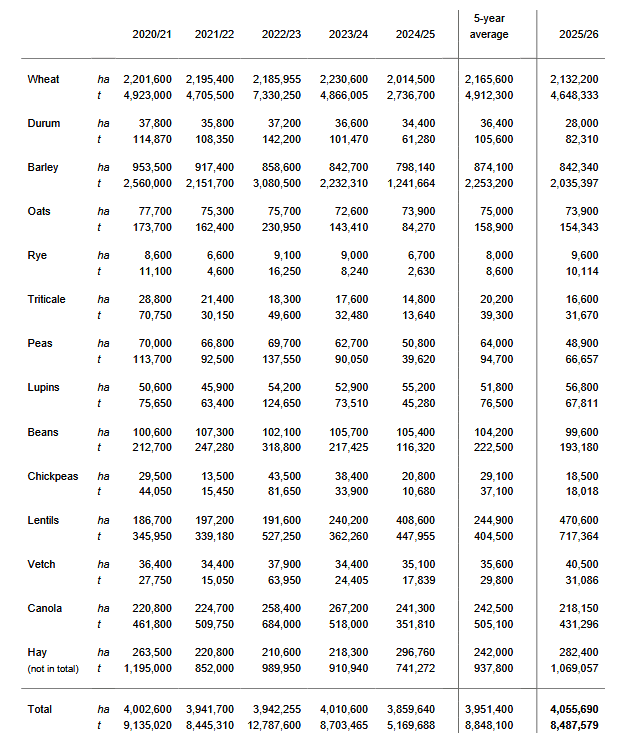
Table 1: Area and production estimates for major SA crops based on conditions as at 14 September 2025 against the five-year average to 2024-25. Source: PIRSA
Source: PIRSA
HAVE YOUR SAY