
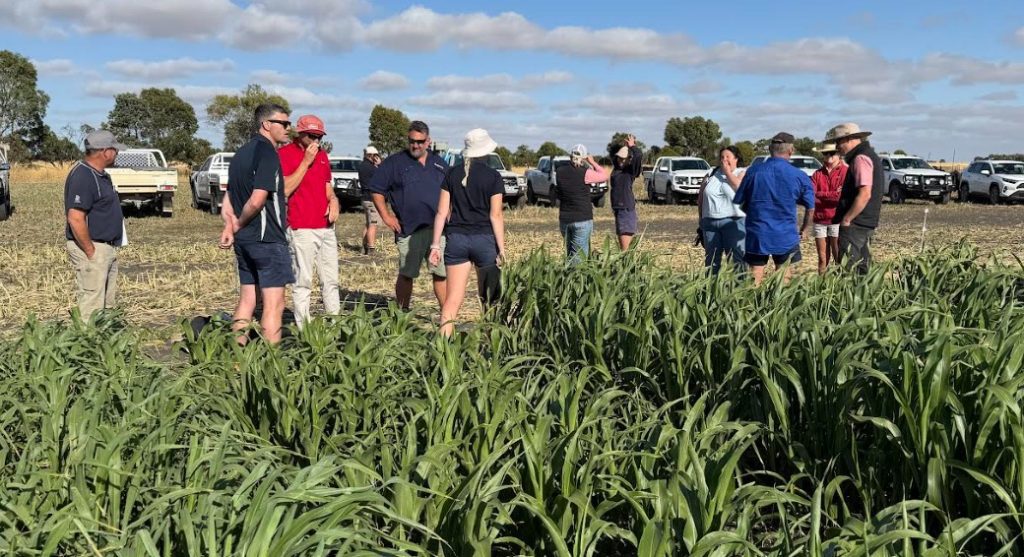
The sorghum trial paddock walk was held February 5 at Struan in SA’s South East. Photo: GSSA
NEW trials are testing the potential of different varieties of sorghum to improve summer fodder options for growers in South Australia’s South East.
The replicated trial at Struan, south of Naracoorte, is designed to assess different sowing dates, the merits of three different sorghum varieties and the impacts of nitrogen applications.
The Grassland Society of Southern Australia Limestone Coast branch research project is entitled Improving the sustainability and irrigation use efficiency of summer fodder through improved management decisions.
The project is funded by a Grassroots grant from Limestone Coast Landscape Board and supported by seed company Barenbrug Australia.
GSSA Limestone Coast branch member, Elders agronomist and GRDC Southern panel member Adam Hancock said there had not been sorghum trials in the region for more than a decade.
“We’re trying to see the yield potential from the new varieties of sorghum,” Mr Hancock said.
“It’s not a crop that we’ve had a lot of work done on for a long time.
“There are a few things that have changed over the decade, including the new varieties, we’re also sowing a lot earlier with the soil temperature at 13 or 14 degrees instead of 16.”
“For southern parts, this could be a really big deal if we could get the crop in the ground three or four weeks earlier.”
Mr Hancock said plenty of trials now have shown that sowing into soils well before 16 degrees is reached is very successful.
“Potentially the very earliest, but risky, is sowing when the soil is 13 degrees and rising.
“This takes some understanding; if you sow at 13 degrees and it drops then you can ruin your crop.
“The best bet is 14 degrees and rising unless you have soil probes on farm.”
The current trial site was sown twice 28 days apart to capture information about what earlier sowing could be worth to growers in SA’s South East.
Variable nitrogen applications are also being tested.
“Because the yield potential is so much higher, we’re testing how much fertiliser you need to apply to capture your maximum yield potential.
“It could be anywhere between 18 and 30 (days) so we need to understand the ideal number.”
The site has been zoned, with one area being cut once and another twice.
A South Australian Research and Development Institute soil agronomy team is running the site and conducting the research.
The GSSA Limestone Coast branch hosted a field day on the site on February 5 to raise awareness of the project.
A further event is planned to outline the findings of the one-year project.
People interested in joining the GSSA can visit https://www.grasslands.org.au.
Students can become members for free.
GSSA has successfully promoted the business of grass, science and farming since 1959 and has branches in Victoria and southern New South Wales as well as SA.
Source: Grassland Society of Southern Australia
HAVE YOUR SAY