
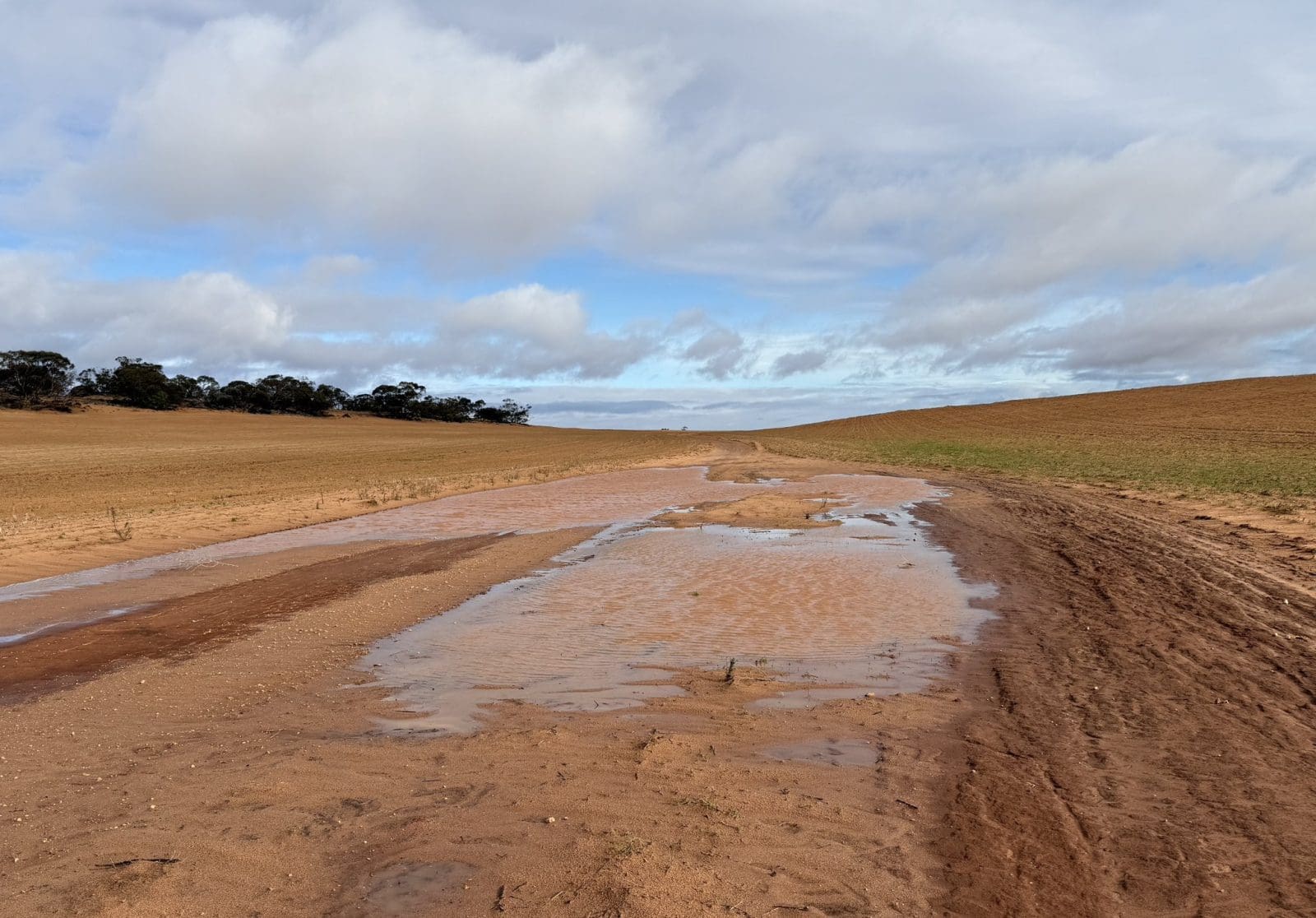
Many parts of the Vic and SA Mallee have had more than 20mm in recent days, their first double-digit fall since November 2024. Photo: John Gladigau
WIDESPREAD rain across South Australia and Victoria has bolstered yield potential for crops after a late and fitful start.
Some regions had their first falls of more than 30mm in 18 months or more, creating run-off to help fill dams, and putting moisture under cereal, pulse, and canola crops, as well as pastures.
Rain has delayed the delivery to SA farms of 6401 bales of donated hay which arrived from Western Australia on the weekend.
Hay has been offloaded at depots to finish its journey to livestock producers once access roads dry out enough to open to trucks.
As Grain Producers SA chair John Gladigau stated in his post on X Saturday: “One rain doesn’t end a drought, and the pain will continue, but nothing lifts spirits like rain – and there are lots of smiles across the state today.”
Crops ‘starting to move’
Platinum Ag Services Clare-based agronomist Phil Holmes said SA’s rainfall event of recent days was the biggest one for the year, and followed lighter and patchier falls earlier this month.
While some of SA’s Murray-Mallee had 15mm or less, instead of the 25mm plus most other cropping districts got, Mr Holmes said the rain has been significant ahead of August, when weather is expected to warm as days lengthen.
“Water’s gotten down into the subsoil, and some dams are beginning to get water in them, and they might be 10 to 20-percent full,” Mr Holmes said.
“It’s properly wet now.
“Now that they’ve started to grow, cereals are on average at the early tillering stage, and crops are starting to move a bit now.”
Mr Holmes said many growers spread urea ahead of rain-bearing fronts coming through in recent weeks and, based on cargoes arriving, supply of fertiliser looks to be sufficient for now.
However, more rain could prompt some shortages of urea as growers look to further boost yield potential.
“If we have a good August, that’s when a deficiency will occur, as I understand it.”
Mr Holmes said more advanced cereal crops were at the mid-tillering stage, and wheat and barley crops generally “haven’t looked back”.
The late start in Vic and southern NSW, as well as SA, may have cost some yield potential, but crops in regions like SA’s South East and Vic’s Western District have avoided waterlogging, often common in winter.
“Canola is starting to move too, and lentils are popping out of their press-wheel furrows, some with a 75mm trench.”
“It could still be an okay year — around average — if we were to keep getting decent rain in August and into September.
“That would finish off the crops west of Clare, and east of Clare, in the colder climate, they’ll need rains into October.”
Totals vary, management challenges present
Strong and persistent winds have preceded much of July’s rain, and Mr Holmes said sandhills prevalent in lighter country have been “problematic” in some districts.
“People delayed sowing crops on those sandy rises, and..after they did sow, fronts were preceded by quite decent winds.
“On the tops of the sandy rises, there was no stubble from last year, and some of that sand has drifted, and been resown.”
More rain is forecast for coming days, and will hopefully get to those places that missed a decent soaking over the weekend.
Wind is also on the forecast, and Mr Holmes said this, as well as rain, and wet paddocks, will make it hard for growers to spray weeds and/or spread fertiliser in coming days.
“A lot of paddocks won’t be trafficable for a week.”
On SA’s Eyre Peninsula, rainfall registrations for the week to 9am today include: Cleve 20mm; Coulta 60mm; Cummins 35mm; Heggaton 3mm; Kimba 31mm; Lock 37mm; Penong 45mm, and Wudinna 34mm.
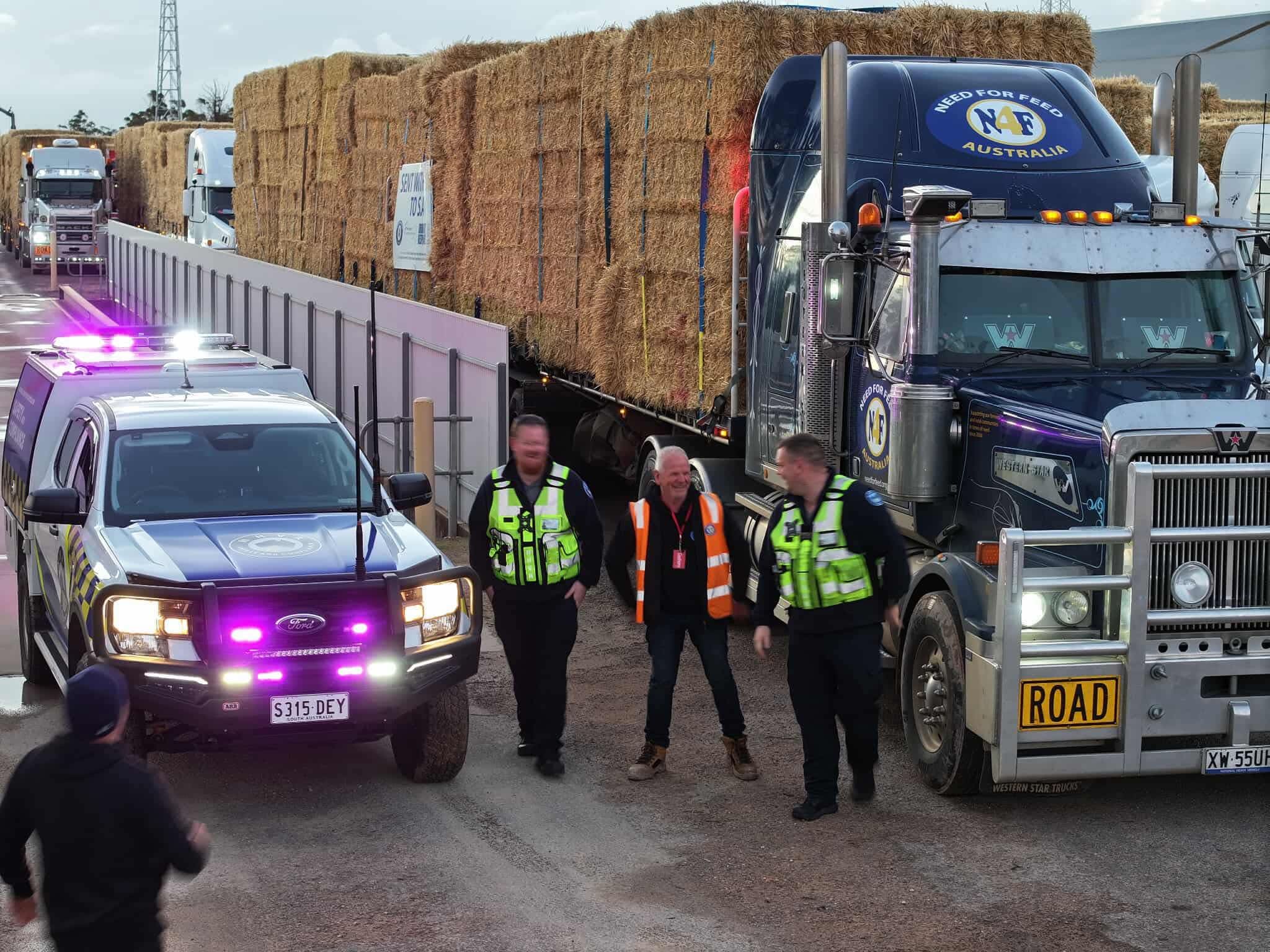
Rain and the convoy carrying 6401 square bales of mostly export-quality oaten hay from WA rolled into SA on the weekend and is being donated to SA livestock producers. Pictured near Kimba on Saturday are Need for Feed’s Graham Cockerell (centre) with NHVR officers. The donation was co-ordinated by Need for Feed with WA’s Farmers Across Borders, with transport costs covered by the SA Goverment. Volunteers, SA and WA government agencies, NHVR, and private sponsors all contributed to the success of the drop. Photo: Need for Feed Australia
On Yorke Peninsula: Kadina 40mm; Maitland 65mm; Paskeville 37mm, and Yorketown 53mm.
In the Lower, Mid, and Upper North, and County Light: Burra 35mm; Clare 58mm; Crystal Brook 27mm; Farrell Flat 67mm; Jamestown 3mm; Melrose 59mm; Riverton and Saddleworth 42mm; Roseworthy 19mm; and Wirrabara 38mm.
In the Murray-Mallee and South East: Alawoona 33mm; Bordertown 51mm; Frances 68mm; Karoonda 29mm; Lameroo 36mm, and Millicent 24mm.
In the Vic Mallee: Murrayville 35mm; Ouyen 4mm; Sea Lake 31mm, and Ultima 30mm.
In the Wimmera: Dimboola 34mm; Horsham 33mm, Nhill 40mm, and Rupanyup 47mm.
Grain Central: Get our free news straight to your inbox – Click here
HAVE YOUR SAY