
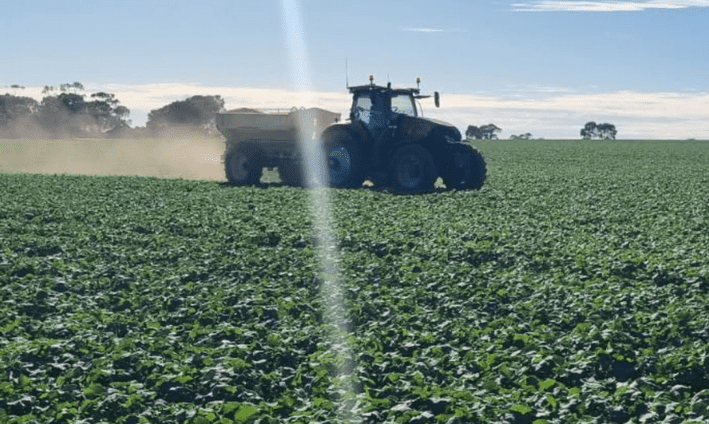
In SA’s Mid North, Eudunda grower Anthony Pfitzner top-dresses March-sown canola with urea early this month. Photo: Pioneer Seeds – Australia
IDEALLY timed rain across almost all of Australia’s grainbelt has supercharged demand for urea as the global market shows signs of returning to normal.
Sources within the fertiliser industry have told Grain Central that enough cargoes are arriving to cover the nation’s winter-crop requirements, and prices are now well below their March and April peak of $1400 per tonne free on truck.
After dropping to around $1200/t in late May, urea is now being offered for as little as $1100/t, still well above the $700/t or so urea was available for prior to the US-Iran conflict impacting supply from the Persian Gulf.
However, most growers and retailers are said to be paying close to $1200/t for prompt delivery, and some throughout the supply chain are shuddering as Federal Government support flows the way of just three of Australia’s many fertiliser importers.
FFSF clocks three more cargoes
Minister for Trade and Tourism Don Farrell yesterday announced the securing of a further three shipments of urea totalling close to 98,500t through its $7.5-billion Fuel and Fertiliser Security Facility.
“The Albanese Government has partnered with Incitec Pivot, CSBP, and Summit Fertilizer to support the purchase of these additional fertiliser shipments, which are expected to arrive in Australia in the coming weeks,” the statement advised.
“In partnership with these companies, the government has now secured around 340,000t of additional urea for Australian farmers.”
The statement said around 1.4 million tonnes of urea has been cleared through Australia’s biosecurity system which has been streamlined and is “helping to get fertiliser to our farmers faster” since the escalation of war in the Middle East.

Collated shipping data shows only two ships are passing through the Strait of Hormuz today, and 500 ships are waiting to get through. Source: Hormuz Strait Monitor
As outlined on the Department of Agriculture, Fisheries and Forestry website, the FFSF provides price-risk support to approved importers with an eye to strengthening Australia’s long-term energy and critical input security.
“The price-risk support is structured as a contract-for-difference structure, whereby government partially covers the downside risk of prices falling; if prices rise, the benefits are shared with government under agreed terms,” the DAFF webpage states.
Marnco managing director Mark Been said FFSF opening to urea in the wake of the halt in exports from the Persian Gulf seems to have been done by the government with the best of intentions, but is pressuring companies like his, which do not have FFSF support.
“Now we’re fighting for price transparency,” Mr Been said.
“Supply’s not an issue; supply was never an issue; through this mechanism there are distortions in the market.”
Staggered start helps
As evidenced by the latest DAS report, South Australia and Victoria got off to a very early start, while northern New South Wales and southern Queensland have had a late one.
It has enabled the eastern half of Australia to split its peak demand for urea for planting, but has thrown the highest prices on to those southern growers who did not have product on hand or booked before the US-Iran conflict escalated in early March.
Sources have told Grain Central that enough urea has either landed or been booked to arrive in time for top-dressing of crops stretching from Qld to SA’s western Eyre Peninsula, and through SA and Vic, over coming weeks.
Riverina Independent Agronomy principal and senior agronomist and Collingullie farmer Neil Durning has summed up the urea situation: “It’s been alright; you just had to pay up for it.”
“That cheap stuff, a lot of it’s August delivery; if you want to reach out and grab urea today, you won’t get it for the lowest prices you’re hearing,” Mr Durning said.
He said growers have had to deal with gaps in supply of urea post planting, but patches of wet weather have allowed some catch-up by slowing or stopping fieldwork on many farms.
Mr Durning described the supply of urea in his district as “momentarily tight”, but mostly flowing in sufficient quantity to satisfy his clients’ pared-back programs.
“We’d be doing 70 percent of what we’d normally do.
“The last time it was expensive like this, people went hard, and it nearly broke some of them.”
He said growers were generally feeding canola to optimum levels, but trimming amounts going on to wheat.
“Whatever we’d normally do, say 250-300kg/ha, we’re taking 70-80pc of that, and we’ll rely on the soil to do a bit more…or deliver a low-protein wheat.”
When more than 4.5t/ha would normally be in sight after a start to the season like this one, Mr Durning said yield targets for wheat have been lowered to around 3.5t/ha, and a soft finish would add tonnes at the expense of protein.
Better late than never
With a roughly three-week sailing time from the Persian Gulf to eastern Australia, the hopefully imminent reopening of the Strait of Hormuz to shipping undoubtedly be positive for the Australian market, where growers in northern regions are now preparing to plant summer crops.
WesCEF-owned CSBP Fertilisers is one of three companies getting Federal Government support through the FFSF, and this week promoted its stocks on hand as being available. Source: CSBP Fertlisers, Facebook page
However, with urea manufacturers on the western shore of the Persian Gulf either shut down or damaged or both as a result of the conflict, a reopening of the strait does not mean a string of vessels will make it to Australia in time for winter-crop top-dressing,
“We’re really running out of time; top-dressing takes us into July or August, so vessels need to be loading or on the water to catch a lot of that,” Mr Been said.
Another source in the fertiliser business said the early start for SA and Vic crops has brought forward peak demand for urea for top-dressing.
“Crops are so advanced that they need that urea earlier than they normally would,” the source said.
“By July, most farmers would have purchased their top-dressing needs, and they’re picking it up now.”
Grain Central: Get our free news straight to your inbox – Click here
HAVE YOUR SAY