
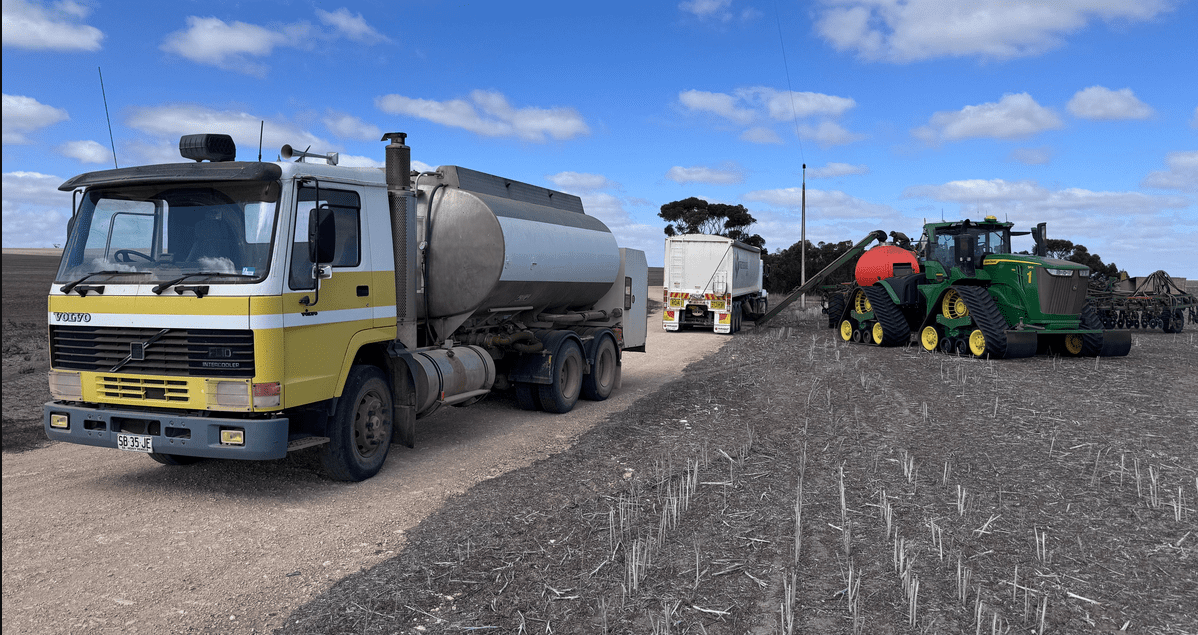
Growers on SA’s Eyre Peninsula are making an early start on seeding, with canola and lentils opening the program. Photo: Peter Glover, Yeelanna
A PATCHY start to winter-crop planting across south-eastern Australia and the recent or imminent arrival of a number of urea cargoes have eased the pressure on fertiliser supplies for now.
Shipping schedules and industry sources say urea has either recently unloaded, is on the berth, or will arrive by mid-May from a number of origins alternative to the Middle East, namely Brunei, Indonesia, Nigeria, and Oman.
These will go some way to countering cargoes ex Persian Gulf ports, which since early March have been unable to transit the Strait of Hormuz due to the Iran-US war.
The conflict has seen urea prices almost double to a peak of $1600 per tonne ex port, now back to more like $1400/t in some locations, a level less likely to cause demand destruction.
Solid progress on EP
Planting of Australia’s winter crop typically starts in earnest on Anzac Day, which falls this Saturday.
However, soaking rain in late February and early March over South Australian and Victorian growing areas, and parts of southern and south-central New South Wales, have kicked off early activity.
On SA’s Eyre Peninsula, Agfert business growth and relations chief officer Tim Gurney said topsoil has started to dry out, particularly with unusually warm maximum daytime temperatures of 32 degrees Celsius as recorded yesterday at Port Lincoln.
“EP is probably 20-25 percent planted, and canola and lentils are going in first,” Mr Gurney said.
“Things are starting to dry out, and we’re almost at that stage where you could start chasing depth but you’d like a follow-up rain.”
Provided the growing season is kind, SA, Vic and NSW growers can plant cereals, pulses, and even canola into June without a a yield penalty.
On the lighter soils of SA and Vic, growers are likely to switch to dry sowing next month in the realistic expectation of a germinating rain.
Canola worth the spend
South of Adelaide, Platinum Ag Services Meningie-based agronomist Matt Howell said canola and fodder crops were being planted at pace.
“There’s a lot of barley, oats and vetch going in for early feed, and the potential for hay later,” Mr Howell said.
“We’ve had a reasonable early bit of rain, and we’ve got a bit of feed in front of livestock.”
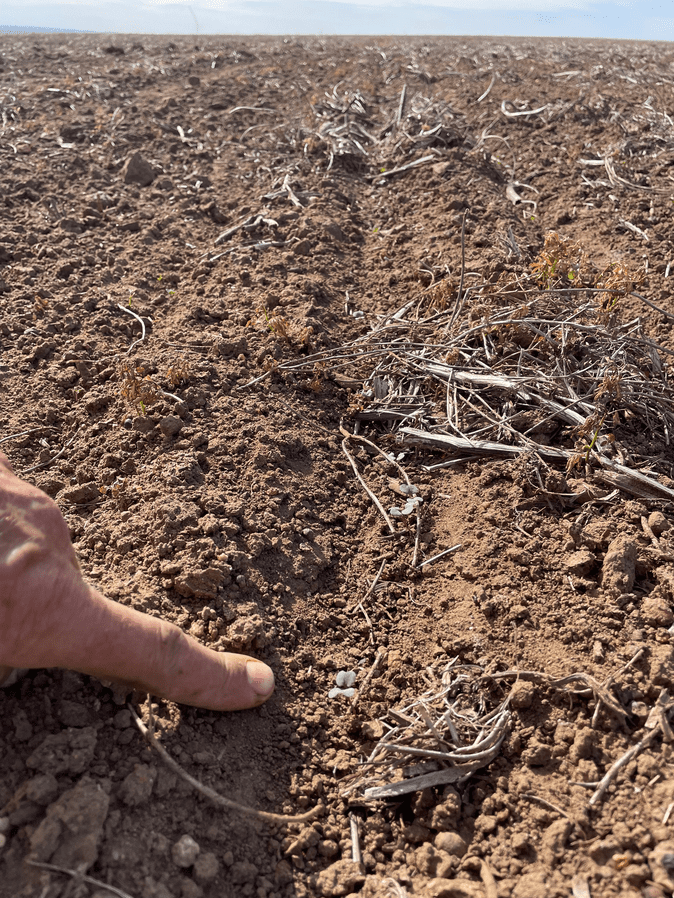
Canola at the cotyledon stage would benefit from rain following unusually warm weather this week. Photo: Mark Modra, Port Lincoln
Mr Howell said the region was seeing producers at least retain their sheep numbers, and some were trading and lotfeeding lambs and sheep, or hanging on to five-year-old ewes for another crossbred lamb.
“Guys are sticking with sheep, and some are trading sheep.”
Mr Howell said the region’s growers were enthusiastic about canola, despite its appetite for nitrogen.
“Canola is king, followed by barley; price isn’t great for the foreseeable future for pulses.
“For us in sandy soil types, canola is reliable; we grew over 2-2.5t/ha on 300mm total rainfall for the year, and urea availability is freeing up.”
“It’s the earlier applications we’ve had to pay up big for.”
Dry north helps south
Urea cargoes coming into Brisbane and Newcastle this month are believed to be well down on April 2025 volume, a function of very dry conditions from the Liverpool Plains to far north-west NSW, and into south-west Queensland.
The Bureau of Meteorology’s outlook points to only a slim chance in coming weeks of soaking rain falling across the wider region, and its growers therefore see little need to buy urea at the currently inflated levels.
This is allowing extra volume to get to Vic and SA ports, where the winter-cropping outlook is stronger by comparison.
Urea up 94pc: Rabo
In its latest Semi-annual Fertiliser Outlook out this week, Rabobank said the international fertiliser market ended the first quarter of the year under severe strain, and faced a prolonged period of tight supply, weak affordability, and heightened price risk.
RaboResearch said fertiliser affordability was already under pressure in 2025, as prices for nitrogen and phosphates had steadily increased.
“Prices for nitrogen and phosphates have risen far faster than agricultural commodity prices, which is compressing farm margins globally and accelerating affordability pressure,” the report said.
“RaboResearch’s fertiliser affordability index has moved decisively into negative territory and is expected to remain constrained throughout 2026, with only limited recovery in the second half of the year.”
Report lead author, RaboResearch senior analyst – farm inputs Bruno Fonseca said this “raises the risk of widespread fertiliser ‘demand destruction’ as farmers around the globe reduce application rates, delay purchases or shift crop choices”.
“The outlook for 2026 points to continued pressure on farm economics and increased downside risks for global crop production and food price stability,” Mr Fonseca said.

RaboResearch analyst Paul Joules.
RaboResearch Australia-based commodities analyst Paul Joules said the conflict had again highlighted the fragility of Australia’s fertiliser supply chain, which relies heavily on imports for critical products such as urea and mono-ammonium phosphate.
“Accounting for currency movements, we estimate Middle East granular urea prices have surged an eye-watering 94pc year to date,” Mr Joules said.
“Diammonium phosphate free on board prices have risen a more modest 11pc year to date, while Vancouver spot FOB potash prices have largely evaded significant price inflation, having risen by 2pc over the same period.”
Mr Joules said the Australian dollar – traditionally a key shock absorber for imported inputs – had strengthened sharply over the past 12 months.
“However, despite this currency appreciation, fertiliser input prices have remained elevated due to ongoing constraints in global urea and natural gas supply chains, meaning Australian growers have still felt retail price inflation.”
While any further strength in the Australian dollar would be expected to help offset the high input prices, recent volatility in urea and phosphate markets suggest global supply and demand fundamentals will continue to exert an outsized influence on local Australian pricing.
“Against this backdrop of compressed margins, Australian farmers – driven by the combination of disappointing grain prices and elevated fertiliser costs – may increasingly favour crops that have historically demonstrated greater margin resilience under variable seasonal conditions.
“Barley and canola are therefore likely to gain ground relative to wheat.”
Ultimately, Mr Joules said RaboResearch expected a pronounced decline in total fertiliser consumption in Australia as growers responded to elevated prices and strategically adjusted cropping rotations.
Grain Central: Get our free news straight to your inbox – Click here
HAVE YOUR SAY