
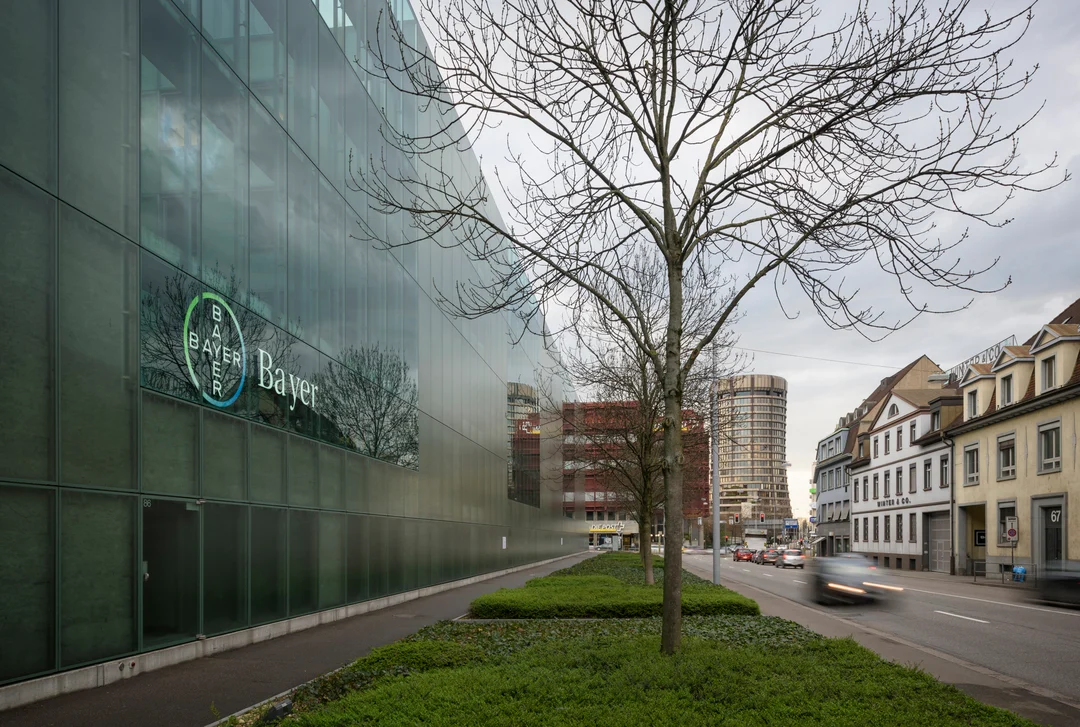
Bayer’s Consumer Health Headquarters in Basel, Switzerland. Photo: Bayer AG
A UNITED States court has approved a settlement worth up to US$7.25 billion, or around A$11B, to resolve thousands of existing and future claims from people diagnosed with non-Hodgkin lymphoma (NHL) after exposure to Monsanto’s Roundup herbicide.
On Friday, Missouri judge Timothy Boyer gave final approval to the nationwide settlement, which was initially agreed to in February this year.
In preliminary approval order from March, Judge Boyer called the settlement “fair, reasonable and adequate”.
While accepting the settlement, Monsanto has maintained that it does not admit liability or wrongdoing.
Plaintiffs may be eligible for payments ranging from US$10,000-$165,000, depending on the type of exposure, their diagnosis and their age at the time of diagnosis.
The highest award level includes people exposed to Roundup while working, such as farmers and landscapers.
The settlement includes plaintiffs who allege exposure to the herbicide prior to February 2026 and have NHL diagnosis or receive a diagnosis of NHL before the end of a 16-year period following the effective date of the agreement.
The court approved total attorney’s fees of US$600 million, about 8.28pc of the total potential settlement amount.
Waters Kraus Paul & Siegel and coalition partners Williams Hart & Boundas, Motley Rice, Seeger Weiss, and the Holland Law Firm loaded the settlement.
Waters Kraus Paul & Siegel partner Peter Kraus said when the settlement was first announced that the agreement would provide certainty for claims alleging a link between Roundup and NHL.
“This settlement provides a structure to address present and future claims so that all our Roundup clients will get an opportunity for compensation,” Mr Kraus said.
“It also allows our clients to avoid litigation risks in an increasingly uncertain legal landscape.
“Unlike previous settlement attempts, this agreement provides a mechanism to fairly compensate tens of thousands of pending Roundup plaintiffs, while also creating a predictable framework for handling future claims.”
Class members also could opt out of the settlement and pursue their cases in court.
Bayer response
In a statement, Bayer said the Court’s final approval order was subject to appeal.
Bayer chief executive officer Bill Anderson said the settlement was part of mutually reinforcing pillars in the company’s multipronged strategy designed to significantly contain the Roundup litigation.
“The Court’s final approval is a decisive milestone in the company’s strategy to mitigate the risks of both pending and future Roundup litigation,” Mr Anderson said.
The company expects the number of opt outs to be manageable and amount to a very low percentage of current and potential future claims.
Bayer’s statement also highlighted the Supreme Court case, known as Durnell, from June this year.
In a 7-2 ruling, the court found that state-level requirements could not override the Environmental Protection Agency’s position on whether Roundup was carcinogenic.
The US EPA has not determined whether the herbicide is a carcinogen.
The ruling was expected to block most US lawsuits over Roundup that fall outside the settlement.
In the statement, Bayer said that the company believed it was adequately provisioned to manage the remaining litigation.
Any plaintiff who chooses to litigate will face the burdens of both establishing that they have viable claims post-Durnell and ultimately proving them to a judge and jury, the statement said.
Australian class actions
There have been two major class actions against Bayer or Monsanto surrounding Roundup’s alleged link to NHL.
Bayer bought Monsanto in 2018.
Neither resulted in a positive judgement and only one, McNickle v Monsanto, made it to the Federal Court.
Filed in 2020 in the Federal Court of Australia, McNickle v Monsanto, featured a Queensland man who had used or been exposed to Roundup products in Australia between July 1976 and October 2020 and had been diagnosed with NHL.
The case went to trial between September and October 2023 with Justice Michael Lee ultimately ruling in favour of Monsanto in July the following year.
Justice Lee found the plaintiffs had not established, on the balance of probabilities, that exposure to Roundup increased the risk of NHL or caused an individual to develop the disease.
There was a similar action filed in 2019 by John Fenton but which were discontinued in January 2025.
Grain Central: Get our free news straight to your inbox – Click here
HAVE YOUR SAY