

Governments and industry bodies across Australia are working together to minimise the risk to poultry, wild birds, and other sectors now that H5N1 has been detected on Australia’s southern shores. Image: DAFF
AUSTRALIAN has confirmed a fourth case of H5 bird flu in migratory seabirds, but there is no evidence of its spread to other birds or into commercial poultry operations, Environment Minister Murray Watt said today.
Australian chief veterinary officer Beth Cookson said in a statement on Saturday that testing at CSIRO’s Australian Centre for Disease Preparedness has confirmed H5 high pathogenicity avian influenza (bird flu) in a giant petrel in Western Australia.
Dr Cookson said this detection marks the fourth wild migratory seabird in Australia to return a positive result for H5 bird flu, with two others confirmed in Western Australia and one in South Australia.
“Western Australian has also reported a further suspect positive detection, in a giant petrel found at Roses Beach, west of Esperance, with samples sent for confirmatory testing at CSIRO’s ACDP.”
“At this stage, there have only been detections in vagrant migratory seabirds that occasionally visit southern Australia.”
Western Australia, New South Wales and South Australia have implemented extensive surveillance and monitoring operations, especially along coastlines.
Last week, Victorian Farmers Federation president Ryan Milgate said although WA is a very long way from Victoria, and governments across the country are well prepared, if the disease takes hold, it will be extremely distressing for farmers and could have significant economic impacts.
“That’s why preparation and vigilance are now critical,” Mr Milgate said.
“We’re urging all farmers and the broader community to stay alert.”
“Any sick or dead birds or animals should be reported immediately to the Emergency Animal Disease Hotline on 1800 675 888.
“Because H5 can cross between species, every livestock sector needs to be prepared, not just poultry producers and producers should review their biosecurity safeguards.”
The VFF’s Stock Sense team will hold a bird flu webinar for producers on Thursday 2 July from 6pm with Dr Graeme Cooke, Victoria’s chief veterinary officer; click here to register.
Victorian wool, poultry farmers prepared
A rapid assessment of the risks posed by high pathogenicity avian influenza to Australia’s sheep and goat industries last year recommended avoiding co-mingling of poultry with small ruminants.
The assessment by Dr Isabel MacPhillamy and Dr Robyn N. Hall concluded that current spillovers of clade 2.3.4.4b HPAI into small ruminants have most likely been via infected poultry or direct contact with large numbers of sick and dead wild birds.
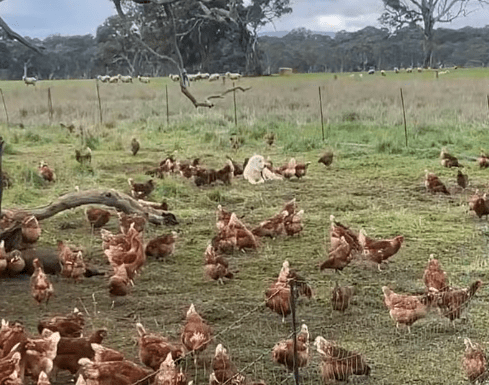
The Mooralla Merino hens on pasture north of Hamilton, Vic. Image: Mooralla Merino Enterprises
They recommended that where possible, prevent or limit access of wild birds, poultry and peri-domestic wildlife to small ruminant feed, pasture, feed storage, water sources, bedding materials and facilities.
Western Victoria Merino producer and regenerative poultry farmer Rick Luhrs said the operation has measures and a plan to minimise contact with wild birds and access to sheep on the farm to lessen the bird flu risk.
He said the hens were on a timed rotation system on pasture to minimise risk and can be locked in sheds if required.
All water and feed is enclosed at all times to eliminate wild bird access.
Guardian dogs eliminate wild birds from the poultry areas.
“We’ve spoken with Agriculture Victoria and had a meeting with Honest Eggs and we’ve got a protocol plan.”
Dr Cookson’s office said there remains no evidence of any mass mortality events and there are no detections in poultry or in Australia’s agricultural production system.
The risk to human health remains low.
Animal Health Australia said national and state response arrangements remain focused on surveillance, epidemiological assessment and determining the extent of infection in migratory wildlife populations.
The Department of Agriculture, Fisheries and Forestry and Dairy Australia commissioned an independent risk assessment on H5 avian influenza (bird flu) in Australian dairy cattle and other livestock in September 2025.
The assessment found that if the virus establishes itself in wild birds in Australia, the risk to the Australian dairy and pork industries is estimated low and negligible for beef cattle and small ruminants, namely sheep and goats.
DAFF said to date there have only been detections in migratory seabirds that occasionally visit southern Australia.
There are no detections in poultry or evidence of spread to, or establishment in, local wildlife. However, the department said maintaining strong farm biosecurity practices remains critical.
Producers should ensure farm biosecurity plans are in place, regularly reviewed, and consistently implemented. For more information see Farm Biosecurity.
Members of the public and farmers are also encouraged to report any sick or dead wild birds. Multiple sick or dead birds or other animals should not be touched, contact avoided, the location recorded and reported to the Emergency Animal Disease Hotline on 1800 675 888.
Grain Central: Get our free news straight to your inbox – Click here
HAVE YOUR SAY