
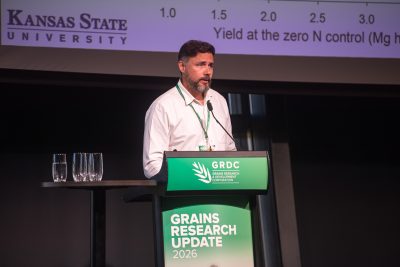
Dr Romulo Lollato speaking at the 2026 GRDC Perth Update. Photo: Lumens Photography/GRDC
RESEARCH delivered mid-February has gained extra relevance after fertiliser supply fell into turmoil at the outbreak of hostilities in the Middle East, leaving growers weighing the profitability of nitrogen fertiliser for top-dressing.
Insights on that topic were delivered to an Australian audience by Kansas State University researcher, Professor Romulo Lollato who worked in Australia for four months as the 2024-25 Grains Research and Development Corporation International Visiting Fellow with the CSIRO.
Professor Lollato was speaking at the GRDC Update held in Perth February 16-17 prior to the conflict breaking out on February 28, lifting global urea prices by around 65 percent and closing maritime trade with the Gulf.
The expense of applied nitrogen versus the gross margin was already of concern.
Their big question is: does the price of wheat at its currently depressed level justify in-crop application of urea to boost yield and/or protein?
View from Kansas
Prof Lollato’s presentation at the GRDC Update in Perth was entitled Yield and protein determination in wheat: Lessons from cultivar selection and nitrogen management from Kansas.
It was given prior to conflict breaking out on February 28 that has lifted global urea prices by around 65 percent by effectively closing the Persian Gulf, when the expense of applied nitrogen versus the gross margin for what was already of concern.
Prof Lollato’s studies have centred on the interaction of genetics, environment and management, or GxExM, which he likened to knobs on a sound system.
“The size of those knobs tells us quite a bit; a lot of it is environment.”
He said around 70 percent of a Kansas wheat crop’s protein is determined by environment, which can throw up anything from a cool moist finish to a hot dry one, while yield responds more directly to management.
“What we see is there’s a phase where yield is limited by nitrogen supply; as we’re increasing our nitrogen supply, we’re increasing grain yield, and finally it levels off.”
For a series of wheat crops yielding on average 4.5 ton/ha, yield appeared to “max out” at around 150kg/ha of N, Prof Lollato said.
“What we see here is we need a bit more nitrogen as well, close to 170kg, to max out protein at these yield levels.
“The question is: Are you getting paid for that protein? If you’re not getting paid for protein, then we are simply interested in maxing out yield.”
In Kansas, he said 11.5-12.5pc was the target protein range, and that trials at around 30 sites indicated crops lost 0.8pc protein for every tonne of yield.
“If you’re harvesting 9pc protein, 10pc protein, you’re harvesting 65 or 70pc of that particular crop’s yield potential, so how much money are we leaving on the table for not having enough nitrogen in the system?
He referenced research by Oklahoma State University’s Prof Brian Arnall into deferred nitrogen application on winter wheat trials with 100kg/ha N applied pre plant to see how late a crop could be top dressing.
The trial applied 100k/ha of N every seven days out to 70 days into N deficiency.
“Even though we’re seeing a nitrogen deficiency, deferring the nitrogen was doing 20pc on average better than the pre-plant nitrogen.”
What the trial sought to discover was what growers across the world, now hoping for a drop in fertiliser prices, may well be asking this season: “How late can we wait and still get a nitrogen response?”
The trial showed that the later nitrogen was applied, the more went directly to protein.
“If we’re going very late, at the second node or later, we’re not matching what the yield was for the pre-plant.”
Prof Lollato stressed that trials on winter wheat on the US Great Plains may be a different proposition to Australia, which grows non-vernalising spring wheat, despite it being planted in autumn or early winter.
“Maybe our pre plant is not as effective as yours,” Prof Lollato said to the GRDC Update audience, made up primarily of researchers, as well as Western Australian growers and agronomists.
In response to a question from the floor, Prof Lollato was asked about the Great Plains growers’ decision-making process around nitrogen fertiliser.
He responded that crops grown in regions where yields are more predictable get much higher in-crop rates than those where prospects are more variable.
“Yield potential really drives grower behaviour regarding nitrogen.”
Global connections
Prof Lollato hails from a family farm in southern Brazil, growing corn, soybeans, spring wheat and pinto or black beans, where the annual average rainfall is close to 1800mm.
“That’s how I got involved in agriculture from the get-go,” Prof Lollato said in conversation with Grain Central after the GRDC Update.
His undergraduate degree in Brazil in agronomy engineering led to a six-month exchange to the US, which led to a Masters and then a PhD at Oklahoma State University studying wheat agronomy and production and crop ecology.
In 2015, he moved across the border to KSU, working in extension and applied research in wheat and forages, from where he has established international connections.
“The ties that I have with Australia began a few years back via the Wheat Initiative.”
Based in Berlin, Germany, it came out of a 2011 meeting between Ministers of Agriculture in G20 countries, and aims to co-ordinate global efforts in agronomic research through 11 working groups.
“I started being part of that group on the expert working group for agronomy, and at that time, the group was led by John Kirkegaard.”
Dr Kirkegaard, a pioneering CSIRO farming systems agronomist, was leading the Wheat Initiative agronomy group with leading Canadian researcher Dr Brian Beres.
Through the group, Prof Lollato also met Victorian agronomy and crop science researcher Prof James Hunt.
“I started participating there more actively, and I made a really good connection with James Hunt.”
Dr Hunt received a grant to visit KSU, and spent some time with Dr Lollato.
“I then had a visit to Australia back in 2019…and that’s where I started making some of the connections that led to this GRDC fellowship.”
Some were made at 2019 Australian Agronomy Conference in Wagga Wagga, and others were made on a road trip to Mildura, where Prof Lollato met CSIRO researcher Kenton Porker.
Dr Porker is based at Adelaide University Waite Research Institute, where Prof Lollato was based for the GRDC fellowship which began in November last year.
His time in Australia included visits to a range of environments stretching from the high-rainfall zone of Tasmania to the semi-arid regions of Western Australia.
Prof Lollato and Dr Porker are now co-chairs of the Wheat Initiative Agronomy Working Group, http://x.com/WheatInitiative.
“As part of that Wheat Initiative group, we had this very close working relationship…and when Kenton became aware of this GRDC International Visiting Fellowship, he sent me the information for that.
“I was due for a sabbatical in my home institution, so I applied for it, and for the visiting fellowship; things got reviewed and they both worked out.”
In the field in Kansas
Kansas harvests close to 9 million tonnes of wheat from 3 million hectares annually, making it typically the US’ biggest wheat-producing, and the source of around 20pc of the national crop.
“That puts the state at number one, most years, for wheat production in the US.”
Prof Lollato’s work at KSU is divided between research and extension.
“The extension piece ends up being a lot of grower education.”
That includes field days and crop schools, while the research component is focused on the southern Great Plains, encompassing Colorado, Oklahoma and Texas as well as Kansas.
International collaborations also feature.
“We’ve done some wheat work in the Republic of Georgia, in Armenia, and in Ukraine as well.
“With this fellowship expanding to here in Australia…we cover quite a wide range of field environments.”
“In Kansas itself, there’s a huge variability in weather conditions because it’s a region with a very steep gradient in rainfall and temperatures.
“I like to say that we have pretty much a natural laboratory there because we have many different climate zones within the same state.”
They range from low elevation, warm temperatures and high rainfall to dry, cool, semi-arid conditions, and yield potential ranging from 0.5t/ha to 8t/ha.
“As part of our research program, we establish trials all over the state.”
The focus is yield-limiting factors faced by growers, and Prof Lollato gains insights into them through on-farm surveys about in-field activity and subsequent yield.
“Once we have that, then we can run a number of analyses to understand…the major factors limiting yields in grower fields.”
Survey results from Kansas have highlighted the importance of sowing dates, nitrogen and sulphur on the nutrition front, varieties with disease resistance, and fungicide management.
“If we think of all the decisions a grower can make in season for their wheat crop, we try to have research that is going to provide very applied information in terms of what they should be doing to maximise their profit at the field level.
“A big focus is fertility, disease management, and sowing dates.
“We sprinkle a lot of other things on top of that just to make sure that we’re developing the information that growers need.”
KSU is one of the US’ many land-grant universities which require its staff to be involved in extension as well as research.
“I am a professor, but I don’t teach any classes; I do extension and research.”
Prof Lollato said a normal year for him includes roughly 70-90 events where he interacts with farmers.
“They have the best questions, because they’re the ones working through those problems on their own farm.”
Thumbs up for Updates
Unlike Australia, where GRDC collects and allocates funding at a federal level, Kansas has the Kansas Wheat Commission, which collects levies from wheat sold in Kansas.
Around half the total collected annually is invested in research, and the balance goes into areas including marketing and advocacy.
Additional funding comes from USDA and other federal organisations.
“There’s definitely a very close contact with the growers since they’re the ones funding the research, and…they’re only going to fund what they think makes sense for moving the growers’ bottom line.
“In that sense, I think there’s some similarities with what the GRDC does here.”
“I’ve been very impressed with the GRDC system, and many aspects of it.
“They’re looking at national projects that I think make complete sense.”
The GRDC Updates have also gotten the thumbs up for bringing together researchers, consultants, and growers.
“I really enjoyed participating in those because it was such an interesting mix of people.”
“That’s definitely a model that, if possible, I’d like to take back to the US.
“When it’s coming from the grower, like it seems that it is here in the GRDC and like what we do in Kansas…it brings value to the farm.”
In Kansas and Australia, Prof Lollato sees nitrogen management in variable seasons as the major challenge based on nitrogen being “one of the biggest costs that we have in the production cycle”.
“There’s such uncertainty on how much we’re going to get as a return in that season; growers are many times reluctant to put enough on, and so the crop ends up with not enough nitrogen…and so you have a new [yield] gap.”
“I think if there is one issue that is common across Kansas and Australia, that will be probably my top pick.”
Varied maturity in Australia
Prof Lollato said Australian growers seemed to have a wider window in which their crops could mature, made possible by the absence of a levelling vernalising period.
“It seems like…here in Australia, with sowing dates, you can modulate your heading time a lot.
“In Kansas, it’s a winter crop, so we need to sow it in the fall; once it’s released from vernalisation into the spring growth, everything is more or less the same phenology, or it catches up so that the phenology is not as different.
“Heading dates are much more similar among varieties there than they seem to be here.”
Prof Lollato said the advantage available to Australian growers was that choosing the right variety could minimise exposure to frost and heat.
“We have heat and frost as well, but we can’t modulate as well our heading date via the sowing date or variety,” he said of the Kansas experience.
Another difference Prof Lollato noted was the greater range of wheat varieties from a wider range of sources available to the Kansas as opposed to the Australian grower.
“In Kansas, wheat breeding is done by not only multiple companies, but also multiple universities.”
KSU has two breeding programs, and releases commercial varieties every year.
“Then you have Colorado State and Oklahoma State and Texas A&M and University of Nebraska; all of those release commercial varieties.
“Variety selection is one of the biggest topics on growers’ minds there, and there’s over 100 varieties that could be good fit for Kansas alone.
“Growers spend a lot of time and effort making that decision about which variety to plant.”
In Australia, the opposite seems to hold.
“My understanding is that it seems like growers move from one variety to the other more in unison, so that there might be a lot of varieties out there, but they’re going to keep the one that is working for them until there’s one that is much better.
“Then it seems like that change is done more abruptly across the region.”
Prof Lollato said around 5-8pc would be the maximum Kansas wheat area held by any one variety.
“In Kansas, there are a lot of varieties grown in small amounts.”
This has not always been the case.
“In 2005, for example…60pc of the wheat area in Kansas was sown to the same variety.”
Prof Lollato said what diluted the dominance of a single variety was the showing up of susceptibility to major diseases like stripe rust.
“In the last 15 years or so, I can think of disease resistance erosion happening with at least three or four of the major varieties, and so…I agree that having everything planted to the same genetics might have some consequences that are not very favourable.”
Editor’s note: Professor Lollato will be a keynote speaker at the 2026 biennial Australian Agronomy Conference to be held in Darwin, August 24-28.
HAVE YOUR SAY