
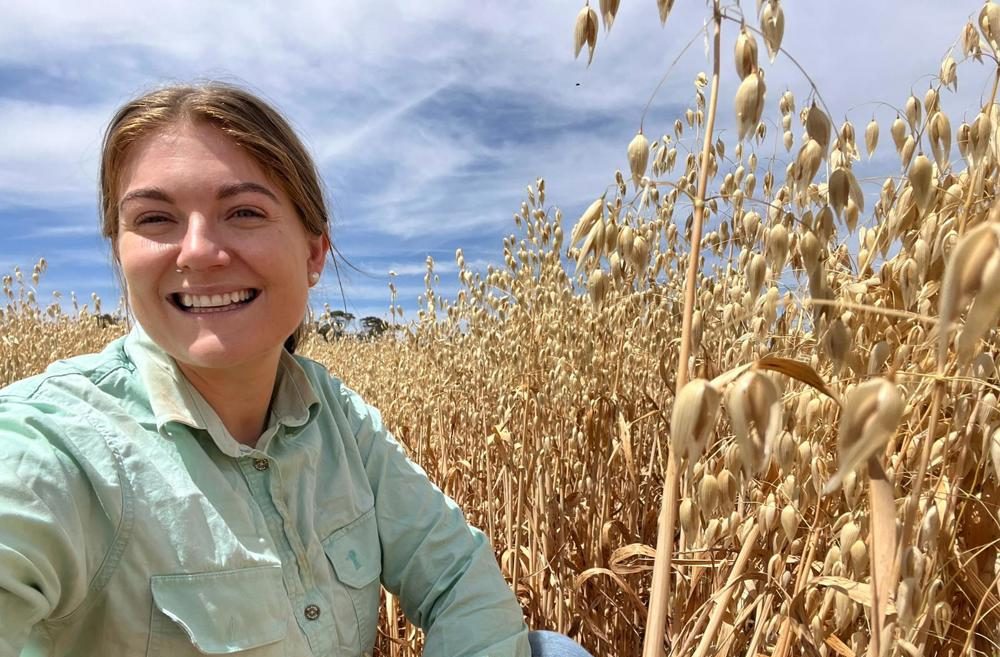
Shannen Davies is a 2024 Nuffield Scholar from York in Western Australia
AN AGRIBUSINESS professional is calling on the Australian oat industry to shift from producing a commodity to producing for function, after two years spent studying global oat markets, competitors and consumer trends.
The call has come from Shannen Davies née Barrett, a 2024 Nuffield Scholar from York in Western Australia, in her report examining the global oat industry and identifying growth opportunities and risks for Australian growers.
Supported by the Grains Industry Association of Western Australia (GIWA) and the Processed Oat Partnership (POP), Shannen’s research took her to Canada, the United States, United Kingdom, Germany, Denmark, Sweden, Ireland and Brazil, meeting farmers, processors and industry leaders in some of the world’s leading oat-producing regions.
Ms Davies works in communications and marketing at cereal breeding company InterGrain and is a part of her family’s cropping and sheep farm in York.
She presented her findings at the 2025 Nuffield National Conference in Adelaide.
Her report, The future of oats: Global trends & opportunities for Australian oats, explores how global demand is shifting oats from a traditional breakfast grain to a high-value food ingredient, driven by health-conscious consumers and growing plant-based markets.
Australia produces around 1.5 million tonnes of oats a year, with WA responsible for more than half of it.
Strong prices and renewed investment in breeding, including $24 million from the Grains Research and Development Corporation since 2020, have lifted grower confidence, with 2025 oat planting forecasts up 140,000ha on the previous year.
“I was struck by how well our systems stack up globally,” Ms Davies said.
“To remain competitive and credible in markets, particularly around oats, which have the ‘sustainable’ reputation, we must benchmark our practices, collect robust data and tell the story of our sustainable farming systems with confidence and clarity.”
The report also flags key risks facing the industry, including price volatility, outdated pricing models and an over-reliance on China, which accounts for more than 60 percent of Australian oat exports.
Market diversification
Ms Davies is calling for continued investment in market diversification, particularly into India and the Middle East, backed by organisations such as the Australian Export Grains Innovation Centre, now part of Grains Australia.
“If the grains industry does not take the lead in this space, others will, and we risk losing the opportunity to shape the narrative ourselves.
“As an industry, we need to be proactive, setting the standards, rather than reacting to them.”
Her research also points to growth opportunities beyond the breakfast bowl, including gluten-free certification, alternative protein products, and cosmetics.
Oats cannot currently be labelled gluten free in Australia under the Food Standards Australia New Zealand Food Standards Code, despite containing no gluten themselves.
Ms Davies said work was already under way, with Grains Australia and university researchers exploring a path to change that.
“I believe we should move away from using the glyphosate-free claim to promote Australian oats.
“While the intention may be to highlight a quality or safety benefit, it risks being misleading.”
Her report recommends the industry instead invest in evidence-based messaging around grain quality and environmental credentials.
Ms Davies’ full report, and her presentation at the 2025 Nuffield National Conference in Adelaide, are available on the Nuffield Australia website.
Source: Nuffield Australia
HAVE YOUR SAY