
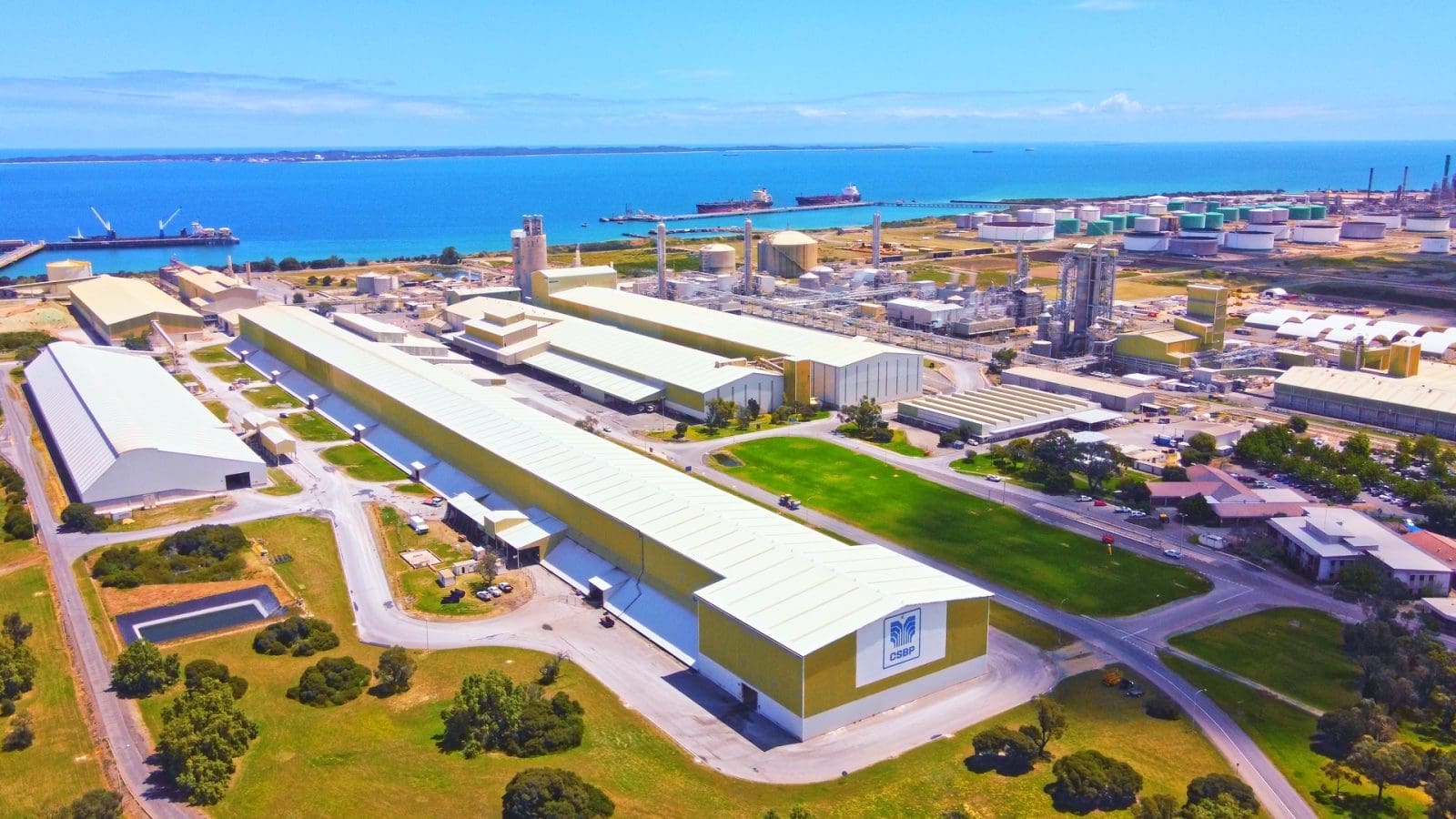
Aerial of CSBP Fertilisers Kwinana works, where the Granulation Plant is located. All photo credit: CSBP Fertilisers.
SUPPLY disruptions have weighed on WesCEF, parent company of CSBP, in the short term, but the company says stabilising urea supply and strong ammonia prices are expected to support its future earnings.
ASX-listed Wesfarmers held a strategy briefing on Wednesday, with its business divisions, including Western Australia-based Wesfarmers Chemicals, Energy & Fertiliser, or WesCEF, providing updates on operations.
WesCEF managing director Aaron Hood said the Middle East conflict and an unexpected closure to the Yara Pilbara plant earlier this year had a major impact on ammonia and urea flows.
“The Middle East conflict in March and April disrupted a number of international shipments, with delays and cancellations impacting supply,” Mr Hood said.
“In response, the CSBP ferts team increased domestic production of liquid fertiliser in partnership with our chemicals business.
“Combining that with alternative international supply, this has helped maintain availability for WA farmers.
“CSBP also worked closely with industry participants and the Federal Government to support the establishment of the fertiliser import facility mechanism through Export Finance Australia or EFA.”
Source: Wesfarmers
He said the company was able to offset the Yara shutdown by relying “heavily on [Yara’s] international network to be able to continue to provide supply and we have that under our contract framework”.
He said this was followed by a shift in WesCEF’s production shutdown so that it could “continue to produce or maximise the ammonia production from our own facilities for that period of time”.
Mr Hood said while supply was maintained, there were cost escalations from these impacts.
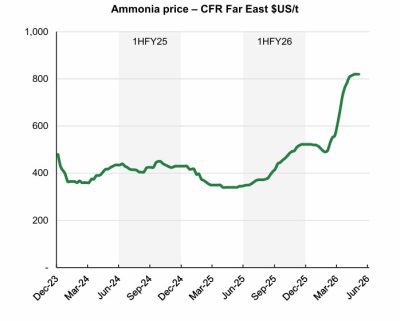
He told analysts that during the Yara shutdown, supplemented ammonia volumes were acquired at the “international import parity price”, which was elevated at the time.
“We’ve seen prices increase sharply in the last few months and this is expected to have a significant impact on earnings in [financial year 2026] and FY27.
“Our import costs reflect spot pricing while sales contracts are based on the average pricing in the prior quarter.”
He said this will negatively impact the rest of FY26 but will provide upsides in the following financial year.
“In the current context, the significant rise in the ammonia price will negatively impact earnings in the fourth quarter of FY26, with the contract lag mechanism providing a benefit to earnings in FY27.
“More broadly, however, given WesCEF is a manufacturer of around half of the ammonia it uses, higher ammonia prices will flow through to higher earnings for the business.”
Fertiliser demand, supply update
Mr Hood said there were clear signals of “demand destruction” in the current season due to the high fertiliser import prices.
He said this was compounded by the uncertainty around diesel availability during seeding months.
He said there will be “maybe 5-15 percent” reduction in fertiliser demand this season due to growers switching to crops with lower fertiliser requirement, and increased areas of fallow.
“There was a component that we think of demand that will be…gone for FY26.
“Coming through to FY27, I can’t call a fertiliser season this early for next year, but one thing that is clear is a stronger ammonia price is good for WesCEF as a manufacturer.”
On the supply front, Mr Hood said he felt “pretty good about that”.
“The combination of us as the largest player in Western Australia, what we did with our manufacturing footprint, being able to pivot to alternate product supply, then working with the government and EFA on this facility, there isn’t a shortage of urea at the moment.
“Prices are coming back down both for import, but also what we’re now to pass on to growers in the market.”
Expansion on hold
Mr Hood noted the debottlenecking project completed on the Nitric Acid Ammonium Nitrate (NAAN) plant at Kwinana in the first half of FY26.
“This increased ammonium nitrate capacity by approximately 40,000 tonnes to a total of 865,000t per annum.
“There is also potential to increase capacity by a further 80,000t across the two remaining NAAN plants at the Kwinana site.”
He was also asked about progress on the CSBP ammonia expansion project which progressed to environmental approvals in April 2023.
Located at Kwinana, the project was set to add 300,000t of ammonia production to the existing site.
At the time, the company expected to make a final investment decision in 2024 if approvals were secured in 2023, with construction potentially beginning in the second half of 2024 and first ammonia production targeted for 2028.
According to the WA Environmental Protection Authority, approvals were granted in February 2024.
Mr Hood acknowledged that approvals had been achieved and that there weren’t any “concerns around ultimately building a facility in Kwinana”.
“It’s really, it’s still a live project within assessment.
“It’s really the commercial kind of vectors of like a long-term stable WA gas price that you can assume.
“I think building large capital items in Kwinana, we’re pretty attuned to the escalation costs that we’ve seen across the strip at the moment.
“Then the other, I think, difficult to forecast is sort of where government policy is going to land on across carbon and how Australia fits in with international carbon pricing and regulations because ultimately we have to be competitive on those fronts as well.”
Grain Central: Get our free news straight to your inbox – Click here