
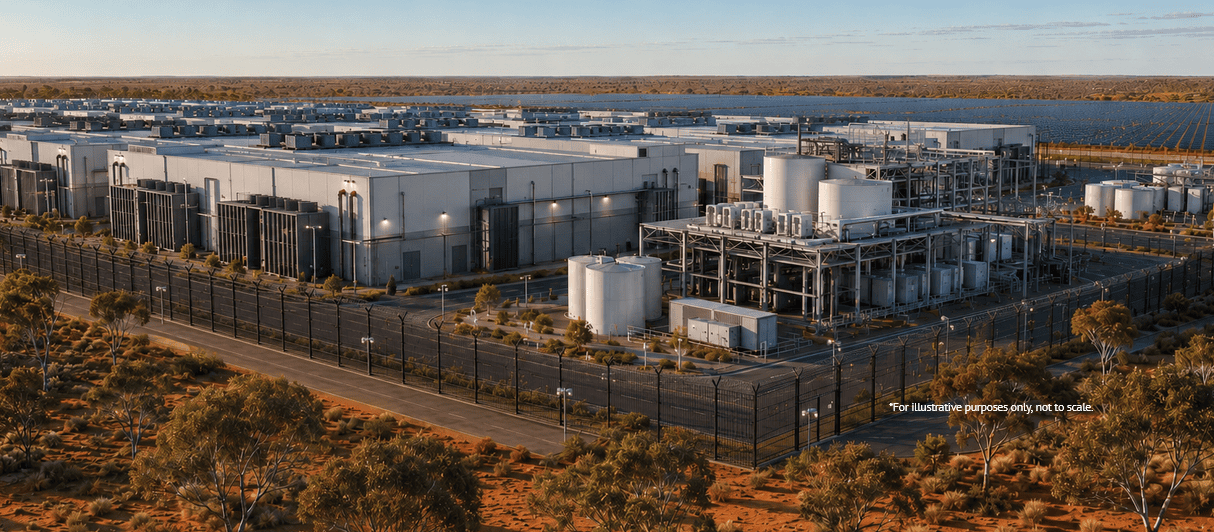
A generated image of the proposed Project Ares on Murranji Station, north-west of Elliott. Image: Energy North
AUSTRALIA is shaping up as a preferred global location for data centres, and facilities are being planned and built not just in capital cities.
Data centres’ appetite for power and water is ringing alarm bells in some quarters, and the Victorian Farmers Federation has been first out of the blocks to look into the possible impacts of the data-infrastructure boom on the regions and on agriculture.
In an issues paper released June 23, VFF president Ryan Milgate said the paper aimed to shed some light on the possible consequences of “going all-in without a plan for these incredibly resource-intensive facilities.”
“We absolutely must have a conversation about the impact of this infrastructure and it needs to be now,” Mr Milgate said.
“With this issues paper, we’re looking to make sure farmers are front and centre in that conversation.”
“We’re seeing huge data centres rising up in the suburbs and their needs impact all the way to farmers and regional communities hundreds of kilometres away.”
Policy lags development
The vast majority of data centres in Australia, either built, being built, or proposed, are in capital cities or regional centres like Townsville and the Sunshine Coast, a short distance to submarine cables that provide international connectivity.
Because of that, they appear likely to continue to cluster on or near the coast.
UTS researcher and lecturer Bronwyn Cumbo said data centre developers are choosing to build in Australia because it has available industrial land with established energy and water infrastructure, proximity to submarine cables that connect data centres to the global network, and a stable regulatory environment.
“Data centres in urban areas mostly co-locators, where the owner will rent out the data hall to a series of clients for data storage and processing purposes,” Dr Cumbo said.

UTS researcher and lecturer Dr Bronwyn Cumbo.
“Regional areas are seeing AI factories being built which are designed to train Large Language Models, or LLMs, before they are released into the world.”
Training LLMs relies on huge amounts of energy and water to power the training process and cool the processors, which produce immense amounts of heat.
“Because LLM training is not time-critical, AI factories can, in theory, be more flexible in when and how they consume energy and water.
“There are new technologies being produced all the time to reduce energy and water consumption.
“For instance, some data centres use closed-loop cooling systems which cap their water intake, but it means they require more energy to cool that water down as it moves heat out of the system.”
Dr Cumbo said the challenge for AI factories in regional Australia is they are rarely close to both energy and water infrastructure.
Industrial sites with established water infrastructure will not have the energy infrastructure, and vice versa, which makes locating these centres challenging and a large infrastructural challenge.
Dr Cumbo said data centres are extractive, and communities are raising legitimate concerns around what this means for land, energy and water security.
“There is a lot of uncertainty around how much energy and water these new data centre clusters will require, and how resources will be allocated and prioritised during periods of drought for instance.
“There is an important role for government to play here.”
She said the federal and state governments have been “slow to respond” with transparent, strategic policies that balance the national and global demand for AI and cloud computing, with the costs to local communities and environments directly shaped by these facilities.
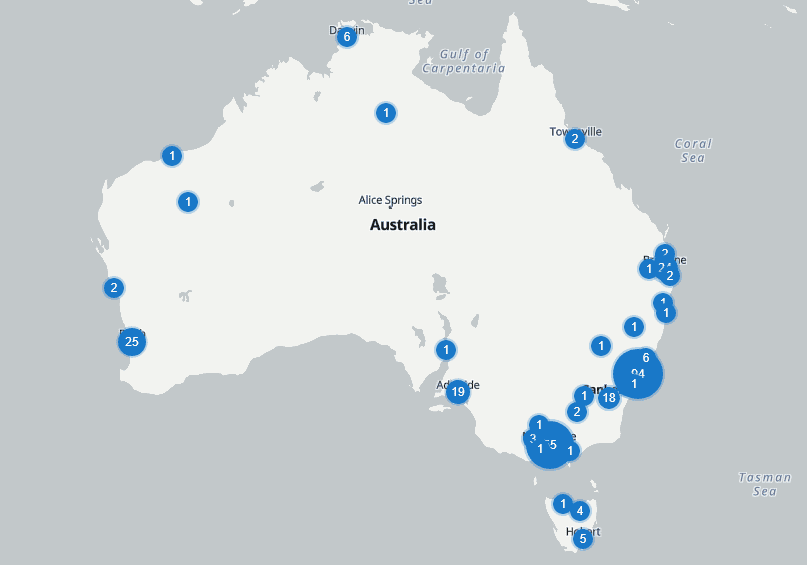
The Data Center Map database shows Australia has 285 data centres operating or planned, with Sydney on 93 and Melbourne on 55 the two most popular locations. Image: Data Center Map
One of the biggest data centres on the drawing board for Australia is Syncline Energy’s Victoria AI Hub at Plumpton, 30km north-west of the Melbourne CBD powered by the Bannerton Solar Farm, but with gas generation as a back-up.
Dr Cumbo said that many new data centres are investing in renewable infrastructure through Power Purchasing Agreements, but there is a disparity in the timing the completion of data and energy infrastructure and contribution to the energy transition.
“A data centre development usually takes two to five years to be built, whereas a new solar or wind farm takes much longer.
“We do need greater clarity around how these data centres will be powered in the meantime, and the impact on net-zero targets”.
“The Federal Government is trying to establish Australia as a sustainable data centre hub for the region.
“It’s worth being critical in terms of its economic benefit to Australia.”
According to the Climate Council of Australia’s Clouded future: Managing risks of the data centre boom report released June 3, data centre energy and water demand look set to triple by 2030.
“Water utilities have received single-site connection requests to be able to use up to 40 million litres a day, equivalent to 16 Olympic swimming pools,” CCA said in a statement.
CCA councillor and Iberdrola Australia general manager regulation and energy policy Joel Gilmore said with government intervention and enforceable requirements, data centres can play a role in Australia’s clean energy shift, support grid reliability, and avoid unnecessary power price rises.
“Data centres are like a giant snowball rolling down the mountain,” Dr Gilmore said, adding that the centres are being built to service “large, well-resourced corporations”.
“If they don’t bring new, low-cost renewables and storage with them and pay for the energy and water infrastructure upgrades they need, they’ll be dumping massive costs on to households and businesses.”
The Australian Energy Market Operator’s 2025 Inputs, Assumptions and Scenarios Report, forecasts that under the Step Change scenario, data centre energy consumption will increase by on average 25pc year on year, reaching around 12 TWh by 2029-30, equivalent to 6pc of Australia’s grid-supplied electricity.
Good and bad for agriculture
As with every sector operating in Australia, agriculture is benefitting from AI.
As outlined in the Australian Trade and Investment Commission’s Unlocking potential with Australian AI report of November 2025, AI is already in use in areas such precision agriculture, robotics such as SwarmFarm, livestock monitoring, and biosecurity.
As outlined by Tim Neale and Meg Kummerow at June’s Rural Press Club of Queensland FarmFest event, farmers can undoubtedly benefit from AI, but its pull on resources cannot be ignored.
Mr Neale referenced some cases in the US of farmers fighting against data centre developments, and their three major requirements of water for cooling, land, and energy.
“They reckon in the future, it’ll be up to one third of all US power will be [used] in data centers; get your head around that one – that’s crazy stuff,” Mr Neale said.
On water, Mr Neale described their need as “enormous”.
“They need…massive amounts of water to cool the service down.”
As National Farmers Federation president Hamish McIntyre said, it is crucial that farmers are appropriately engaged throughout the planning process for data centres.
“Proposals to repurpose productive farmland for data centres must be assessed carefully against the impact on food production, water availability, and energy systems,” Mr McIntyre said.

NFF president Hamish McIntyre.
Following VFF’s release of its report on data centres, Grain Central has contacted all of Australia’s other state farming organisations for their thoughts on data centres and their impact on agriculture and resources.
Following are their responses, and a look at one proposed data centre in each state:
Queensland
AgForce Queensland’s Land Use Protection Committee is yet to formalise a policy on the interface of data centres with Qld’s agricultural sector.
In inland Qld, data centre development is limited thus far, although one is in operation at Wellcamp, on Toowoomba’s western fringe, with maximum capacity seen at 7.5MW.
The Latan Data Centre and Renewable Energy Project appears to be the biggest facility planned for inland Queensland.
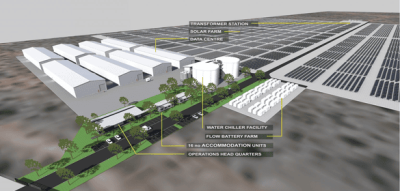
A generated image of the Latan Data Centre. Image: AEWC
The 100MW+ facility on the site near Charters Towers is still in the approvals stage, with construction expected to start next year.
It is set to include a renewable-integrated energy platform with on-site solar generation and a battery energy storage system (BESS), supporting peak load management, overnight resilience, and future grid-interactive operations.
Townsville-based company AEWC is behind the project, and its website says Latan has been designed to deliver secure, sovereign, and sustainable digital infrastructure from a location near major energy and fibre corridors.
AEWC says Latan will offer “enterprise, hyperscale, and government clients a future-ready solution outside congested metro zones”.
New South Wales
The NSW Government on March 27 announced 15 data centre projects, all in Greater Sydney, that will progress through the Investment Delivery Authority.
“The scale of investment endorsed through the Investment Delivery Authority reflects strong private sector confidence in NSW as a home for this digital infrastructure,” NSW Treasurer Daniel Mookhey said.
“At the same time, we recognise this growth must be managed responsibly.
“That’s why we’re releasing a consultation paper to inform a Data Centre Strategy that considers energy and water use, infrastructure capacity and the long‑term interests of NSW households and businesses.”
NSW has no data centres planned for rural areas, but does have facilities in regional NSW centres.
These mostly belong to Australian company Leading Edge DC, whose key investors are Sydney-based Washington H Soul Pattinson and US-based Digital Bridge.
Most of NSW’s data centres are clustered in western Sydney, where the 1.2GW Mamre Road Data Centre at Eastern Creek is being built for US company AirTrunk.
It will be the biggest in the state, and the NSW Government Planning Portal said it will include diesel back-up generators and 14,430kl of diesel storage.
AirTrunk is a consortium led by Blackstone and CPP Investments, or Canada Pension Plan Investment Board, and owns data centres in the Asia-Pacific region and the Middle East.
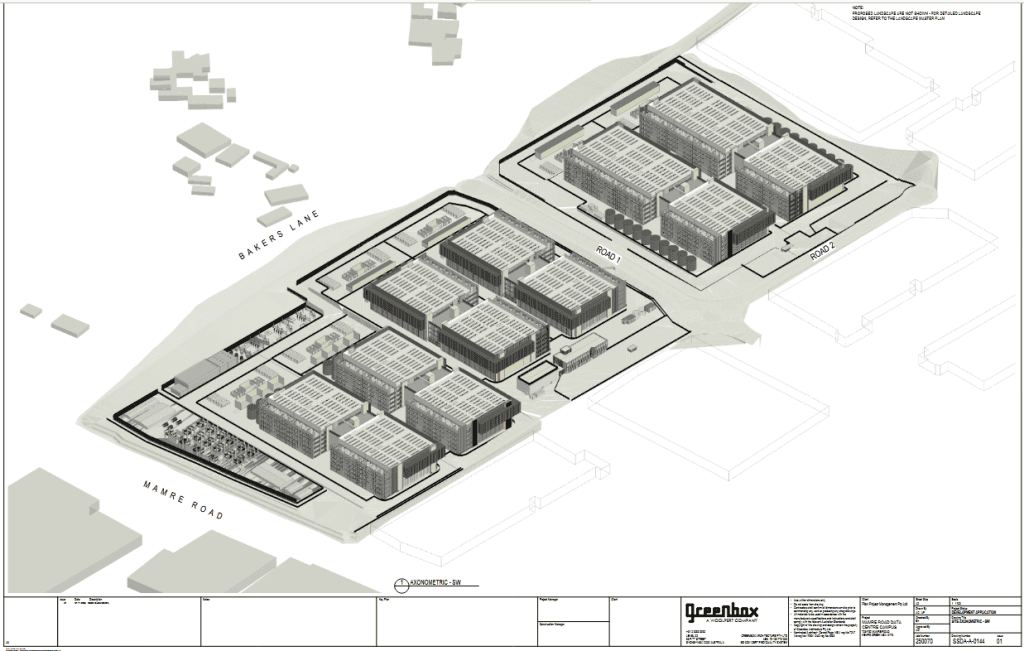
Plans for the 1.2MW Mamre Road data centre in western Sydney. Image: via NSW Planning Portal
NSW Farmers Association president Xavier Martin said in assessing any proposed developments, NSW Farmers’ guiding principle is always to support agricultural use of productive land and water resources.
“We can’t reinforce enough the importance of transparent and genuine consultation processes for any data centre projects and for due consideration be given to potential impacts on regional farming communities prior to approval,” Mr Martin said.
“The use of agricultural land and any productive water must be prioritised to deliver food security for the domestic and global population.”
“It’s crucial that data centres don’t negatively impact the natural resources and the agricultural industries that support Australia.”
Victoria
The VFF has been lobbying hard for the agriculture point of view to be considered when it comes to issuing approvals for projects related to Vic’s power grid, critical minerals extraction, and now data centres.
The VFF said Vic’s agriculture sector must not be forgotten in the face of a rapidly expanding data centre infrastructure boom sweeping the state.
VFF’s abovementioned paper highlights the scale of proposed data centre developments across Vic, with more than 30 projects currently proposed that could jointly require around 9GW of electricity.
The paper said water demand was “set to skyrocket by 2030”, with conservative estimates suggesting demand will surge to equal the annual water use of an extra 330,000 Victorians.
“We’re on a collision course where Victoria’s farming sector will compete with this infrastructure for water and land to host renewable-energy infrastructure,” VFF president Ryan Milgate said.
“Many countries eventually introduced specific rules to manage the impacts of large-scale data centres, but only after pressure on local infrastructure, water supplies and electricity systems became apparent.”
“Victoria has an opportunity to learn from those experiences and ask the hard questions now.”
“We know that state and federal policymakers are already grappling with these issues, and it’s important that farmers are at the table in those discussions.”
In regional Vic, Singapore-based global asset manager and operator Keppel has leased 123ha in the proposed Gippsland Renewable Energy Zone at Morwell from Australian energy and infrastructure landowner Lightwood Group.
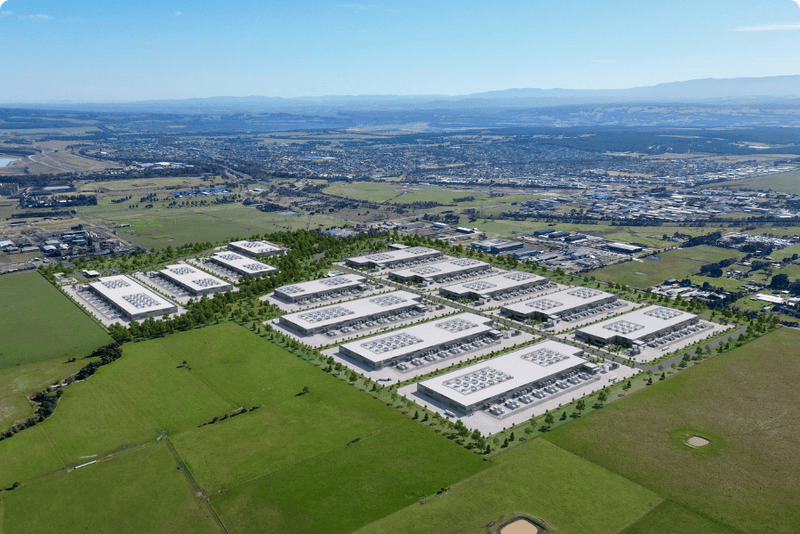
Keppel has secured a 123ha site at Morwell in Vic’s Latrobe Valley on which it plans to build regional Vic’s largest data centre. Image: Keppel
In a January 15 media release, Keppel said it planned use it to bolster its gross power capacity in Asia Pacific from 300MW to more than 1GW by developing the 720MW facility.
The project is still in the planning stage, and has the potential to be the biggest data centre in regional Vic.
It is close to the site of the former coal-fired Hazelwood Power Station, and one of Vic’s largest electricity nodes, and has direct access to existing non-drinkable water for cooling.
“With the closure of coal-fired power stations and associated industries announced for 2028 and 2035, investment of this nature is critical to providing certainty for the local workforce and creating new pathways for skilled workers.,” Latrobe City Council said.
Tasmania
As investment in AI infrastructure accelerates, TasFarmers chief executive officer Nathan Calman said governments and regulators needed to ensure planning and approval processes kept pace with the scale and complexity of these developments.
“AI will play an important role in Australia’s future, but that future cannot come at the cost of our ability to grow food and fibre,” Mr Calman said.
“Data centres place significant demands on electricity, telecommunications, land and water.
“Those resources are already under pressure, and primary production must remain the priority.”
“Protecting productive farmland isn’t about stopping development; it’s about making sure we get the balance right.”
TasFarmers said well-planned projects could create broader regional benefits if governments took a strategic approach.
He said projects should be assessed on the opportunities they create for regional Australia, “not simply the returns they generate for investors.”
“If new infrastructure can strengthen irrigation, improve energy networks or deliver other long-term benefits for farming communities, then that’s a conversation worth having.”
Singapore-backed Firmus is behind the major development, Project Southgate in Launceston, which will deliver up to 400MW of compute capacity through its AI fa
“AI Factories are purpose-built to power, train and inference artificial intelligences,” Firmus co-CEO Oliver Curtis said.
“With Tasmania’s clean energy and our AI Factory platform, we believe this will be the most cost-effective, sustainable AI facility in the world,” Mr Curtis said.

Former Qld premier Campbell Newman is managing director and chair of Arcana Capital, site owner of the proposed Burnie data centre. Photo: Arcana Capital
Firmus has submitted plans to build further AI factories at Bell Bay, on the site of the former Gunns Pulp Mill, and Wesley Vale, east of Devonport.
Sydney-based New Energy Opportunities received planning approval in April to build a data centre in Burnie, with Arcana Capital the owner of the site to be developed by VIRIDIS Green Data Centres.
“We are delighted to be working with Viridis to deliver cutting-edge technology to the north-west coast of Tasmania whilst adding value for our investors,” Arcana Capital chair and managing director Campbell Newman said.
“This project sees the repurposing of the old Advocate Newspaper print centre to a modern information technology asset for the 21st century.
South Australia
SA has an overwhelming concentration of its data centres in and planned for Adelaide, with the exception being the Sydney-based Iris Energy, or IREN, 800MW facility at Bundey, between Burra and Morgan in the Mid North.
On track to start up in 2028, this will be the Nasdaq-listed company’s first Australian data centre.
Grain Producers South Australia CEO Brad Perry said SA was actively encouraging data centres to locate close to renewable energy generation and major transmission infrastructure.
“The challenge is that many of those renewable energy developments are themselves located within some of the state’s most productive grain-growing regions.
“As demand for AI infrastructure grows, governments need to be careful that we don’t inadvertently place increasing pressure on productive agricultural land.”
He said SA’s grain-growing regions play a critical role in food and fibre production, and “land should not gradually be chipped away through the cumulative impact of different infrastructure projects”.
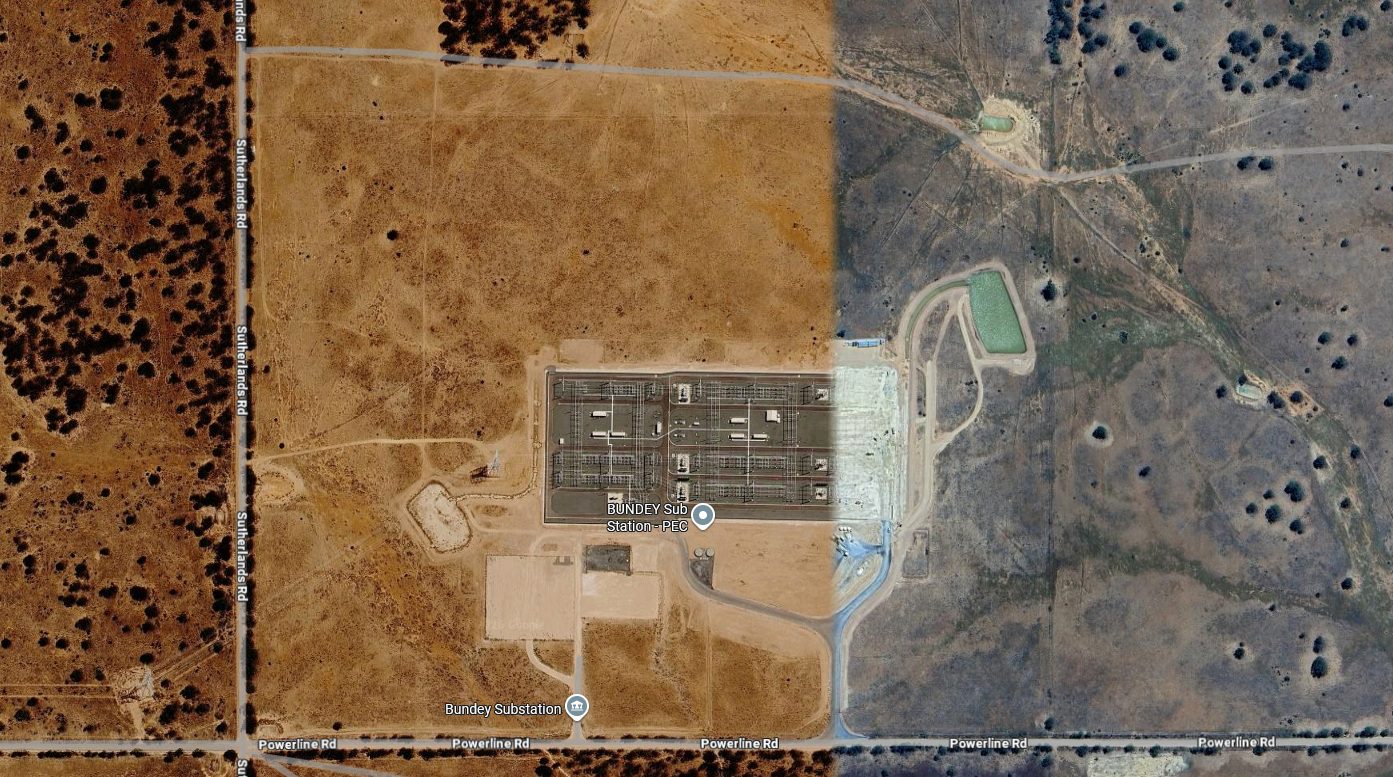
Bundey, in SA’s eastern Mid North, is the site the IREN project. Image: Google Earth
“We accept there can be coexistence, but that requires careful and thorough strategic planning. We need to ensure these facilities are located on the most appropriate land, rather than simply the most convenient land.”
“We’ve already seen grain producers asked to accommodate mining, renewable energy projects, transmission lines and more.
“If data centres are now following that same infrastructure into agricultural districts, governments need to take a long-term view of cumulative land use.”
IREN co-founder and co-CEO Daniel Roberts IREN’s Bundey facility will be able to serve global and regional AI demand, as well as SA’ growing need for AI compute.
“South Australia offers what AI infrastructure at scale requires: abundant clean energy, the connectivity to serve the APAC region, and a state government that understands the opportunity and is acting on it.”
Western Australia
WA has most of its data centres in Perth, with some further capacity in the mining hubs of Newman and Port Hedland.
No data centres are in the pipeline are planned WA’s Wheatbelt, but Project Meridien, south of Broome, is in the planning stage in the Great Sandy Desert adjacent to pastoral country.
Through Gingerah Energy, it is a joint venture involving Longreach Capital Investment, Fugro Australia and the Karajarri Traditional Owners, and plans to generate solar, wind, and geothermal energy on site.
On its WA Investments website, the WA Government has described Project Meridien as one of the world’s largest renewable-powered AI infrastructure projects.
It states the project is in the same time zone as roughly half the world’s population, and will help to meet demand for sustainably powered data centres.
The development will be built in stages, beginning with about 240MW of IT-processing capacity powered with 1.4GW of renewables, and a phase one investment decision by 2029 ahead of maximum processing capacity seen at more than 1GW.

WAFarmers CEO Trevor Whittington
When asked about what data centres might mean for WA’s cropping country, WAFarmers CEO Trevor Whittington said they were a better option than wind farms.
“If you gave most country towns a choice between a data centre and a wind turbine, I reckon they’d take the data centre every day of the week,” Mr Whittington said.
“One creates permanent skilled jobs, pays its own way and is no taller than the local gum trees; tThe other dominates the landscape, divides communities and provides very little long-term employment.”
Northern Territory
The NT Government has called the NT “Australia’s key digital gateway to Asia and beyond”, and Darwin is already home to a number of data centres.
A major boost in the NT’s AI capacity will come from Project Ares, expected to start with a 500MW capacity upon completion in 2029, ahead of building to 1GW.
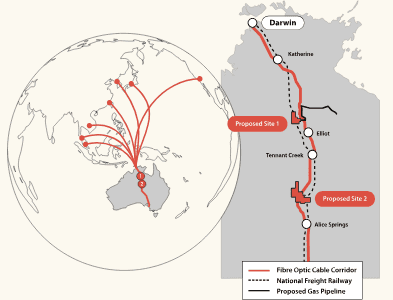
Two potential sites have been chosen for Project Ares and the co-located Project Sol, with the first choice being north-west of Elliott. Image: Energy North
Described by Energy North as a “hyperscale AI data centre campus with integrated renewable energy generation”, the proposed Project Ares will be co-located with Project Sol at Murranji Station in the Barkly Region of the Northern Territory.
The project does not yet appear to have NT Government approval, with two sites currently under consideration.
Both Project Sol, a planned green ammonia facility, and Project Ares have been granted Major Project Status by the Federal Government, with Project Ares the only data centre on the 30-project list, which includes Project Sol.
Energy North is headquartered in Singapore, with project delivery and operational teams based headquartered in Perth, WA.
Grain Central: Get our free news straight to your inbox – Click here
The office of David Ettershank, Member for Western Metropolitan Region in the Victorian parliament, is working with Borderlands co-operative and local community groups campaigning for a moratorium on data centre expansion across Vic, and to amplify concerns coming from the farming sector. Email [email protected] or phone 03 9317 5900 to find out more.