
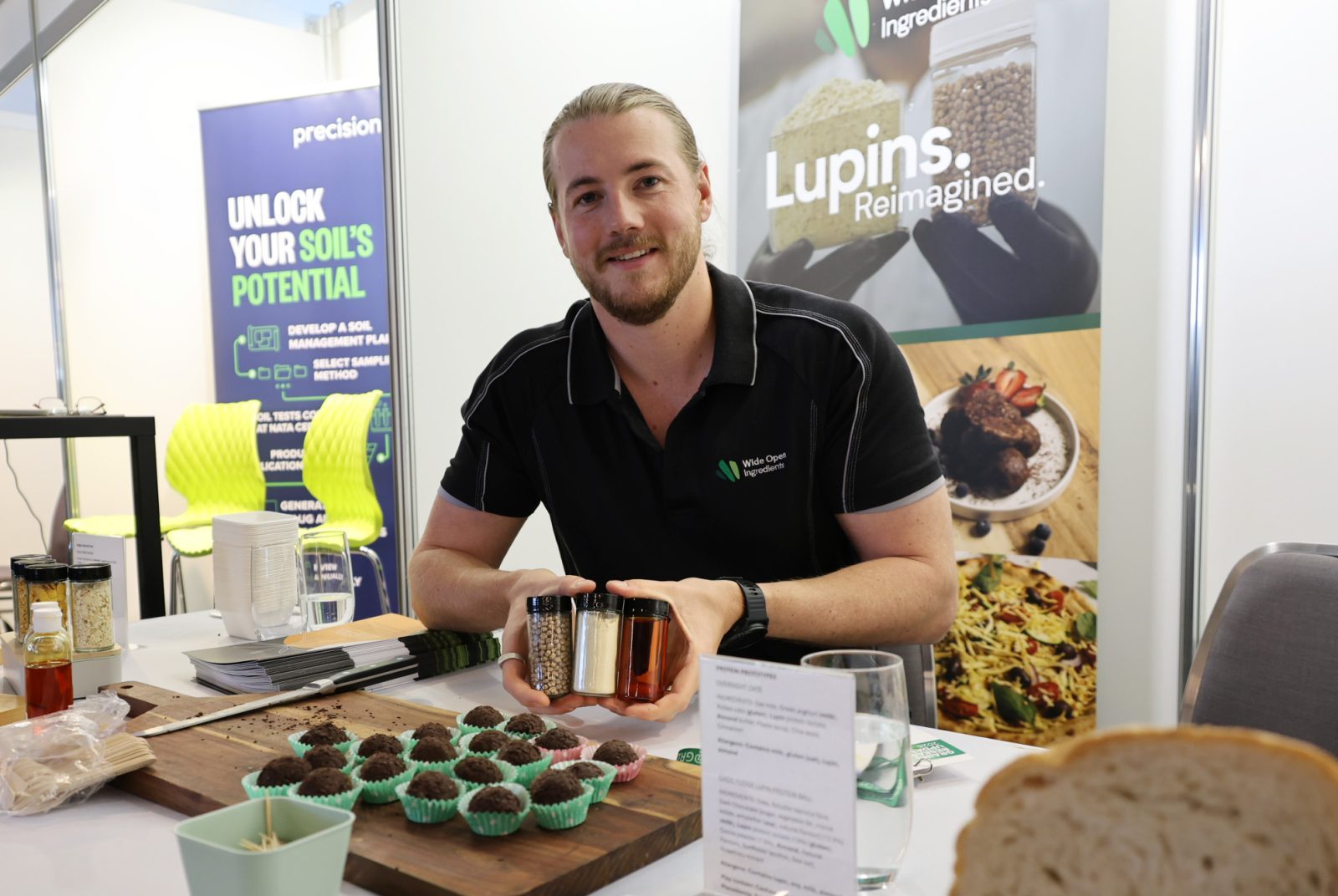
Wide Open Agriculture exhibited at the 2026 GRDC Update in Perth in February, and WOA operations manager Peter Downey fielded inquiry from growers, consultants, and researchers about potential for lupins as a source of high-value oil, fibre, and isolates. Photo: Liz Wells
POTENTIAL for Western Australia to develop a major value-add for lupins has increased with Wide Open Agriculture completing its study into the building of a plant to produce 10,000 tonnes per annum of protein isolate.
The completed Industrial Scale Manufacturing Study (IMS) will allow WOA to further explore the manufacturing economics of the facility, and engage with potential strategic and commercial partners, government agencies, and funding bodies.
In addition to producing lupin protein isolate, the proposed WOA facility has been designed to produce up to 700t of lupin oil and 17,000t of lupin fibre from the same high-quality feedstock.
WOA is based in WA, which grows more than 80 percent of the world’s lupins, and the Grain Industry Association of WA forecasts production from the lupin harvest now kicking off at 720,000t.
Currently, only a small proportion of WA’s lupins go to human consumption, with most exported to Asia and Europe for stockfeed, and the balance used by the domestic stockfeed market.
Study provides blueprint
WOA chief executive officer Craig Swan said completion of the IMS was an important milestone for WOA.
“We now have a detailed technical and commercial blueprint for how our proprietary whole-of-seed technology could be deployed at industrial scale and an engineering baseline we will use now to engage with contract manufacturing partners we plan to work with,” Mr Swan said.
“We are focused on contract manufacturing, growing sales, demonstrating customer traction and improving unit economics.
“At the same time, the IMS gives us a credible foundation to continue engaging strategic partners, governments and potential funding sources around the longer-term opportunity.”
Completion of the IMS is part of WOA’s four-stage Building Better Economics strategy.
Its first three stages remain WOA’s priority, and include the aim to cut its fixed cost base through winding down its German manufacturing operations based on its 2023 purchase of Prolupin GmbH.
WOA’s other two immediate priorities are a switch to capital-efficient contract manufacturing, and expanding commercialisation of its ingredient platform.
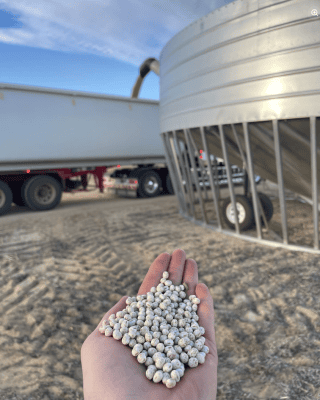
WA produces most of the world’s lupins, and most of them go into export and domestic stockfeed markets. Photo: WOA
The strategy’s final stage will evaluate the longer-term opportunity for industrial-scale Australian manufacturing.
WOA said the incremental economics of its whole-of-seed model is central to its strategy achieving maximum returns for investors, communities, and the environment in developing higher-value ingredients from an abundant Australian agricultural crop.
WOA said while the IMS is based on a plant which annually produces 10,000t of lupin protein isolates, this amount is not a production target or a forecast of future production.
The study assumes full production is achieved and maintained after construction and ramp-up periods, and none of the modelled revenue is contracted or covered by offtake arrangements.
In 2024, WOA and Saputo Dairy Australia mutually agreed to terminate a non-binding Memorandum of Understanding which was initially hoped to kick-start commercial production of lupin protein in Australia.
The facility on which the IMS is based is currently unfunded, and the schedule adopted for the study assumes that, were the project taken forward, a definitive feasibility study would commence next year.
This would be followed by a final investment decision in mid-2028 and construction and commissioning would run for around 30 months from that decision, with production to start in 2031 at the earliest.
WOA said potential contract manufacturing partners have shown initial interest in jointly exploring large-scale facilities in the future.
Source: WOA
HAVE YOUR SAY