
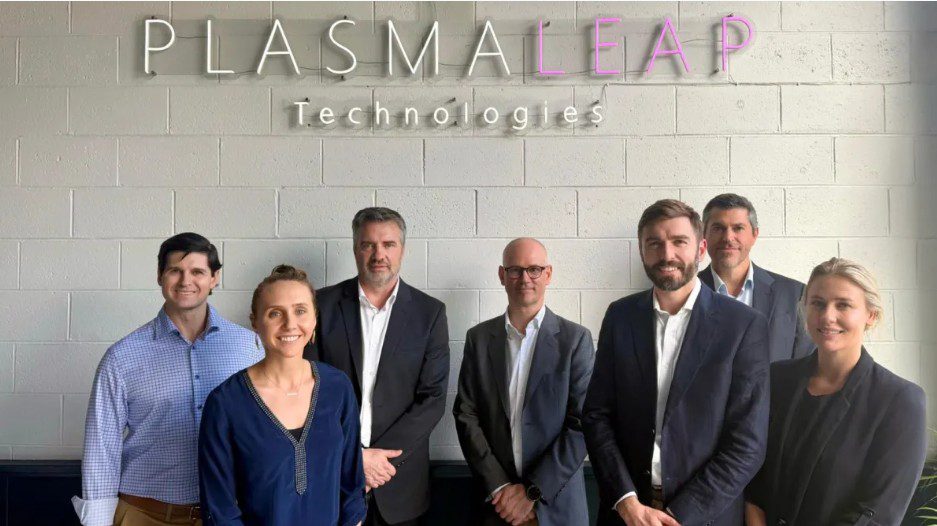
Marcella McClatchey and Tom Kehoe from the Gates Foundation with investor Stian Nygaard from Yara Growth Ventures and PlasmaLeap’s Frere Byrne, PJ Cullen and Samantha Cullen.
AUSTRALIAN company, PlasmaLeap Technologies has secured nearly $30 million in funding from strategic and institutional investors, led by the Gates Foundation, Investible, and Yara Growth Ventures, the venture arm of Yara International, to advance its zero-emissions ammonia and nitric acid technology.
The Series A round, which closed in January, also included Twynam, GrainCorp Ventures, Uniseed/UniSuper, Artesian, Hort Innovation, the Grains Research and Development Corporation, SVG Ventures, and Agnition Ventures, part of New Zealand fertiliser co-operative Ravensdown.
The proceeds will be used to progress first-of-a-kind fertiliser hubs in New South Wales and Tasmania, expand field trials, and further develop PlasmaLeap’s core technology.
Funding will also support longer-term applications in sustainable fuels and energy systems.
PlasmaLeap’s chief executive officer and co-founder Frere Byrne said the technology, which was spun out of the University of Sydney, enables farmers to produce sustainable nitrogen fertiliser directly on their farms or at local hubs, reducing emissions, input costs, and supply-chain dependency.
“The backing of these strategic and institutional investors is strong validation of both the PlasmaLeap technology and the scale of the opportunity,” Mr Byrne said.
“This funding allows us to move from successful trials into real world deployment, demonstrating how clean, decentralised fertiliser and chemical production can transform agriculture, reduce emissions and guarantee sovereign security of critical resources like food and fuel.”
Nitrogen fertiliser production, transport, and application accounts for a significant share of global industrial emissions – around 2.5 percent of global CO2e – driven by fossil fuel-intensive manufacturing, long-haul transport, and chemical losses at the crop.
Moreover, fertiliser access and cost vary dramatically across the globe, with the retail price in certain parts of sub-Saharan Africa being nearly double the world FOB price, due to issues around importation, logistics, and financing.
“PlasmaLeap has developed a breakthrough platform for fertiliser with lower CO2 emissions, delivering step-change improvements in energy efficiency,” Yara Growth Ventures investment director Stian Nygaard said.
“We see strong potential for this technology to scale competitively and reduce the climate impact of farming.”
Yara International fertigation director Martin Debaig said liquid nitrogen production with zero-emissions was the “new frontier in agriculture”.
“The PlasmaLeap technology can unlock opportunities for scaling-up fertigation and precision farming globally,” Mr Debaig said.
The global market for ammonia, the primary ingredient in most nitrogen fertilisers, is worth approximately US$69 billion a year, and projected to triple in size over the next 20 years.
PlasmaLeap’s patented reactor technology produces ammonia and nitrate using only air, water and renewable electricity.
The company’s modular systems are scalable and designed to integrate with existing fertiliser supply chains.
The technology has the potential to improve national food security, reduce exposure to international price shocks, and reduce and stabilise input costs for growers.
This capability becomes increasingly critical as resource availability and geopolitical instability continue to impact global fertiliser markets.
It is also expected to generate high quality carbon credits through the decarbonisation benefits it brings through production, transport and application-related emissions reduction.
PlasmaLeap is considering a number of carbon standard methodologies that may be applied to credit generation from its technology.
PlasmaLeap continues to advance its technology platform with a focus on efficiency, scalability and commercial deployment.
It also has potential to produce synthetic hydrocarbons from biogas, syngas, or other low-carbon feedstocks, supporting decarbonisation pathways for hard-to-abate sectors.
Source: PlasmaLeap
HAVE YOUR SAY