
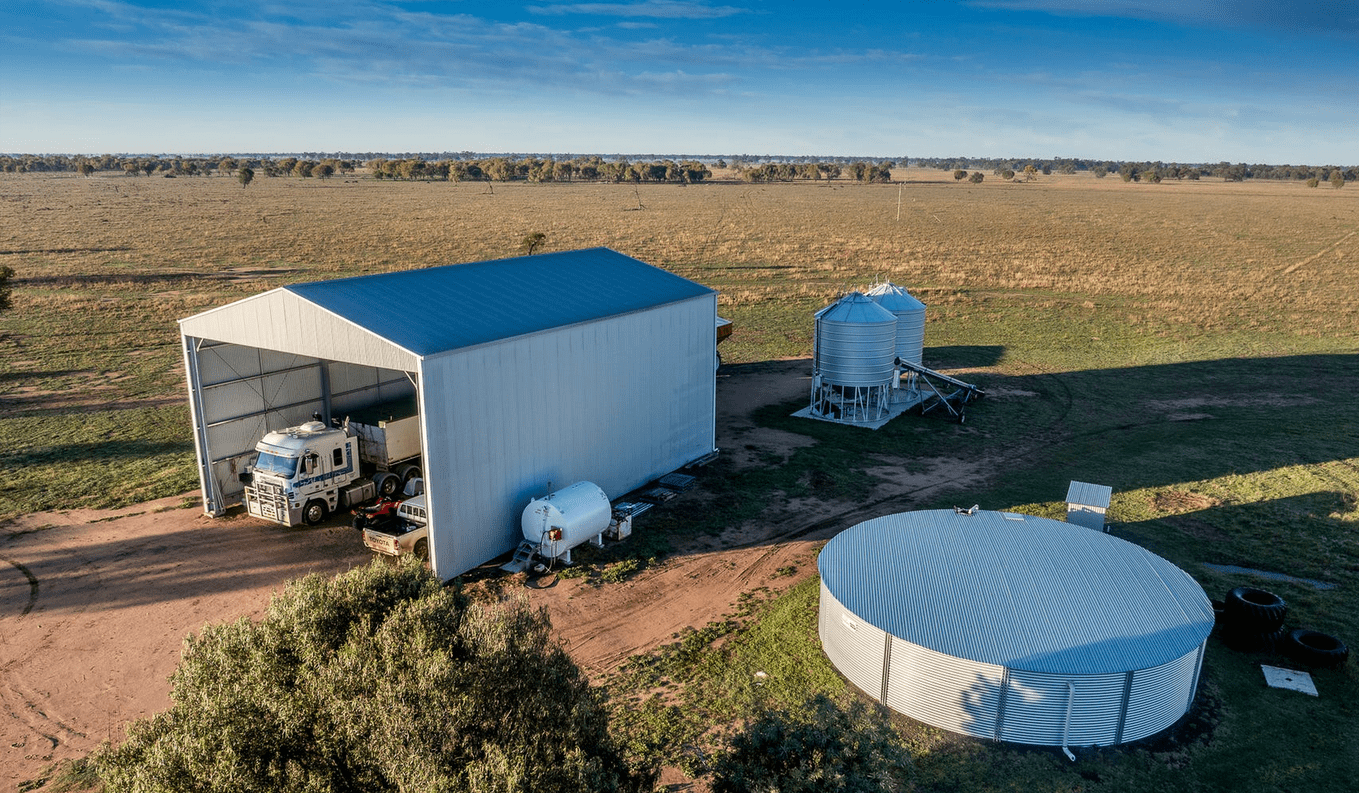
Bourbah has sold to a near neighbour in the Gulargambone district. Photo: Elders
BUYERS from within the region have expanded their holdings with purchases in north-central New South Wales, namely Myalla at Narromine, Bourbah at Gulargambone, and Digilah Station at Dunedoo.
Myalla
After a hotly contested auction, a neighbour has paid $8.4 million under the hammer for sought-after farming country in the Narromine district, in central western NSW.
Offered to the market by Matt and Susie Rae, the sale ends three generations of family ownership.
The 1055ha Myalla, which means gathering spot in the local native Wiradjuri language, is 31km south of Narromine and 69km from Dubbo.
While the property has previously run both cattle and sheep, it was operating as a cropping enterprise, with around 85 percent of the open cropping myall and belah country considered arable.
Described as a stand-out, the soils consist of heavy grey self-mulching clays complemented by areas of fertile red loams that typically grow wheat, canola and barley.
Elders agent Brian McAneney said Myalla is positioned between the Bogan River and Narromine, and offers the best of the area.
“Widely regarded as some of the district’s most sought-after farming country, it represents a first-class cultivation and fattening opportunity with an enviable reputation for producing high-yielding crops,” Mr McAneney said.
Water security is supplied by the Narromine Irrigation Scheme.
Infrastructure includes a four-bedroom home, steel cattle yards, sheds and six 42-tonne cone-bottom silos.
Bourbah
A near neighbour has paid around $6M to expand with Bourbah, a cereal cropping and sheep breeding and finishing enterprise in north-west NSW.
Offered to the market by the Taylor family after several generations of ownership, the 1285ha property is 22km west of Gulargambone and 42km from Coonamble.
Elders agents Brian McAneney was unable to disclose the name of the buyer or the price paid; however, Bourbah was listed for $5.95M on a bare basis after failing to sell at auction.
Mr McAneney said the property presented in first class order and is located in a highly sought-after area of the north-west, where such properties rarely hit the open market.
The rich grey self-mulching soils to red/brown loams and areas of sandy soils grow wheat, barley and canola.
Bourbah was sold with 520ha of cultivation, 410ha of open grazing country (which could be easily cultivated) and an additional 355ha of timbered grazing country.
It is well watered by an equipped sub artesian bore and six dams.
Infrastructure includes a three-bedroom home, numerous sheds, new steel cattle and sheep yards and seven silos with 389 tonnes of capacity.
Digilah Station and Spring Valley
After more than five decades of family ownership, Dunedoo’s historic Digilah Station has been split up, with the homestead portion selling to Michael McLennan and Meg Becker of Beef Lamington Speckle Park near Mudgee for $4.53M, or $8033/ha.
The highly improved grazing and dryland cropping property sits 18km from Dunedoo and 107km from Dubbo.
Owned by the Callow family for the past 50 years, the 1210ha Digilah Station was offered for sale in June 2020 by retiring owners Bob and Fay Callow.
When it failed to sell, they leased it and then reoffered it to the market in September last year for offers above $9.5M.
Following the transaction, the remaining 646ha Spring Valley is now offered by private treaty for $4.6M, or $7115/ha.
While it currently produces dryland winter crops in combination with cattle breeding and finishing, LAWD agent Mark Mudford said Spring Valley is equally suited to sheep breeding and lamb production.
“It provides the incoming buyer the flexibility to produce grains, beef, wool and lamb and is ideally suited to purchasers seeking an additional property in a productive region, or as a standalone asset being above the minimum lot size for a building entitlement.”
The pasture base on Spring Valley has been highly improved with 58 percent, or 374ha, sown to sub-tropical and temperate perennial pastures.
Established perennial native grass and clover pasture is prominent across 240ha, with the remainder of the property comprising 2ha of remnant vegetation.
The topography ranges from creek flats suitable for dryland cropping, to undulating improved pastures and elevated partly timbered grazing portions.
Water is supplied by equipped bores and 13 dams, underpinned by a spring to autumn dominant rainfall pattern of 620mm per annum.
The Merrygoen Creek traverses 3km of the property and provides several permanent waterholes.
Infrastructure includes steel cattle yards.
Digilah Station was originally taken up by Robert Moore Richardson in 1854 for sheep grazing.
Ten years later it became the home station for the Patrick empire that stretched from Merrygoen and Leadville to beyond Dunedoo.
In 1914, the crown acquired most of the leased lands for closer settlement, reducing Digilah to its present size.
Today, Digilah Station is home to several remarkable examples of early colonial architecture, including the 1860 timber slab shearing shed built from local huge ironbark posts and cypress pine crossbeams and the historic stables and hay barn, all of which have been meticulously maintained.
During the marketing campaign, the owners’ son Chris Callow said the family had been lucky enough to have some help with maintaining the historical buildings, and the shearing shed is as good as the day it was built.
Grain Central: Get our free news straight to your inbox – Click here
HAVE YOUR SAY