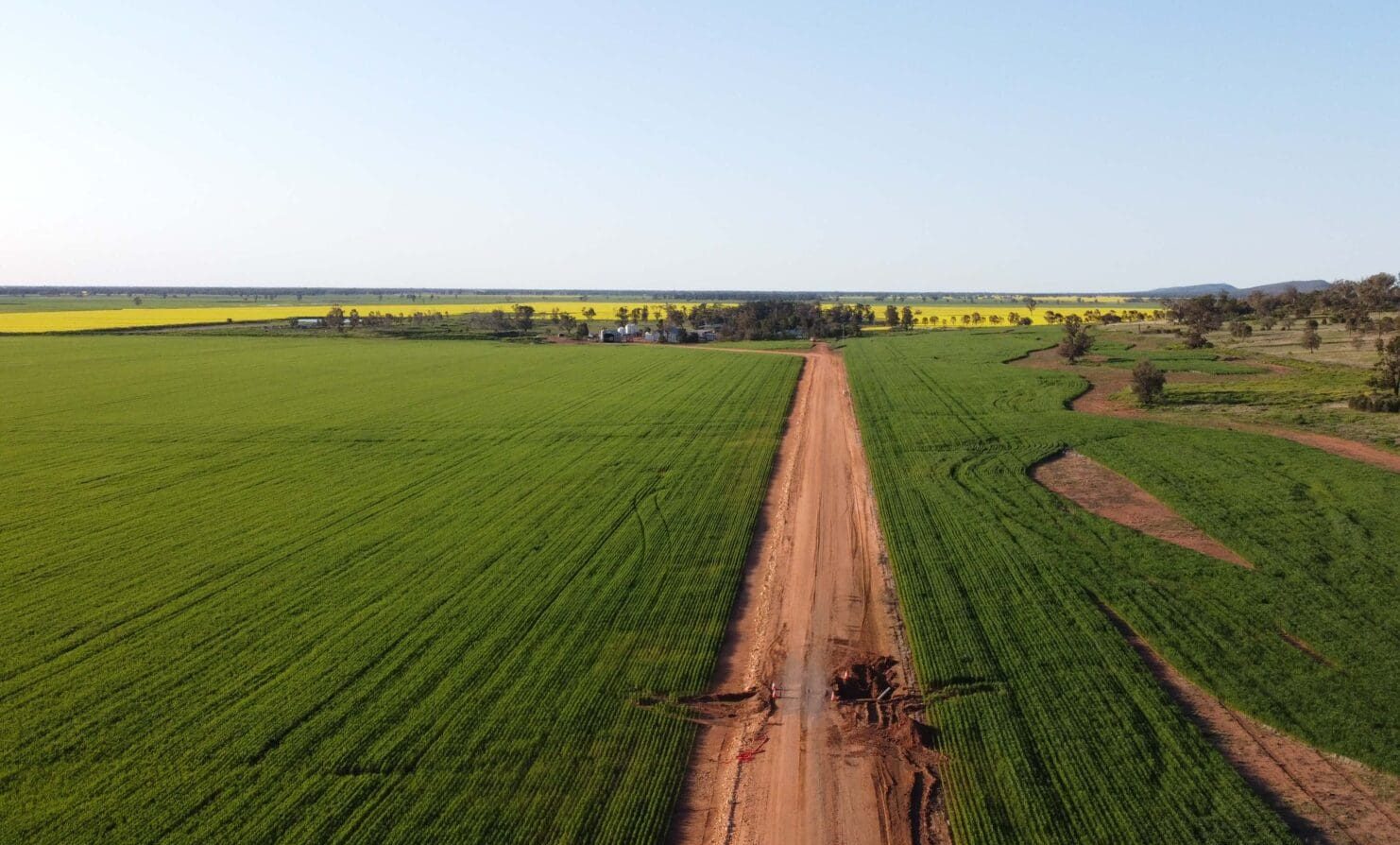
Kentucky in the Wirrinya district south of Forbes was one of the properties purchased by Alkira Farms in 2025. Photo: LAWD
AS THE YEAR draws to a close, we take a state-by-state look at the defining cropping and mixed-farming property sales of 2025.
This is not a definitive list, as other significant properties have sold in off-market deals.
It is, however, interesting to look back over the past year at the prices and size of the more significant cropping and mixed farming properties that have changed hands.
Biggest buyer
Alkira Farms, an investment arm of the Farmland Reserve owned by the Utah-based Church of Jesus Christ of Latter-day Saints, pulled out its cheque book and in the space of two months spent $138 million on more than 14,500ha of farmland in New South Wales – however that figure is understood to be much higher with Alkira also securing the Chudleigh family’s country near Kentucky, in an over-the-fence deal.
March – It paid $68 million for a large-scale dryland cropping operation in the renowned Golden Triangle region of northern NSW adding it to its growing Australian agricultural portfolio. The 5694ha North Star Aggregation, 45km north of Moree and 55km from Goondiwindi, comprises three separate properties within a 6km radius of one another – 2204ha Marlow, 2296ha Kirewa and 1221ha Calrossie. Across the aggregation, 93 percent is arable and grows wheat, barley, canola and chickpeas throughout the winter months, with the opportunity for cotton and sorghum during the summer months.
April – A week after securing the North Star Aggregation, Alkira purchased the 6020ha Kentucky Aggregation between Forbes and West Wyalong in NSW’s Central West for $38M bare. The dryland cropping opportunity is 90pc arable and grows summer and winter crops including wheat, barley, canola and chickpeas on mostly open and level land benefitted by black self-mulching clays and undulating red loams. The extensive infrastructure included numerous dwellings, sheds, a 2300-tonne grain storage shed and a new 15,000-tonne grain bunker storage facility.
Two weeks later, Alkira paid $32M for a northern NSW institutional grade dryland cropping and irrigation business. The 2832ha Carnarvon Aggregation is located south-west of Gunnedah, on the edge of the Liverpool Plains, and comprises two non-contiguous hubs 7km apart – the 2173ha Carnarvon (1335ha Carnarvon, 540ha Kairi and 298ha Part Tourable) and the 659ha Dunroamin. The mostly level, black basalt self-mulching country grows summer andwinter crops including cereals, oilseeds, legumes and cotton. There is 1764ha of dryland cropping, 108ha under centre pivot, and 156ha of lasered irrigation underpinned by 1000ML from the Cox’s Creek and 850ML of on-farm water storage.
In August last year, Alkira Farms partnered with Melbourne-based Warakirri Asset Management and paid more than $350M for one of Australia’s largest privately owned irrigation and dryland farming enterprises – southern Queensland’s 26,855ha Worral Creek Aggregation including 65,900ML of water entitlements.
Highest sales on a state-by-state basis
Western Australia
Cropping-only aggregation
January – The largest cropping sale in 2025 was a portion of the 77,954ha Merredin Farms Wheatbelt Portfolio in WA’s Central East Wheatbelt. Nine farmers paid close to $40M for 24,224ha. While the arable rate per hectare was unavailable, the fence-to-fence rate works out at $1651/ha. Extensively developed, 66,159ha were identified as arable across the aggregation, supported by improvements and infrastructure conducive to grain and oilseed production. Merredin Farms also was offered with carbon-farming and renewables potential.
Mixed aggregation
July – The Oaks, a significant and strategically located mixed farm on WA’s south coast, raised $53M on a bare basis. Spanning 5313ha, 3998ha are arable which means it transacted for more than $13,250/ha. Located 40km north-west of Esperance, the property features Dalyup loams on undulating slopes and sand-over-gravel profiles growing wheat, barley and canola. The balance consists of perennial pastures running 12/DSE during winter months. It was offered with advanced technologies, soil amelioration, modern machinery and extensive water facilities including three rivers and 30 dams.
March – The 11,503ha Connawarrie, a cropping, sheep and wool aggregation in the Great Southern region, raised $35M ($3580/ha arable bare). Located in a high rainfall zone near Mt Sheridan, north of Newdegate, it boasts wide, open, undulating farmland and long runs for efficiency of production. Around 9775ha are arable with the cropping program growing barley, oats, wheat and canola on mostly mallee andgrevillea loams and duplex soils. The Newdegate area is also a highly regarded area for sheep production, with pastures able to deliver consistent wool production, strong growth rates and healthy lambing percentages. Connawarrie can carry 5000 sheep, but at the time of sale had been conservatively running around 3800 head.
Record per-hectare basis
September – While enjoying an excellent season, the 3030ha Wicherina Farms in the northern wheatbelt transacted for $7619/ha or more than $20M. The property boasts sought after sandplain country in the Eradu locality that runs from Mingenew to the eastern fringe of the Chapman Valley, north of Geraldton. Around 2625ha of the sand over gravel and clay soil types are arable and suited to grain and oilseed production. It features large open paddocks with long run-lines to create ease ofoperation and working efficiency, with the vendors undertaking a long-term soil amelioration program.
Queensland
Grain only
September –7000ha (80pc) of the large-scale dryland cropping enterprise Jandowae Aggregation was purchased for $90M bare. Located 50km north of Dalby on the Darling Downs, the 9966ha portfolio comprises 16 holdings across three hubs within a 15km radius of one another. The 9520ha (96pc) of arable land, including 585ha of irrigation, is used entirely for cropping purposes. It produces wheat, barley, chickpeas and mung beans through the winter months and cotton and sorghumduring the summer.
June – The blue-ribbon Janerin Aggregation on the Darling Downs sold for $77.5M walk in walk out or $75M ($25,782ha) on a bare basis. Spanning 2896ha, it is located 13km from Brookstead and 72km from Toowoomba and comprises four adjoining freehold irrigation properties – 548ha Melrose, 812ha Cabarita, 854ha Dunbar and 681ha Willowtree. Across the portfolio, there is 2459ha of cultivation, including 2035ha of developed irrigation, growing mostly cotton and sorghum on Anchorfield soil types, described as the finest on the Darling Downs. These deep black to dark brown, self-mulching clays typically grow wheat, barley and chickpeas in the winter months. Boasting frontage to the Condamine River and Northern Branch, it was offered with 7324ML of water entitlements and 4680t of grain storage across the four properties.
Mixed aggregation
September – The 15,601ha Arcturus Downs Aggregation in the highly regarded Central Highlands sold for more $120M including substantial water allocations. On a bare basis, it achieved $106M, with the irrigation land making $8000/ha, the dryland $7000/ha and the grazing balance $5500/ha. Located 32km from Springsure and 61km from Emerald, the three neighbouring properties (7940ha Arcturus, 3848ha Kronje and 3813ha Barton) produce 1000ha of irrigated cotton, sorghum and mungbeans, and 6852ha of dryland wheat, barley, chickpeas, sorghum, cotton and oats on productive brigalow and deep alluvial scrub soils. The balance breeds and backgrounds cattle, with a portion to be planted to native vegetation. It was offered with 3363ML from the Comet River, underpinned by additional overland flow water harvesting capabilities following high rainfall/river flow events. Supplied by 10 equipped bores, 14 dams, as well as permanent and seasonal waterholes, it boasts an integrated grain storage complex with a combined capacity of 7850t, including a drive-over receival hopper, grain drier, out-loading facilities and a full-length 80-tonne capacity weighbridge.
Standout on a per-hectare basis
May – One of the last remaining dryland farming development opportunities in the Border Rivers Catchment of southern Qld sold at auction for $23M ($6821/ha) – a sale everyone is still talking about. At the time of sale, the 3372ha
Eumerella, south-west of the Moonie River and adjacent to the Thallon township, was pastured with abundant Mitchell grass and supporting a Merino sheep and woolgrowing operation. The property sits on prized cropping country with three
neighbours developing their holdings to broad scale dryland cultivation. Herron Todd White Rural Director Bart Bowen described the result as “one of the strongest on a per hectare basis in the western Border Rivers region. Sold as grazing land with development potential, the price achieved at auction reflected rates more typically associated with cropping land.”
November – The 857ha McIntyre Aggregation on the Darling Downs achieved $22,660/ha after being offered as three separate holdings at auction. While not a record, the sale of the blue-chip dryland farming opportunity to three local farming families was a standout for the year. Located 35km south of Dalby and 55km west of Toowoomba, the 348ha McIntyre raised $8.52M ($24,483/ha), 207ha Colonsay sold for $4.495M ($21,715/ha) and 301ha Noritor made $6.405M ($21,209/ha). The flat open downs country with deep fertile dryland black self-mulching soils grows cotton
and wheat and was offered with an excellent fertiliser history.
New South Wales
March – The 5694ha North Star Aggregation, that formed part of the 23,595ha One Tree Portfolio, achieved $68M ($12,839/ha) bare. Located in the renowned Golden Triangle region of northern NSW, it comprises three separate holdings. Around 5296ha are arable and grow wheat, barley, canola and chickpeas in the winter and cotton and sorghum during summer.
March – The 3096ha Bulgandra Aggregation, 8km south-east of Rand and 62km north-west of Albury, sold for $44M bare. It is recognised as a producer of high-yielding cereal, canola and pulse crops on 2961ha of arable country. It was offered with extensive support infrastructure including 1400-tonnes of grain storage, an optimal natural-resource base, excellent fertiliser and input history, and strategic positioning to key grain export pathways.
Standout on a per-hectare basis
April – One of the record-breaking sales in northern NSW was Quirindi’s 812ha Romney Vale on the Liverpool Plains that drew strong local and overseas interest. The heavy black self-mulching soils, ideal for both irrigation and dryland cultivation, are typically planted to cotton and sorghum.
The 335ha of lateral irrigation achieved $22,500/ha, the 409ha of dryland black soil cultivation made $19,500/ha and the 68ha of mixed arable and grazing land was analysed at $8000/ha. The sale price included 720 units of Upper Namoi Zone 10-aquifer licence at $4500/unit.
When it comes to a standout sale on a per-hectare basis in southern NSW, Herron Todd White valuer Andrew Garnsey said nothing stood out in 2025.
“Generally, prices for smaller grains and mixed farms appear to be softening, mainly due to a below average harvest, seasonal conditions and an interest rate outlook which is not moving down anytime soon. As a result, producers are focused on reducing debt rather than expanding. For those heading to market, vendors are choosing the auction system over expressions of interest as they seek to meet the market.”
Victoria, South Australia and Tasmania
Last year, the southern states were experiencing poor seasonal conditions which resulted in a more cautious approach from farmers who elected to preserve their cash, given the high cost of inputs and put on hold any expansion plans.
As a result, volume levels reached an historic low and 2025 rural property transactions took a nose-dive. However, this spring has seen widespread rain, particularly in Victoria’s drought-affected south-west and south and west Gippsland. While the drought is certainly not over, buyer confidence is anticipated to improve.
Victoria
July – The extensively developed irrigation aggregation, Torrumbarry Farms, changed hands for $54 million. Located near Echuca in northern Vic’s LoddonMallee region, it is adjacent to the Murray River. Spanning 4031ha, close to half
(1887ha) is under centre-pivot, lateral and flood irrigation with 1636ha used for dryland cropping. Benefitting from 427mm of annual rainfall, the fertile soils typically grow wheat, barley, canola, silage and fodder crops. It was sold with 2113ML of annual water entitlements from the Murray and Goulburn Rivers.
South Australia
January – The Eyre Peninsula’s 840ha Mateenia Aggregation, 14km west of Ungarra, that sold at auction in August 2024 but settled earlier this year, transacted for $12.6M ($17,898/ha). Described as quality cropping country with reliable yields
and rainfall, it comprises 717ha at 62 Degners Road that sold for $10.45M and 123ha at Lot 3 Richardson Road that achieved $2.15M. Across the holding, 704ha are arable and feature mainly red and brown loams over clay soils, with the
continuous cropping program consisting of wheat, barley and canola.
May – While the price remains confidential, the Hancock family’s 2429ha HFE Aggregation, also on the Eyre Peninsula, was one of few sales of scalable cropping land in the state this year. The continuous cropping portfolio, 11km south of Lock and69km north of Cummins, consists of four parcels of land that were divided between two locals post auction. Each had been fenced into large paddocks with long easy runs allowing for efficient cropping, with most of the aggregation deep ripped over the past two years. The flat to undulating land features sandy loam soils over clay that typically grow wheat, barley canola and lentils.
Standout sale
An auction that had everyone talking was the 322ha Argyle Farm in the state’s mid-north that sold for a record $12M. With 322ha being arable (the balance being creek lines), the sale price equates to around $39,000/ha. Located 3km north of Alma, 11km north-west of Owen and 15km north of Hamley Bridge, it is situated in a highly sought-after farming region underpinned by 500mm of annual average rainfall. The block boasts rich, fertile red and brown loams and darker chocolate soils that can grow cereals, lentils, legumes, pulses, oilseeds and hay production.
In summary
At the time of publication, Grain Central counted at least 68 cropping and mixed farms across the country as sold, and 130 listed for sale.
Disclosed 2025 cropping and irrigation property sales reported by Grain Central show:
- 3 properties sold in the sub $5M bracket
- 5 properties sold in $5M-$10M;
- 5 properties sold in $10M-$15M;
- 19 properties achieved above $15M;
Disclosed 2025 mixed-farming property sales reported by Sheep Central and Grain Central show:
- 7 properties sold in the sub $5M bracket;
- 3 properties sold in $5M-$10M;
- 3 properties sold in $10M-$15M;
- 13 properties achieved above $15M.
Disclosed 2024 cropping and irrigation property sales reported by Grain Central show:
- 1 property sold in the sub $5M bracket;
- 2 properties sold in $5M-$10M;
- 5 properties sold in $10M-$15M;
- 11 properties achieved above $15M.
Disclosed 2024 mixed-farming property sales reported by Sheep Central and Grain Central show:
- 0 properties sold in the sub $5M bracket;
- 2 properties sold in $5M-$10M;
- 6 properties sold in $10M-$15M;
- 18 properties achieved above $15M.
Disclosed 2023 cropping and irrigation property sales reported by Grain Central show:
- 0 properties sold in the sub $5M bracket
- 5 properties sold in $5M-$10M;
- 7 properties sold in $10M-$15M;
- 4 properties achieved above $15M.
Disclosed 2023 mixed-farming property sales reported by Sheep Central and Grain Central show:
- 2 properties sold in the sub $5M bracket;
- 5 properties sold in $5M-$10M;
- 10 properties sold in $10M-$15M;
- 18 properties achieved above $15M.
Grain Central: Get our free news straight to your inbox – Click here
HAVE YOUR SAY