
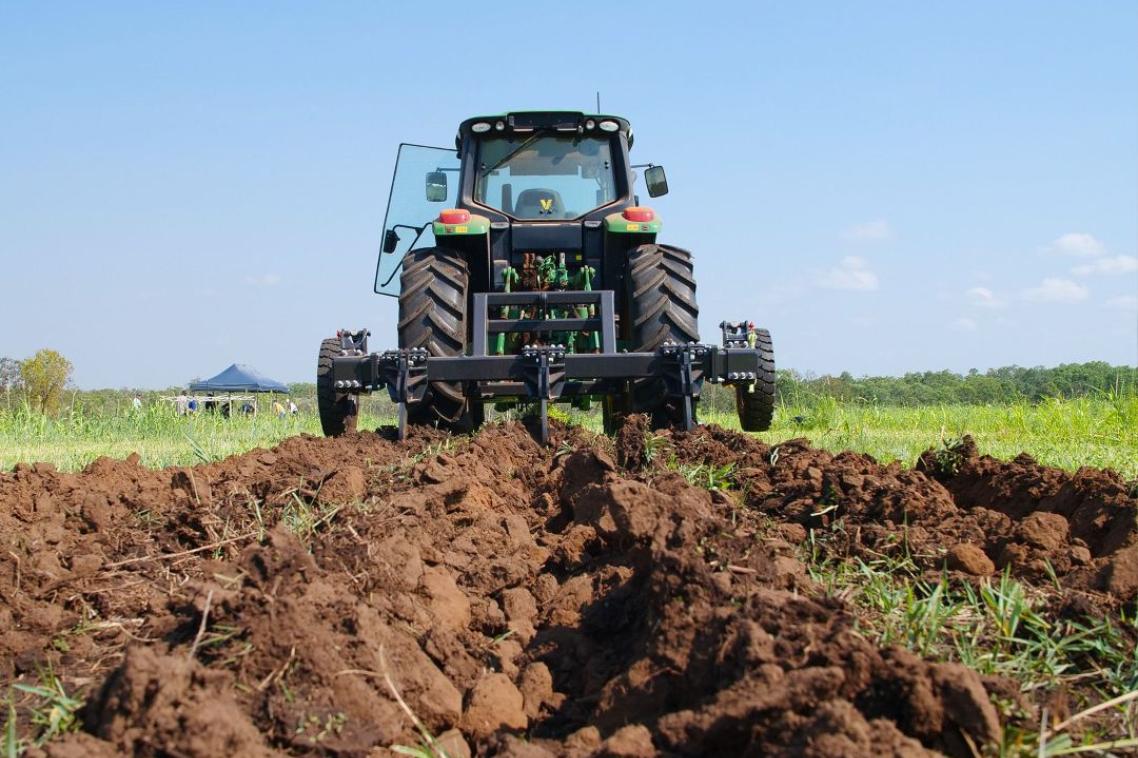
The delving implement in action bringing the clay to the surface. Photo: UQ
RESEARCHERS from The University of Queensland are digging deep to improve soil health in the Northern Territory and demonstrate the potential of an emerging crop industry.
Lead researcher Yash Dang from UQ’s School of Agriculture and Food Sustainability said the presence of clay beneath the region’s infertile, dry and sandy surface presented an opportunity for farmers.
“Clay can help improve the sandy soil, which is generally low in organic matter and water holding capacity,” Dr Dang said.
“Many growers have tried to apply organic matter to the surface of their paddocks but because of the high temperatures and high soil aeration, it is oxidised and doesn’t last long.
“What we are proposing is to penetrate the surface and incorporate organic matter into the subsoil so it can act as a slow-release nutrient bank and improve soil vitality.
“We use an implement called a delver, which is dragged behind a tractor to disrupt the soil below the surface creating 40-centimetre channels where we add the organic matter.”
Working in partnership with the NT’s Department of Agriculture and Fisheries and farmers across six NT sites, including Darwin, Alice Springs, and Katherine, is Guta Bedane.
“Delving improves the soil twofold – it brings the negatively charged clay from the subsoil to the roots and there it attracts basically anything that’s good for the crop, including organic matter and fertilisers,” Dr Bedane said.
“Bringing clay to the root zone will enhance soil water holding capacity, soil structure and microbial abundance with the addition of organic matter.
“This will boost the crop yield and biomass and increase the carbon in the soil.
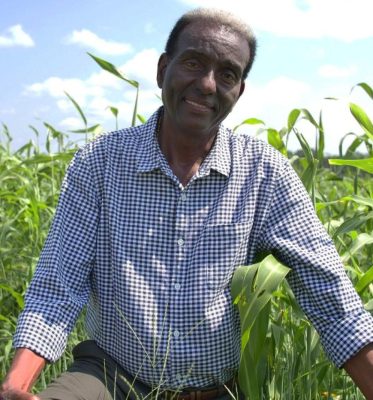
Dr Guta Bedane. Photo: UQ
“This is a very new concept in the Northern Territory, but it has proven success in large cropping areas of Western and South Australia.
“It’s like renovating a house – it’s not something you do every year or every five years; it’s a long-term renovation that lasts for decades.”
As part of the trial, barley is being grown using five different treatments: compost; green manure; delving alone; delving with green manure, and the control, which is the existing farmer’s practice.
“We don’t have concrete results yet, but we just did some biomass sampling and the crop grown on the delved plot with organic matter incorporated could yield about 30 percent higher than the control treatment,” Dr Bedane said.
“We need to confirm results across sites and seasons, but early signs are very promising.”
Trials demonstrate soil potential
Darwin agronomist Fergal O’Gara is hosting one of the trial sites on his property.
He said the trial was an opportunity to learn more about the potential of improving local soils to be fertile and productive for cropping.
“It’ll be very interesting to see if delving can help improve soil health in conjunction with other practices like liming and cover cropping,” Mr O’Gara said.
“You just never stop learning and every time you go out in the paddock, every time you put an implement in the paddock or put a new crop in the paddock, you do learn.”
The trial will continue for 4 years, with different crops planned for next season.
Northern Hub regional soil co-ordinator Emily Hinds said the trial was an opportunity to prove southern Australia techniques like delving could work in the NT.
“Bringing this research up here to demonstrate is really important,” Ms Hinds said.
“The cropping industry has been around for a while, but I guess we haven’t had the science to confirm its potential.
“That is why I am so excited about this project because it gives us the evidence to move forward with confidence.”
At the end of the trial, the delving implement will be gifted to trial partner the NT Department of Agriculture and Fisheries, making it available to local producers.
Field days will continue to be held throughout the trial offering local producers and industry stakeholders an opportunity to learn more about its potential.
Source: University of Queensland
HAVE YOUR SAY