
THE World Meteorological Organization said El Niño conditions have developed in the tropical Pacific and are forecast to strengthen rapidly over the coming months, increasing the likelihood of heatwaves, droughts, heavy rainfall and other extreme weather events in many parts of the world.
However, the Geneva-based organisation is not backing the term “super El Niño”, which is not part of its operational classification system.
WMO classifies El Niño-Southern Oscillation, or ENSO, events as weak, moderate, strong or very strong, and its monthly Global Seasonal Climate Update released today indicates a rapid development into a strong El Niño event during July-September 2026.
“El Niño conditions are already underway and are forecast to strengthen rapidly into a strong event, as accurately anticipated by WMO forecasts,” WMO Secretary-General Celeste Saulo said in WMO’s Global Seasonal Climate Update out today.
“This will intensify the chances of drought and heavy rainfall and the risk of heatwaves on land and marine heatwaves in many regions of the world.”
“The WMO community has launched an unprecedented mobilisation to coordinate activities across the United Nations and at regional level to support governments, humanitarian organisations and climate-sensitive sectors.
Multi-model ensemble forecasts from leading global producing centres indicate a consistent and significant warming of ocean temperatures across the central and eastern equatorial Pacific, with seasonal-average sea-surface temperature anomalies expected to exceed 2 degrees Celsius in key monitoring regions.
Forecast models show remarkable agreement, providing high confidence in the outlook.
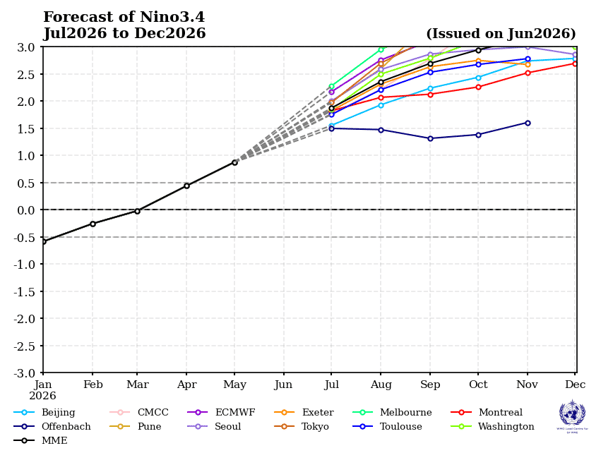
Multi-model ensemble forecasts from leading global producing centres for the central and eastern equatorial Pacific. Image: WMO
El Niño is expected to continue strengthening during the Northern Hemisphere autumn, with its influence extending across many regions of the globe.
Meanwhile, the equatorial Atlantic basin is expected to remain generally warmer than average.
The Global Seasonal Climate Update complements WMO’s full El Niño/La Niña Update issued June 2.
It provides a broader assessment of seasonal climate conditions by incorporating the influence of multiple climate drivers, including the Indian Ocean Dipole and Atlantic Ocean conditions, in addition to El Niño.
Temperature, rainfall outlook
The Global Seasonal Climate Update predicts an overwhelming likelihood of above average temperatures across most land areas between 60°S and 60°N, which covers nearly all populated areas outside Polar regions.
Over the oceans, the equatorial Pacific reflects a heavily structured footprint of the rapidly intensifying El Niño event, with more than 80-percent likelihood of above-normal sea surface temperatures in the equatorial Pacific east of the Date Line.
Above-normal temperatures are also predicted for the Indian Ocean and the tropical Atlantic.
In contrast, a persistent horseshoe-like pattern of below to near-normal temperature probabilities is predicted across the North Atlantic.
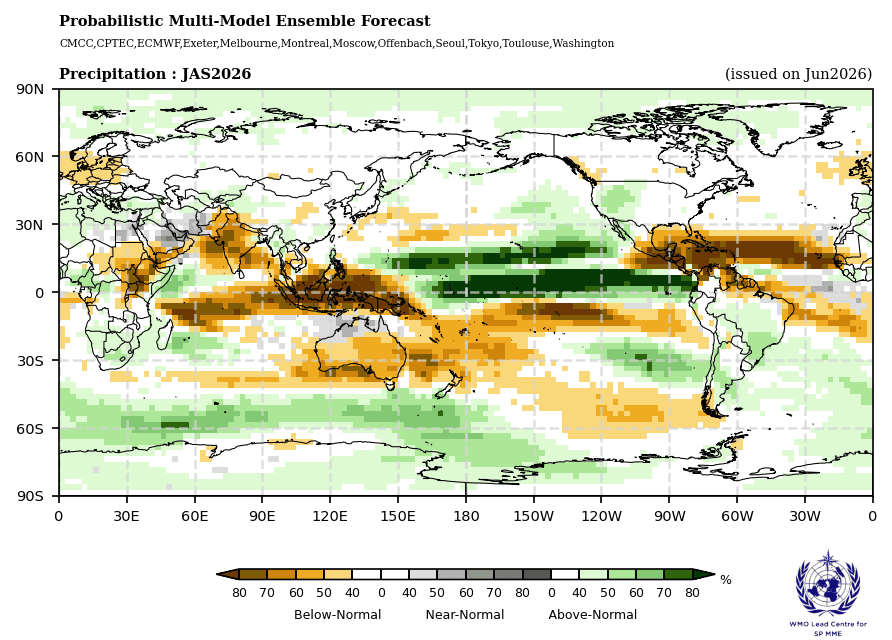
WMO’s July-September 2026 rainfall outlook reflects a pattern that is consistent with a strengthening El Niño event.
Enhanced likelihood of above-normal rainfall is forecast across the central and eastern equatorial Pacific, while below-normal rainfall is more likely across parts of the tropical Indian Ocean, the Indian sub-continent and much of Australia.
Across equatorial Africa, the probabilistic signals display a prominent east-west contrast.
Land areas bordering the northern Gulf of Guinea are forecast to receive above-normal rainfall, in contrast to below-normal rainfall for the Greater Horn of Africa.
Below-normal rainfall is also forecast for parts of Central America, the Caribbean and north-western South America.
In contrast, wetter-than-average conditions are more likely across portions of the southwestern United States.
Across Europe, forecasts suggest a north-south contrast, with increased chances of above-normal rainfall in southern Europe and below-normal rainfall in northern Europe.
However, for Europe, forecast confidence remains lower than in many other regions.
Source: United Nations’ World Meteorological Organization
NOTE: Australia’s Bureau of Meteorology on June 16 announced the ENSO was in an El Niño phase.
HAVE YOUR SAY