
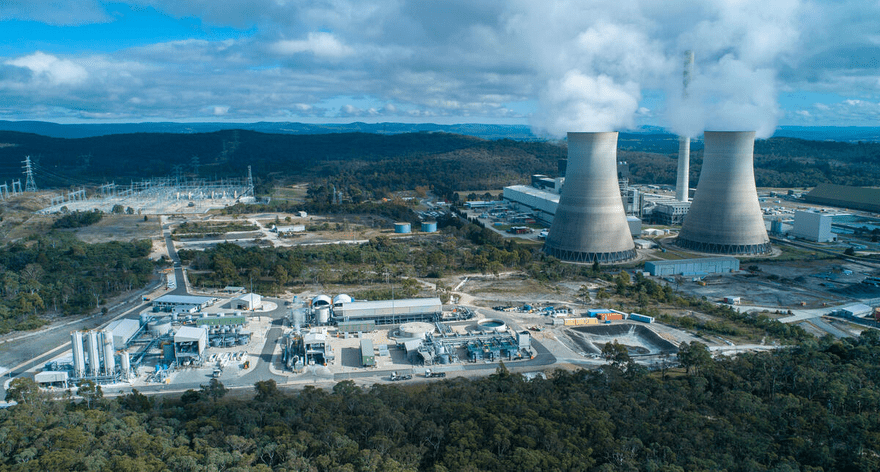
The coal-fired Mt Piper power station near Lithgow, NSW, which is expected to remain in operation until at least 2040. Photo: Energy Australia
THE FEDERAL Government yesterday announced its emissions reduction target of 62-70 percent by 2035 from 2005 levels.
The target is based on advice from the Climate Change Authority, an independent statutory body established in 2011 to provide expert advice to the Federal Government on climate change policy.
“This is an ambitious but achievable target , sending the right investment signal, responding to the science and delivered with a practical plan,” a joint statement from Prime Minister Anthony Albanese, Treasurer Jim Chalmers, and Minister for Climate Change and Energy Chris Bowen said.
“It builds on what we know are the lowest cost actions we can deliver over the next decade while leaving room for new technologies to take things up a gear.”
“The global shift to clean energy represents one of the biggest economic transformations since the Industrial Revolution, and it presents Australia with an enormous economic and jobs opportunity.”
The government said the bulk of the reductions to reach the initial stages of the 2035 target range can be achieved through actions in five priority areas which build on existing policies.
These are:
- Clean electricity: more renewable electricity generation, supported by new transmission and storage, including household batteries;
- Lowering emissions by electrification and efficiency: The New Vehicle Efficiency Standard to support consumers switching to EVs and improving energy efficiency
- Expanding clean fuel use: establishing a low-carbon liquid fuels industry and supporting green hydrogen;
- Accelerating new technologies: through Future Made in Australia investments, and innovation support through the Australian Renewable Energy Agency; and,
- Net carbon removals scaled up: enabling landholders to earn money for eligible carbon storage and a robust Australian Carbon Credit Units scheme.
To help meet the target, the Federal Government has also announced:
- A $5-billion Net Zero Fund in the National Reconstruction Fund, to help industrial facilities decarbonise and scale up more renewables and low-emissions manufacturing;
- $2B for the Clean Energy Finance Corporation to continue to drive downwards pressure on electricity prices;
- $1.1B to encourage more production of clean fuels in Australia;
- $40 million to accelerate the roll out of kerbside and fast EV charging across cities and regions;
- $85M for frameworks and tools to help households and businesses understand and improve their energy performance; and,
- $50M for sports clubs working to decarbonise and drive climate action.
The joint statement said the reductions target range set for 2035 will protect the environment and secure Australia’s prosperity through creating jobs and economic growth.
“The government’s sensible, practical approach means our exporters, farmers and key industries will be able to compete and succeed in the world and our environment will be safe for future generations.”
Mixed reaction from farm lobby
After not being compensated for “billions of dollars in emissions reduction activities they undertook to meet the nation’s Kyoto Protocol commitments”, NSW Farmers said primary producers must not shoulder the burden of meeting the 2035 emissions target.
“Before government does anything else on emissions, they need to pay their debts and recognise agriculture’s unique capacity to sequester carbon, not steal it,” NSW Farmers president Xavier Martin said.
He said farmers were apprehensive about what this target could mean for them, after having already made, and continuing to make “huge contributions to carbon sequestration” through cropping, and looking after landscapes “sequestering millions of tonnes of carbon out of the atmosphere”.
“Alongside that, Australian farmers are driving a huge number of carbon-sequestration activities and projects on-farm to hold carbon in soils or trees, both under management programs and informally.
“The fact is, we’re well and truly paying for everyone’s carbon sins.”
Mr Martin said farmers and food security were already being pressured by “reams of green tape that had been imposed on agriculture”.
“Not only have billions in carbon credits been stolen from us, but our farm communities are bearing the brunt of the impacts in the race to renewable power.”
“Meanwhile, we’re the only sector in the Australian economy that has substantially reduced emissions over the last 30 years, and that data’s just the tip of the iceberg when it comes to farmer’s contributions to sustainability over the years.
“Farmers have been blamed unfairly and left to foot the carbon bill for too long; that must stop, so we must speak up.”
National Farmers Federation interim chief executive Su McCluskey said climate action is vital, and agriculture is already actively contributing.
“It’s encouraging to see our nation collectively striving for solutions with this 62-70pc range target,” Ms McCluskey said.
“While the NFF supports an economy-wide aspiration of net zero by 2050, it cannot be net zero for agriculture.
“If we don’t get climate policy right, farming will only get harder.
“Quite simply, we cannot comprise our food and fibre security.”
The simultaneous release of the Agriculture and Land Sector Plan sets a pathway for agriculture’s engagement with Australia’s Net Zero Plan to transition to net zero by 2050.
The plan recognises Australian producers are “global leaders in low-emissions food and fibre production”, supports a balance between agriculture, carbon storage and nature repair, and states decarbonisation must benefit farmers and regional communities.
The NFF supports these principles.
“Food and fibre security must come first, and it is reassuring to see this recognition has been embedded in the sector plan.
“Productive farmland should not be sacrificed to offset emissions from other industries.”
“Right now, agricultural land is under pressure.
“Farmers have little say in transmission lines tracking across arable land, while demands are increasing from renewable proponents and carbon-only revegetation projects.
“Ag is already the forefront of emissions reduction, having cut its net-greenhouse gas emissions significantly since 2005.
“Farmers are being led by science and innovation to tap into animal genetics that focus on low-carbon outcomes, advances in feed additives, and methane-mitigating pastures.
“We are committed to working with our members and the government to ensure agriculture remains at the forefront of smart, practical climate policy.”
Source: Federal Government, National Farmers Federation, NSW Farmers
HAVE YOUR SAY