
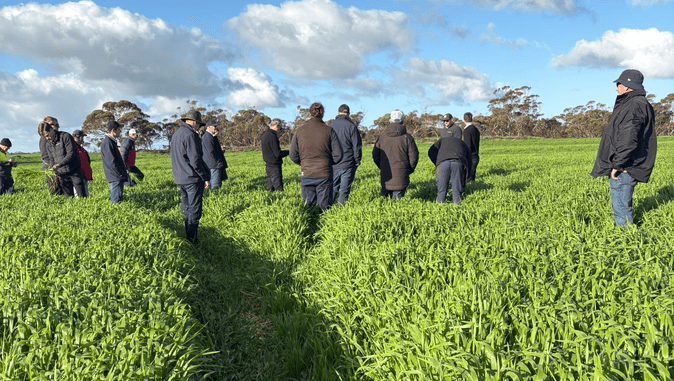
Cereals in the Victorian Mallee are heading for bumper yields, provided frost does not damage the maturing crop. Photo: Matt Witney, Dogshun Medlin
WHEAT and barley markets have jumped in recent days as Asian demand responds to the choke on Russian grain shipments, which is magnifying weather shocks in the Northern Hemisphere.
This has pulled Australian wheat exports out of the doldrums, with values up $10-$15 per tonne, and considerably more for those covering short positions in a market which is all of a sudden providing competition to the domestic consumer.
In the southern market, prospects for an enormous barley crop have stymied any rally, but wheat values have jumped as exporters start the scramble for bulk business.
| July 9 | Today | |
| Downs barley | $380 | $390 |
| Downs SFW | $375 | $390 |
| Downs sorghum | $355 | $358 |
| Mel barley | $335 | $333 |
| Mel ASW | $350 | $360 |
Table 1: Indicative prices in Australian dollars per tonne for prompt delivery.
Export demand lands in north
Wheat bids from some bulk handlers in northern New South Wales are up around $20/t in the past 10 days to reflect their interest in export accumulation.
The lift reflects moves in global wheat markets now that Ukrainian drone strikes have curtailed Russian exports from Sea of Azov ports.
At Narrabri, AgVantage Commodities broker Brendon Warnock said the ongoing disruption to shipping through the Strait of Hormuz, plus the heat-affected crop in western Europe, were also behind the recent rally in global wheat values.
“A few stories are coming together that are supportive; these war-type stories and weather concerns are feeding into that speculator market,” Mr Warnock said.
In the physical market, Asian demand that until recently was being satisfied by a ready supply of Russian wheat has now turned its focus south.
“Asian consumers will start to look more to Australia.
“In the short term, we’ve seen a bottom in the market.”
Across Australia, wheat carry-out into new crop is seen at anywhere from the USDA’s estimate of 5.61 million tonnes (Mt) to Lachstock Consulting’s 15-year high of 7.97Mt.
A national export program ahead of harvest could well see that decrease considerably, and Western Australia’s shipping stems indicate a slew of prompt wheat cargoes have just been booked.
If export demand spreads east, consumers will not want to be caught napping.
“I think there’s still a fair bit of filling in to do for the trade to cover their shorts…and the chance of higher international prices.
“It’s starting to get to the point that consumers are wanting to secure supplies.”
On the production front, Queensland crops are looking for a drink, while those close to and east of the Newell Highway are ready to be top-dressed and have average yield prospects in sight, provided sufficient rain falls in the growing season.
“Generally, around our part of the world, soil moisture is pretty good.”
“It’s a market in transition.”
Mr Warnock said not all country fallowed for winter crop was planted well west of the Newell and north of Coonamble, but regions further south are in good stead.
South forward selling canola
In South Australia, Victoria and on the slopes of NSW, crops are looking at above-average to bumper yields based on subsoil moisture and their strong start.
Growers are seeing delivered depot new-crop canola prices at more than $800/t, and have started to forward sell small amounts of new-crop barley ex farm.
Southern wheat and barley prices in the prompt market have rallied in response to news of limited grain supply out of the Black Sea, and the shrinking of western Europe’s export surplus due to its hot and dry summer.
“Russian wheat prices are firming, and my sense is the Asian market is going to have to come back [to Australia],” Wilken Grain trader Andrew Kelso said.
“They’ve been waiting for cheap European and Black Sea wheat.”
Surety of supply and not just price has become a factor.
“There’s no point buying cheap wheat if you can’t ship it.”
China has already been buying new-crop Australian barley, and this may need to accelerate to compensate for less corn available for shipment out of Europe.
At Horsham, Mygrain broker Andy Brown said growers were looking forward to a fine week or two to continue top-dressing and spraying herbicides and fungicides.
He said growers were jumping on new-crop canola bids at local sites of at least $800/t.
“We’re talking decile eight or nine [pricing], which is up $20-$25 on where it was a while ago,” Mr Brown said.
“My line of thinking is they might be looking to do 20pc at these numbers.”
New-crop barley has traded in very small amounts at around $275/t on-farm,
“The barley crops are amazing,” Mr Brown said, adding the price was not “that magical $300” growers traditionally target, but the promise of near-record yields made the weaker pricing a consideration.
“We could see 7t/ha,” he said of the Wimmera’s barley crops.
“Guys in the Mallee are shooting for 5/t plus, when normally it would be 2.5-3t/ha, and wheat could be 4-4.5t/ha this year.
“Wheat doesn’t look anywhere near as good as the barley.
“Blokes that have been farming for 50 years have never seen it this good.”
Light frosts have settled on some crops in SA, Vic and NSW in the past week, a welcome retardant to their rapid development.
Mr Brown said Vic crops have enough moisture to finish growing, and only “Jack Frost” seems capable of denting their yield outlook.
Grain Central: Get our free news straight to your inbox – Click here
HAVE YOUR SAY