
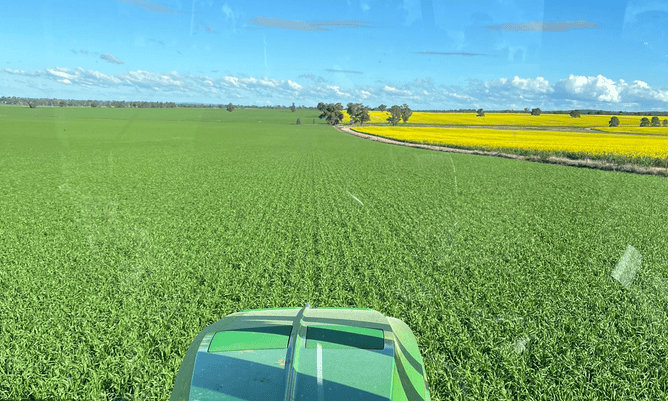
Spraying a paddock of wheat with fungicide and broadleaf herbicide at Mirrool in southern NSW. Photo: Jamie Pursehouse
GRAIN prices are continuing their rise, fuelled by the heat in global wheat markets, and by uncertainty from the Australian grower about new-crop production.
Across southern Australia, wheat and barley crops have stellar yield prospects, but their early development puts them at risk of incurring damage from frost, a hard start to spring, or both, as El Niño looms large in the grower’s mind.
In its July 14 summary, the Bureau of Meteorology said forecasts point to a strong to very strong El Niño event, based on the extent of warming in the central tropical Pacific Ocean, and most models indicate it could peak at levels among the highest observed since 1950.
This means growers are concerned conditions could turn hot and dry, which would severely impact yield prospects, and they are therefore being cautious about selling forward.
| July 16 | Today | |
| Downs barley | $390 | $400 |
| Downs SFW | $390 | $395 |
| Downs sorghum | $358 | $363 |
| Mel barley | $333 | $340 |
| Mel ASW | $360 | $370 |
Table 1: Indicative prices in Australian dollars per tonne for prompt delivery.
Worry in north
Cropping regions in Queensland and New South Wales recorded little to no rain in the past week.
Qld crops are in need of a drink to preserve yield prospects, and early Central Qld crops are as few as four weeks away from harvest.
Sources say much of the wheat and barley market action occurring in the Qld and northern NSW market is confined to the trade, with significant stocks still in grower hands, either on farm or in warehousing.
“Growers are not selling; they’re seeing values firm, so they’re not touching it,” Sunrise Commodities managing director Scott Merson said.
The El Niño event currently under way appears to already be impacting yield prospects in Qld, and stretching its fingers into northern NSW.
“The grower’s very concerned,” Mr Merson said of the season.
Consumers including feedlots are said to be mostly covered into new crop, and leaving 2027 business to the trade thus far, with January barley bid at around $400/t delivered Downs, $2/t below wheat.
At a discount to wheat of around $40/t, sorghum is pricing into the prompt domestic feed market in Brisbane and on the Downs as the bulk export program ex Brisbane slows.
Southern Qld growers with fallow country and significant subsoil moisture are expected to start planting sorghum from next month if they get 15mm or so to wet the topsoil.
“A lot of fallows have good moisture underneath them on the Downs; if we get rain, and the soil temperature’s there, they’ll be into it.”
Top-dressing pause in south
Growers across southern Australia have already done a significant amount of top-dressing of winter crops with urea, and most have pulled up as they wait to spread more ahead of the next front.
The forecast holds little hope for that in the remaining days of this month, and follows a dry week for most growers in South Australia, Victoria, and NSW.
While some light frosts have settled on crops, mostly in NSW, in the past week, daytime temperatures remain relatively mild, and crops are well ahead of their usual mid-winter development.
Wagga Wagga-based trader Peter Gerhardy, Peters Commodities, said lack of waterlogging, often experienced in June and July, is a further reason for the advanced state of the crop.
“Growers got in early and fed their crops and, lo and behold, we haven’t had a saturating June and July,” Mr Gerhardy said.
Growers generally have urea on hand to keep top-dressing once the next major front pops up on the forecast.
“Everyone’s telling me their crops are three to four weeks early.”
Wheat and canola are seen as having a greater risk of frost damage than the earlier-maturing barley.
“There is concern about frost; it’s not in the back of the grower’s mind, it’s moved towards the front.
“Provided it keeps raining, the frost won’t be a major issue.
“It looks like it’s going to be an exceptionally early harvest.
“If it continues to rain, we could have a cracker of a harvest in barley especially.”
The unusually warm winter to date, plus the abundance of in-crop rain, means vetch hay crops are tall, and looking like they are ready to be cut.
However, the days are too short to allow mown hay to dry enough to be baled, and quality come haymaking time in spring is anyone’s guess.
It is one of the topics likely to be broached in a one-hour Agriculture Victoria online discussion from 9am on August 14 with Dr Kate Burke looking at practical ways to navigate this complex growing season.
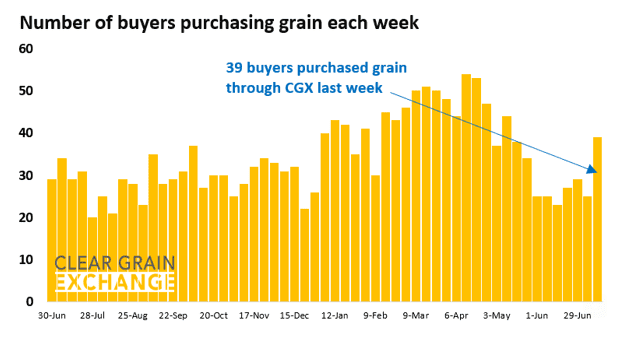
Online trading platform Clear Grain Exchange last week recorded its biggest number of buyers since May. Source: CGX
On the market front, Clear Grain Exchange managing director Nathan Cattle said in Monday’s weekly wrap that that pricing was trying to factor in the potential impact of the closure of the Kerch Strait, and global demand was shifting from Russia to other origins such as Australia.
“The one large crop in a major exporting country that’s been pulling prices lower happens to be in a war zone susceptible to supply disruptions, as is happening now,” Mr Cattle said of the Russian wheat crop.
Grain Central: Get our free news straight to your inbox – Click here
HAVE YOUR SAY