
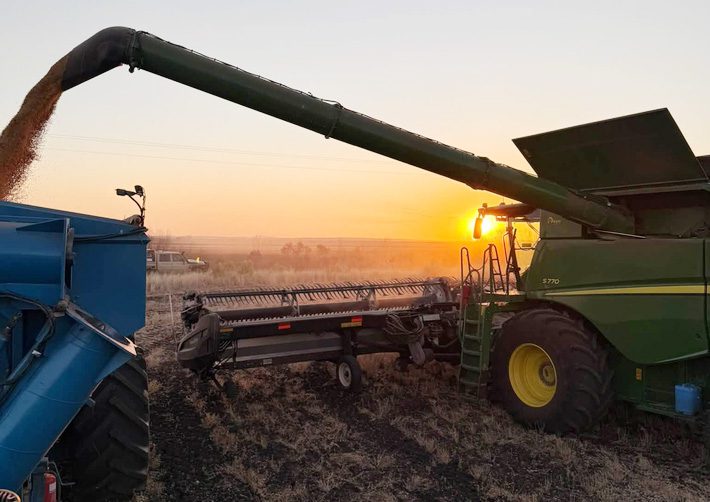
Chickpea harvesting at Gindie in CQ. Photo: Bendee Farming
HOT and drying weather this week in Australia’s major lentil-growing areas may have foiled the chances of this year’s crop setting a new record.
Chickpeas are also feeling the pinch from a dry finish, while faba beans are enjoying the best of the season.
On the price front, chickpeas have rallied as exporters jostle for new-crop tonnage, while lentils have sagged under the weight of the big Canadian crop and the impending Australian harvest.
Domestic demand has maintained faba bean values over the past month, with upside expected if the El Niño weather event takes hold in south-eastern Australia, and if Egypt returns as a buyer.
In other news, Western Australian bulk handler CBH Group is preparing to expand its pulse receivals this harvest.
All prices quoted are in Australian dollars per tonne unless stated otherwise.
Chickpeas
The market for chickpeas delivered Brisbane is nudging $900/t after a steady climb from from $810/t in late August.
Grain Central understands a cargo of Australian chickpeas recently traded into Pakistan at US$724/t c&f, which supports current pricing.
The rally reflects Queensland yields which have not lived up to their earlier potential due to a lack of in-crop rain, and competition from exporters on what has been harvested to date.
Sunrise Commodities managing director Scott Merson said growers have been uncertain about yield, and have therefore been reluctant to forward sell.
“Growers don’t want to stick their necks out because they don’t know what their yields are going to be,” Mr Merson said.
Chickpeas harvested last year and stored on farm have been trading at around $20/t below new-crop, a spread which is narrowing as exporters look to book tonnage for nearby shipment amid uncertainty about new-crop volume from southern Qld.
Based on the large proportion of Central Qld chickpeas now in the bin, quality is good, and yields have been around 1.5-2t/ha.
“The chickpea crops we’ve seen so far are not the big boomers we’d hoped for, but yields have been steady,” pulse agronomist Paul McIntosh said.
“They’re starting to harvest on the Western Downs now, and right through southern Queensland, and quality is good.”
Faba beans
Egypt is Australia’s biggest customer by far for faba beans, and is currently out of the market because it has adequate supplies, and because action by Houthi militants has made the sending of ships into the Suez Canal an uncertain proposition.
In his September 22 report, GrainSource trader Simon Hutt said the price guide for 2026-27 Victorian faba beans now sits at $450-$460/t delivered Melbourne and Geelong,
Mr Hutt said large buyers of feed have indicated $425/t port equivalent is the level at which faba beans become worth swapping into their rations.
“At that level they buy around six months’ cover at a fixed price with carry, and do not chase dips.
“In our view, domestic feed demand at around $425/t port equivalent is setting the floor under new-crop values, and export bids are sitting at that same level.”
Domestic feedmills are the sole source of demand, with one Brisbane mill bidding $465/t delivered this week.
This represents a significant premium over the south to reflect the small southern Qld and northern New South Wales crop, harvest of which is due to start next week.
Conversely, the crop in the southern half of NSW and in Vic and South Australia is expected to be a big one, and its chances of getting to Egypt in the nearby are being thwarted by competition from a record Lithuanian crop, and expensive freight.
“Bulk freight from Australia to Egypt, routed around the Cape of Good Hope while the Red Sea is closed, is quoted to us at around US$100/t,” Mr Hutt’s report said, adding freight was up around $30-40/t pre-closure, but down from its mid-September peak.
“Container freight is quoted substantially lower than bulk.
“We expect exporters to favour containers, shipping smaller parcels earlier, with export demand arriving gradually through the season.
“There is no guarantee, though, that containers will be available when they are needed.
Lentils
Canadian new-crop now being shipped and Australian carry-out on top of imminent new-crop supplies have lentils delivered southern ports trading at around $550/t, down $20/t since late August.
On SA’s Yorke Peninsula, YP Ag agronomist Nat Lloyd said desiccation of lentils ahead of harvest is expected to start late next month.
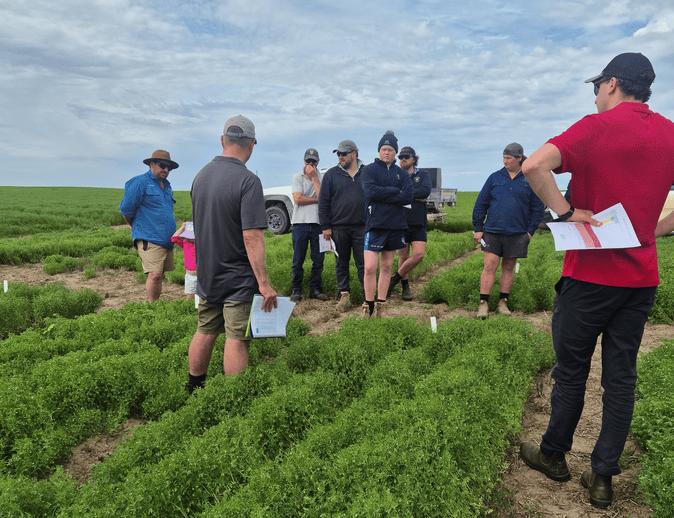
A lentil field day earlier this month with GEM Agronomy’s Jason Brand at Lameroo in SA’s Murray Mallee. Photo: Charlie Bensen
After an early and ideal start and a kind winter, SA and Vic crops have been on track for record or well above-average yields.
However, maximum daytime temperatures yesterday at or near 35 degrees Celsius have challenged or broken some records for September, and with winds as well, Mr Lloyd said some crops are stressed.
“They’re definitely starting to struggle, and losing a bit of colour,” Mr Lloyd said.
“They looked awesome before the heat, but some of them are flowering and aborting.
Mr Lloyd said earlier lentils started podding 10-14 days ago, and the kind season has made the plants unusually bushy, which is preventing sunlight from penetrating all of the plant.
“This weather’s belting them around a bit; we’ve had 4mm of rain so far in September.
“We need another two weeks of kind weather, and 15-20mm of rain; that’s due to come through today and tomorrow.”
“With all this yield potential, that last rain has become more important; some crops will start aborting if we don’t get rain.”
Upper YP lentil yields are generally seen at 2.5t/ha, down a little from earlier expectations, but in line with PIRSA’s latest estimate for SA lentils of 2.06t/ha, based on 1.12 million tonnes from 543,100ha.
CBH ready for pulses
In WA, CBH Group is preparing to receive more pulses at more sites this harvest, which has already started in its northern Geraldton Zone.
“CBH is expanding selected pulse services for 2026-27 in the Kwinana, Albany and Esperance zones,” CBH Group said in a notice to growers.
“If you’re growing lentils, faba beans or field peas, log your planted hectares in Paddock Planner to help CBH plan segregations and site readiness.”
In its Kwinana South Zone, CBH Group plans to receive lentils at its Metro Grain Centre in Perth’s western suburbs, as it did for the first time last harvest.
It is also ready to receive faba beans at sites in its Albany and Esperance zones, and field peas at sites in the Esperance zone.
Growers are invited to contact their CBH Group business relationship managers for pricing information.
Grain Central: Get our free news straight to your inbox – Click here
HAVE YOUR SAY