
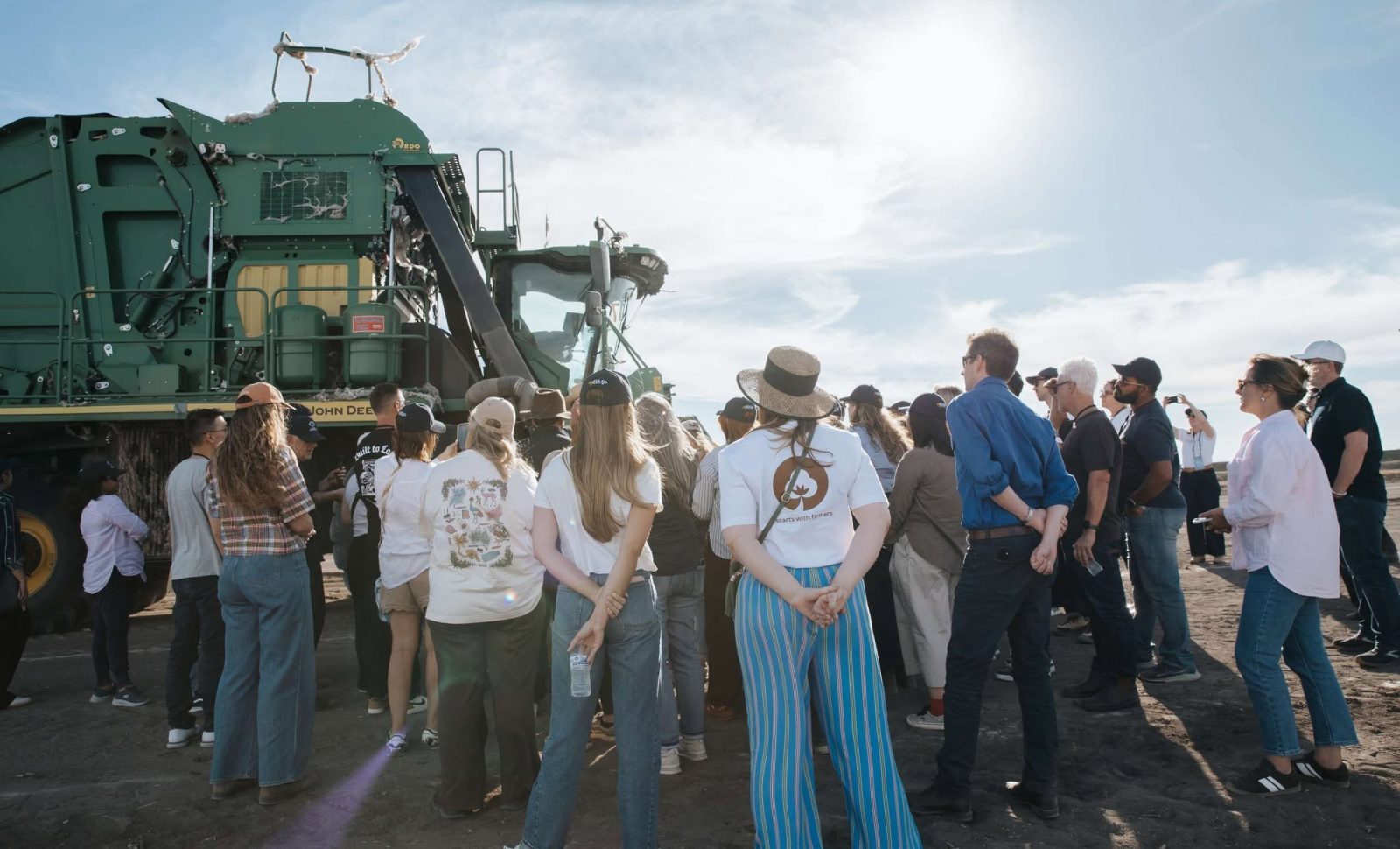
As part of Camp Cotton, Cotton Australia welcomed 50 delegates from some of the world’s leading fashion brands to the Namoi Valley to experience Australian cotton at the heart of cotton country. Photo: Jaz Morrison via Cotton Australia
COTTON Australia has defended its efforts to increase demand for Australian-grown cotton, while acknowledging more could be done with greater government support.
They have come in a response from the representative body’s chair Liz Stott to Louis Dreyfus Company senior head of cotton Joe Nicosia, and shared with Grain Central, following his comments at the Australian Cotton Conference in August.
During one session, Mr Nicosia said Australia was not doing its “job” in supporting the United States’ efforts to boost cotton demand over man-made fibres.
Speaking directly to the Australian industry, he said: “Australia: you don’t attack the demand side at all, and you don’t advocate for your own commodity.”
Mr Nicosia said the industry should push for legislation similar to the proposed Buy American Cotton Act, which would encourage cotton consumption over man-made fibres through tax credits.
In response, Ms Stott said, “driving demand for Australian cotton [was] actually a key priority for Cotton Australia” and embedded in its Strategic Plan.
“Our Cotton to Market program has been operating since 2013 and works directly with brands, retailers, manufacturers, NGOs and others throughout the textile supply chain to increase the use of Australian cotton,” Ms Stott wrote.
She said this program has “grown enormously”, with 64.5 million units processed through the Australian Cotton Mark licensing program in 2025, a 92 percent increase on the previous year, with more than 50 licensed brand partners.
Units processed through the Australian Cotton Mark program increased 13pc in 2024, after jumping 91pc in 2023.
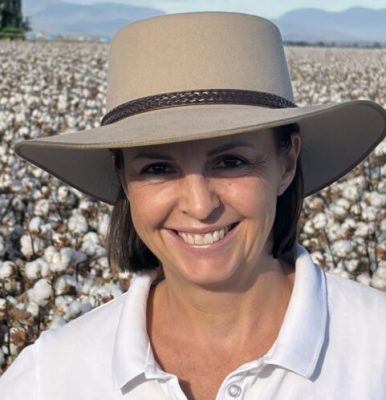
Cotton Australia chair and southern NSW grower Liz Stott.
Major contributors to the program’s growth in 2025 included the signing up of labels such as Target, Caprice, Big W, Sussan and Designworks.
Ms Stott pointed to the work of Camp Cotton and the Australian Natural Fibres Forum as two events where Cotton Australia worked to bring the “supply chain into our industry”.
“There is also a considerable amount of work happening less visibly behind the scenes.
“Our Cotton to Market program has spent years working with organisations such as Textile Exchange and Cascale to ensure Australian cotton and cotton more broadly are appropriately recognised within the frameworks that influence sourcing decisions by global brands.
“That has included work around the Preferred Fibres and Materials Matrix and the Higg Materials Sustainability Index, where Australian cotton production data is now specifically represented.”
Ms Stott said Australia was a foundation member of the Make the Label Count coalition, an international campaign which “successfully challenged the way the EU Product Environmental Footprint methodology treats natural fibres compared with synthetics and has now helped secure a review of that methodology”.
US comparison cautioned
Alongside highlighting the Australian industry’s achievements, Ms Stott said comparisons with the US cotton sector failed to account for differences between the two.
“Australia produces a relatively small and variable share of the world’s cotton crop, but we are incredibly proud of the innovation, yields, quality and consistency our growers achieve.
“That quality means Australian cotton is highly regarded by mills and spinners around the world, and we have worked very hard to build on that reputation with brands and retailers further along the supply chain.
“We are also doing this in a very different environment to the United States.”
She said Cotton Australia was funded mostly by voluntary grower levies and “does not operate with the same level of government support or policy architecture available to US cotton”.
“So while I understand the comparison [Joe was] making, I don’t think Australia and the US are necessarily starting from the same place or working with the same resources.
“Could we achieve more with greater investment and government support? Absolutely.”
Ms Stott suggested Mr Nicosia consider the influence of companies such as LDC and their capacity to advocate for natural fibres over synthetics.
“Organisations such as Louis Dreyfus Company have enormous global reach through the cotton and textile supply chain.
“If businesses of that scale joined more strongly with producer organisations in advocating for cotton as a natural fibre – particularly around microplastics – our collective voice could become much more powerful.
“Rather than reinventing work that is already under way, I think there is a real opportunity to build on it.”
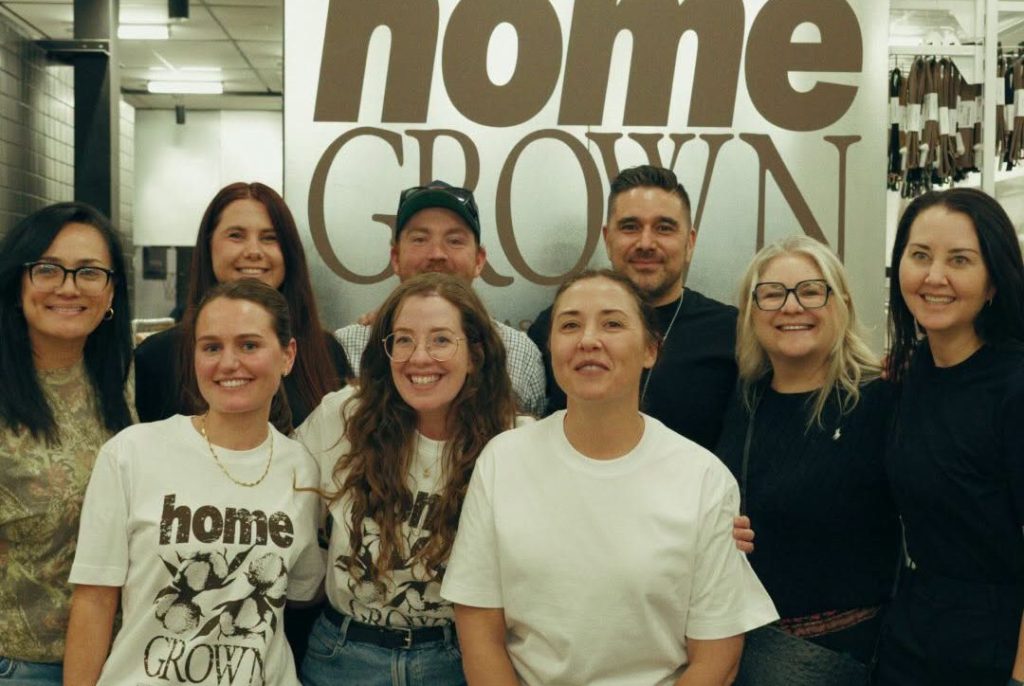
Clothing brand AS Colour and Cotton Australia hosted an event last week to coincide with World Cotton Day. Held in Fitzroy in inner-city Melbourne, the event celebrated Australian-grown cotton. Photo: AS Colour
Mill usage on rise
The US Department of Agriculture Cotton and Wool Outlook report published last month forecast that global mill use of cotton would increase 1.5 percent or 1.8 million bales to 122.9Mb in the year to July 2027.
This would be the highest level of cotton-mill use in six years, with all major spinning countries forecast to increase consumption or maintain current levels.
The USDA report stated that “steady world economic growth projected and higher polyester prices” are behind this growth.
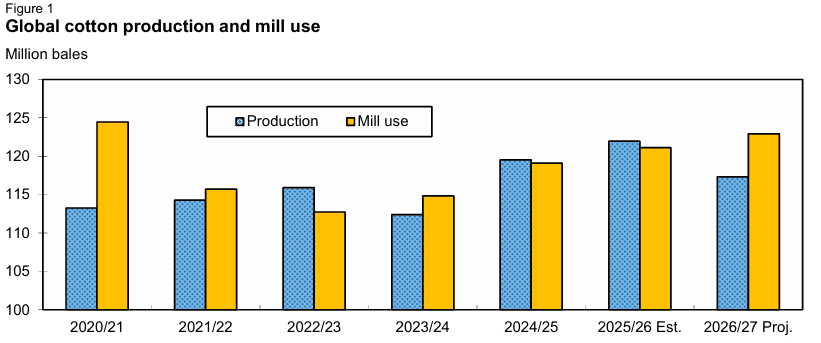
Source: USDA, Economic Research Service based on the USDA World Agricultural Supply and Demand Estimates reports. 1 bale equals 480 pounds.
The top six spinning countries are China, India, Pakistan, Vietnam, Bangladesh and Turkiye.
The largest user of raw cotton is China, which accounts for the 34pc of the global total in 2026-27.
According to the report, China’s mill use will increase 400,000b to 42Mb in 2026-27.
China accounts for 42pc of Australian cotton exports for the 2026 season, making it the country’s largest market, according to the Australian Cotton Shippers Association’s October report.
The USDA report has the US cotton mill use forecast at 1.5Mb in 2026-27.
The figure represents about 11pc of the US season’s projected 13.8Mb crop, but half Australia’s expected 3Mb.
Source: Cotton Australia, USDA
HAVE YOUR SAY