
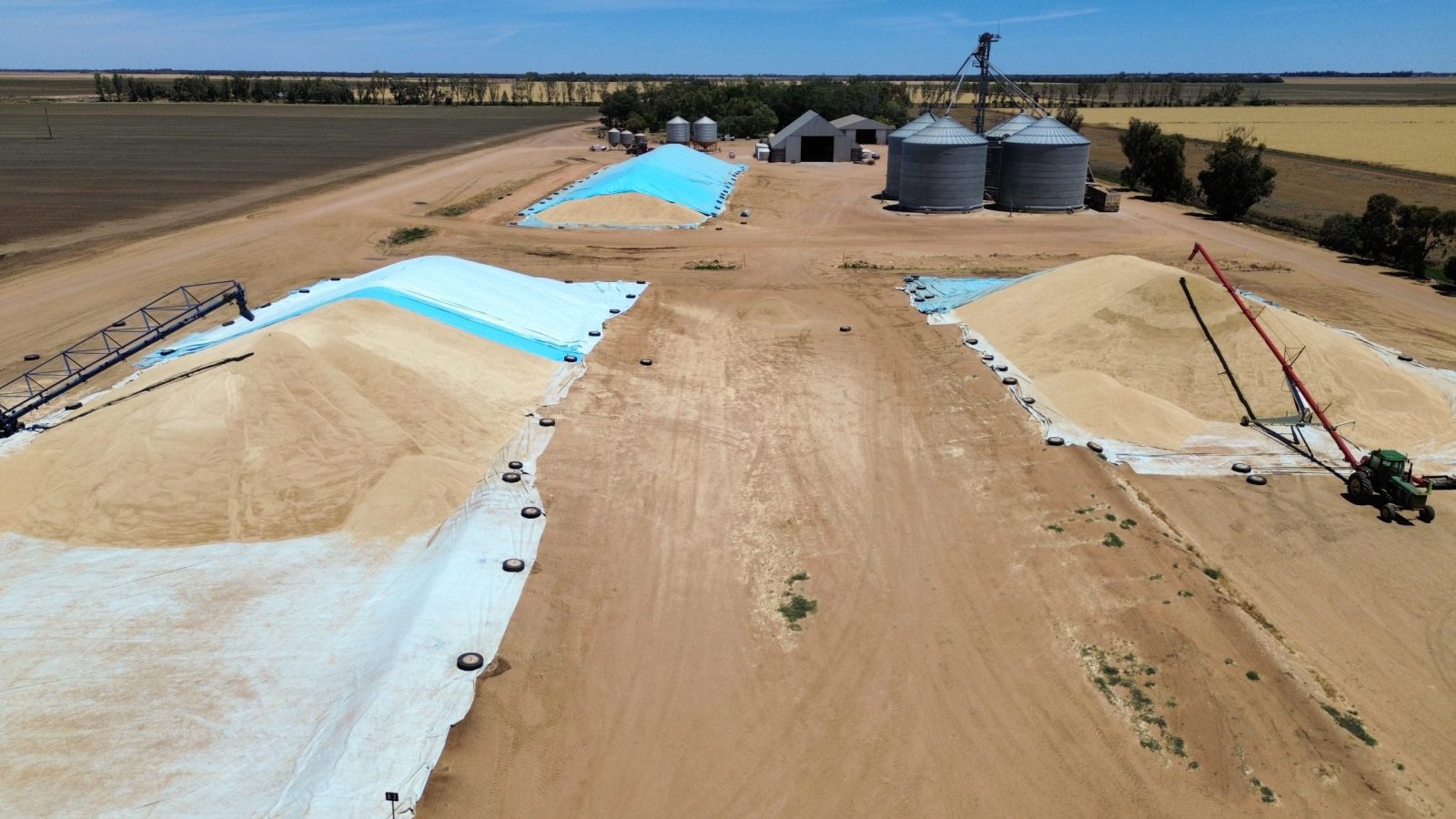
One of DC Agri Solutions’ sites in the Riverina. Photo: DC Agri Solutions
AS CROPS gets bigger and the supply chain more complex, the call for contracted storage and fumigation services is being answered by companies like DC Agri Solutions.
Based in Parkes in the Central West of New South Wales, it was started in 2023 by husband and wife Dave and Chelsea Simpson, and based on experience built through years working for a private bulk-handler in nearby Forbes.
DC Agri Solutions has built a solid customer base which includes a bulk grain terminal in Newcastle, and corporate and private farmers, as well as container-packing operations spread from Dubbo to Victoria.
Last harvest, the business made its first trip to service clients in Western Australia, and is now preparing to employ permanent staff in the west as the demand for on-farm and private storage grows.
Storage for efficiency
WA’s most recent harvest set a record for the state, and also for CBH Group, its major bulk handler, with receivals of 24.2 million tonnes.
Both the volume and intensity of the WA harvest, where a number of large growers can harvest as few as two crops, perhaps lupins and canola in the Geraldton zone, and canola and wheat or barley in the others, means bunkers are on the WA radar.
“They’re looking at bunkers to ease that harvest pressure for them,” Mr Simpson said.
In eastern Australia, Mr Simpson has seen growers develop their on-farm storage in recent years to minimise harvest pressure, improve quality through blending and moisture-reducing aeration, and increase marketing options.
He can see the same happening in WA, where big harvests have put pressure on CBH Group, which is responding with upgrades at major sites, and brought more competition to the storage market.
“WA is going to catch up with the set-ups in the east once they start building on-farm storage and see how it can benefit them.
“For growers, it means they don’t have that time pressure in a big harvest to cycle trucks through a bulk-handling site that might be 50km or more away.
“If you’ve got your own storage, you can be more efficient, and deliver your grain without the chance of being stuck in a line-up.”
DC Agri Solutions is also looking to increase its efficiency by having a full-time presence in WA ahead of this year’s harvest.
“At the moment we’re flying in and out.”
Most of DC Agri Solutions’ work is in central and southern NSW, where Mr Simpson said more crop types and the wider overall harvest window have made on-farm storage a must for the company’s clients.
Alongside wheat, barley, and canola, Mr Simpson said a growing number of pulses is being stored on farm for sale into peaks in their markets.
Adding to the reasons for farming operations to have on-farm storage are summer crops, which have expanded their footprint when gross margins stack up, and subsoil moisture permits.
“Sorghum is coming further and further south, and we can deal with it, and any commodity we’re asked to, whether it’s wheat, barley, canola, chickpeas, lupins, or whatever.
“We do some export container work, and the rest is farm work, plus harvest work.
Fumigation options
Mr Simpson said demand for bunkers as a flexible and affordable option to store grain has grown in eastern Australia, and was evident in WA too.
“We have teams that will put down floor tarps for bunkers and cover with top tarps, and we can weld and sew tarps on site.”
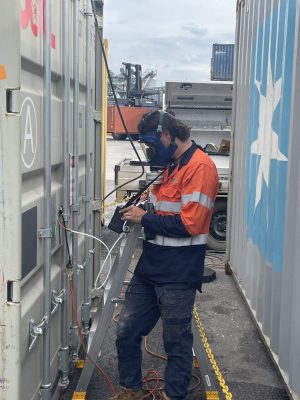
Fumigating a container at a packing site. Photo: DC Agri Solutions
After the bunker is laid out and covered, DC Agri Solutions can also look after fumigation.
“We can fumigate silos, silo bags and packing facilities as well as bunkers.”
Mr Simpson said last harvest saw the DC Agri Solutions team look after six bulk grain sites, all within three hours’ drive of Parkes.
“That’s one less job people on the farm, or at bulk sites, have to look after.”
In WA, DC Agri Solutions’ experience will bolster a new skill set for the state’s growers and bulk handlers.
“We know there are not too many people over there doing this stuff, and we have different fumigation options to offer.”
These can be chosen by clients based on insect pressure, permissible maximum residue levels based on target markets, time, and cost.
“We have a hi-flow phosphine unit which is much quicker than traditional phosphine blankets or tablets.
“We can also use sulfuryl fluoride, which is quick acting, and can be used as a 24-hour fumigation, as well as methyl bromide when required.”
Grain Central: Get our free news straight to your inbox – Click here
HAVE YOUR SAY