
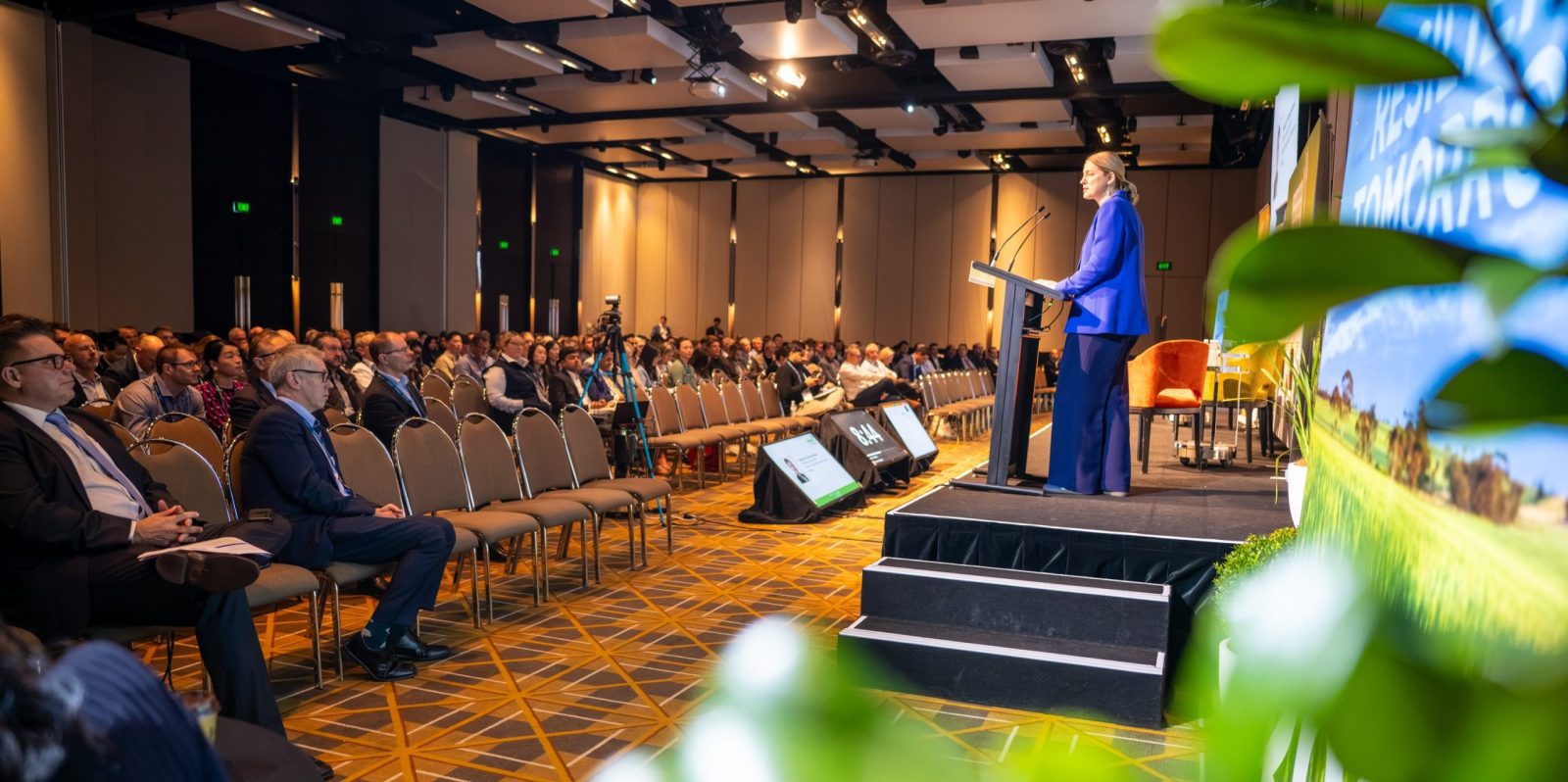
Federal Minister for Agriculture Julie Collins addresses the Australian Grain Industry Conference which includes mention of its work around helping to secure fuel and fertiliser. Photo: AGIC 2026/AR Thomas Photography
AUSTRALIA’S peak demand period for urea is closing, and prices have at long last retreated to around $800 per tonne ex port depot.
The level has not been seen since late February, when conflict between the US and Iran stopped urea exports from the Persian Gulf, and put a rocket under values, which lifted to close to $1450/t in March and April.
They’ve been a long time coming down, and 2026 will be remembered in agricultural folklore as the year the Federal Government stepped in, seemingly with all good intentions, to secure fertiliser to help ensure Australia got a properly fed winter crop going, which by and large it did.
At the Australian Grain Industry Conference on July 29, Federal Minister for Agriculture Julie Collins outlined the undeniable overall benefits from the Fuel and Fertiliser Security Facility, and the volumes involved.
“We’ve supported now the purchase of around 800 million litres of additional diesel for Australians and around 340,000 tonnes of urea for farmers,” Ms Collins told the Melbourne gathering.
In the bigger scheme of things, the amount is only 10-15 percent of Australia’s annual urea requirements, all of it imported, totalling around 3-4 million tonnes, according to the presentation later that day by S&P Global principal fertiliser analyst Isaac Zhao.
Ms Collins outlined the government’s establishment of the Fertiliser Supply Working Group in response to the Middle East conflict, and told the AGIC gathering she had made it a priority that “coordinated action actually had the highest impact for so many of you”.
Based on the adage that “there’s nothing to cure high prices like high prices”, some of that impact was a broadside to importers other than Incitec Pivot operating in eastern and South Australia, and CSBP Australia and Summit Fertilizers in Western Australia, which benefitted from the FFSF.
As the global market fell, those companies had some government-backed price protection, while others, including Melbourne-based Marnco, have had to wear large losses.
The matter could normally be something the Australian Competition and Consumer Commission might investigate, but the unprecedented nature of the FFSF means the government entity is unlikely to find itself at fault.
“We’re licking our wounds now; some of them are seven figures,” Marnco managing director Mark Been told Grain Central of the fall-out from the falling market on those participants who are not Incitec, CSBP or Summit.
Marnco is one of several companies Grain Central understands has nonetheless made a submission to the ACCC, which provided the following response: “The ACCC is aware of concerns expressed within the fertiliser sector, and is engaging with stakeholders regarding these concerns.”
Plain speaking at cotton conference
Speaking at the Australian Cotton Conference earlier this month, Fertilizer Australia chief executive officer Stephen Annells defended the body’s role as a representative organisation and not a lobby group when involved in the aforementioned Fertiliser Supply Working Group.
“I think there’s a bit of confusion as to the power that Fertilizer Australia holds,” Mr Annells said.

Stephen Annells
Its members make up around more than 95pc of all fertiliser imported, manufactured and distributed throughout Australia.
“Fertilizer Australia isn’t the tobacco lobby for the Australian fertiliser industry.
“We don’t push to maximise sales.”
He said FA pushed for the “responsible and sustainable use of fertiliser” within Australian cropping systems.
“We don’t get involved in our members’ commercial arrangements.
“We just expect them to compete on the…marketplace and not breach any trade practices rules.”
FA found itself in uncharted waters in March after its board meeting, when it was decided all CEOs of the companies represented needed to get the government’s ear and ensure fertiliser was on its radar in formulating a response to the Persian Gulf crisis.
He said FA asked the government to put together a group for the fertiliser industry to “discuss concerns, raise issues, seek solutions, share information and basically have a group that was agile and was able to work through some of the issues that we may face”.
What eventuated was the still-operating Fertiliser Supply Working Group, which includes FA, the National Farmers Federation, and “a plethora of government agencies and bodies”, and it has continued to meet fortnightly.
“I represent Fertilizer Australia, but also I represent the rest of the industry as well because it is an industry-based thing as far as the government is concerned.”
The group is a government initiative, and government controls communication out of it, and the FFSF mechanism.
“The first that Fertilizer Australia heard of that mechanism was the same time as everyone else on the 28th of March…when the Prime Minister announced it.”
Mr Annells said FA went to the government to seek more information on it for its members.
“There wasn’t a lot of information available at that time and all they asked Fertilizer Australia to do was to provide a list of importers to them.
“We did that and then we went back and provided a list of the exporters to Australia as well because it was a supply issue.
“Since that time, Fertilizer Australia has advocated on behalf of all importers and has advocated on behalf of retailers as well for access to that, but that’s been the limit of our involvement with it.”
Improved profile
While companies beyond the three which have benefited from Federal Government support may not be happy that they have been long product in a falling market, they are at least part of a sector with an improved national profile.
This has been helped by the Federal Energy Minister’s weekly addresses.
“Chris Bowen gets up every Saturday morning and talks about the amount of fertiliser and the amount of fuel that’s in Australia…so we have their attention now.”
“The government is focused on the two big Fs now: fuel and fertiliser; when this first started, they were only focused on fuel.”
Mr Annells said shortly after this crisis erupted, FA put a submission to the government which included sanctions in place on Russian exports.
“New Zealand and Australia are the only two countries that maintain sanctions on Russia for fertiliser.
“Other countries have sanctions on Russia for different things, but Australia and New Zealand have maintained that on fertiliser.”
Mr Annells said that became a moot point when Russia in mid-March ceased exports of its products, and China did the same thing with nitrates and urea “as they do from time to time.”
Grain Central: Get our free news straight to your inbox – Click here
HAVE YOUR SAY