
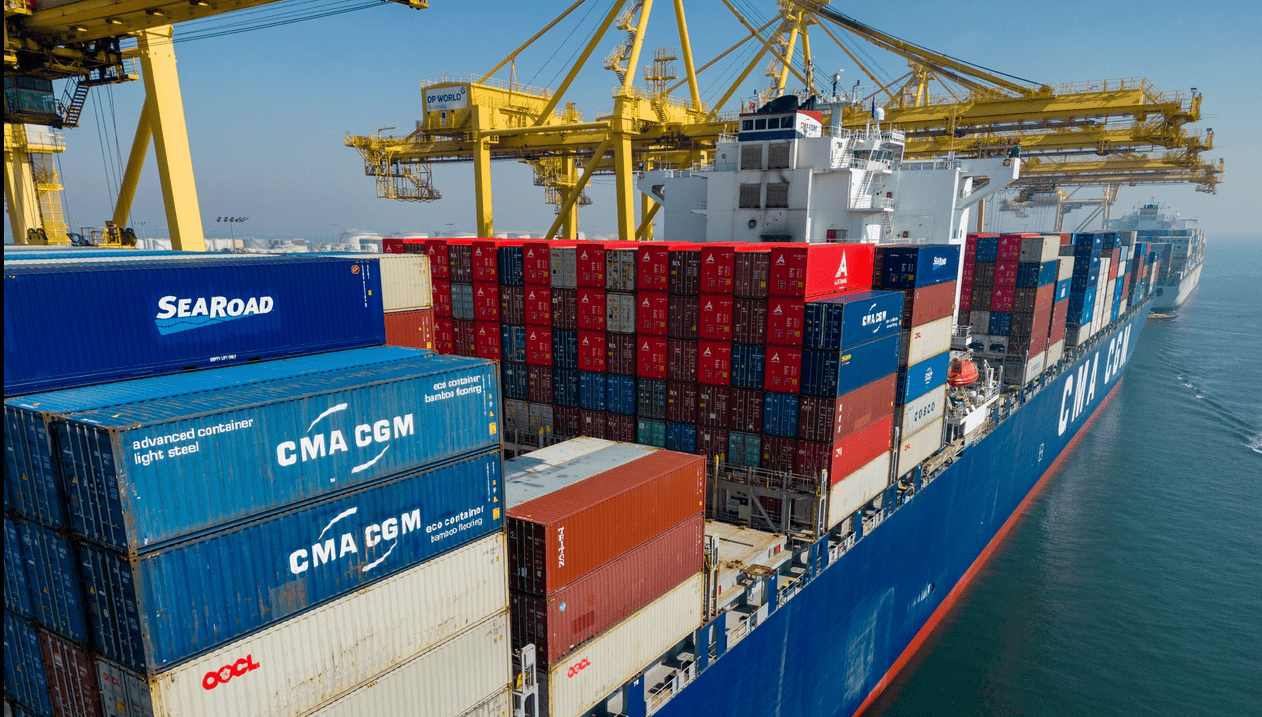
Increased costs, delays and uncertainty are impacting Australian agricultural exports going to or through the Middle East. File photo: NSW Ports
THE ONGOING closure of the Strait of Hormuz and conflict in the Middle East has intensified sea-freight disruptions as shipping surcharges mount for cargo in the region.
According to Australia’s Freight & Trade Alliance (FTA) and the Australian Peak Shippers Association (APSA), container shipping lines commenced emergency measures almost immediately following the US-Iran strikes on Saturday.
It has limited traffic through the Strait of Hormuz, a key shipping route for Gulf ports, with shipping lines restricting freight availability in some cases, rerouting services, and introducing emergency freight surcharges.
Mediterranean Shipping Company, the world’s largest container carrier, announced on March 3 an End of Voyage declaration for all shipments in its custody in the Arabian Gulf.
“All shipments currently en route will be diverted to the next safe port of discharge,” the MSC notice said.
“At that location, cargo will be discharged and placed at customers’ disposal for local delivery and recovery.”
On top of this move, MSC is also placing a surcharge of US$800 per container on all affected shipments to cover the deviations costs.
“MSC sincerely regrets the necessity of this decision, which arises from exceptional circumstances beyond its control, and appreciates your understanding and cooperation during this time.”
FTA general manager freight policy and operations and representative of the APSA Tom Jensen said this move had significant ramifications for cargo owners, with the potential for shipments to be discharged short of the destination and forcing the owners to absorb the costs.
“So that means shippers must arrange alternative logistic solutions to reach their final destination and they may be faced with additional port-handling, storage, detention, inland-transport costs; you name it,” Mr Jensen said.
“Shippers are up for a massive amount of extra cost in that respect as well.
“So not only are you hit with the extra fees associated with getting your goods to the final destination, once they get offloaded at the nearest port, you’re also off for $800 US in the containment-deviation surcharges as well.”
Mr Jensen said this situation also raised insurance issues concerns, with FTA/APSA members telling them that some providers have ceased coverage due to the MSC decision.
Suspensions, deviations
Also on March 3, shipping line HapagLloyd announced it was suspending the Strait of Hormuz transits until further notice.
“As a result, services calling ports in the Arabian Gulf may experience delays, rerouting, or schedule adjustments,” the Hapag-Lloyd notice said.
“We are working to minimise disruption and will communicate any material changes to affected shipments as soon as possible.”
CMA CGM also confirmed the suspension of all bookings to ports in Bahrain, Kuwait, Qatar, the United Arab Emirates excluding Fujairah and Khor Fakkan, Saudi Arabia excluding Jeddah, King Abdallah Port, Yanbu, NEOM, and Iraq’s Umm Qasr.
The company stated that emergency measures are being implemented for all shipments to and from the following countries: Iraq for Umm Qasr, Bahrain, Kuwait, Yemen, Qatar, Oman, UAE, and of Saudi Arabia.
“These measures include, but are not limited to, vessel deviations to contingency ports,” CMA CGM said.
Other shipping lines that have issues similar notices in the past two days include COSCO, Ocean Network Express, and OOCL.
Freight increases
Following reports of CMA CGM and HapagLloyd implementing one-time surcharges, FTA/APSA said Maersk has responded with similar emergency freight increases.
This is alongside announcing suspending cargo booking acceptance in and out of UAE, all Oman ports barring Salalah, Iraq, Kuwait, Qatar, Bahrain and two Saudi Arabia ports until further notice.
The Emergency Freight Increase will be applied at $1800 for 20-foot dry containers, $3000 for 40- and 45-foot dry or high-cube containers, and $3800 for refrigerated and specialised equipment.
According to FTA/APSA, these charges apply to “all bookings not yet shipped, cargo already on the water, and future bookings from 2 March 2026”.
“The carrier notes that the revised freight levels reflect the significant operational costs arising from the closure of the Strait of Hormuz.”
Mr Jensen said these freight surcharges weren’t “marginal add-ons” and would follow-on to consumers in time.
“For many trades, that magnitude can rival or exceed what the base ocean freight cost.
“We’re hearing…impacts in excessive of a million dollars at this point in time for certain suppliers and exporters from Australia.
“It’s not looking good, and it’s going to have dire impacts and likely put on effects to the cost of living as well.”
Australia exports wheat, canola and feed barley in bulk to the Middle East as well as containerised pulses, like lentils and chickpeas.
Australia relies heavily on imported fuel and fertiliser, much of which is sourced from the Middle East.
Grain Central: Get our free news straight to your inbox – Click here
HAVE YOUR SAY