
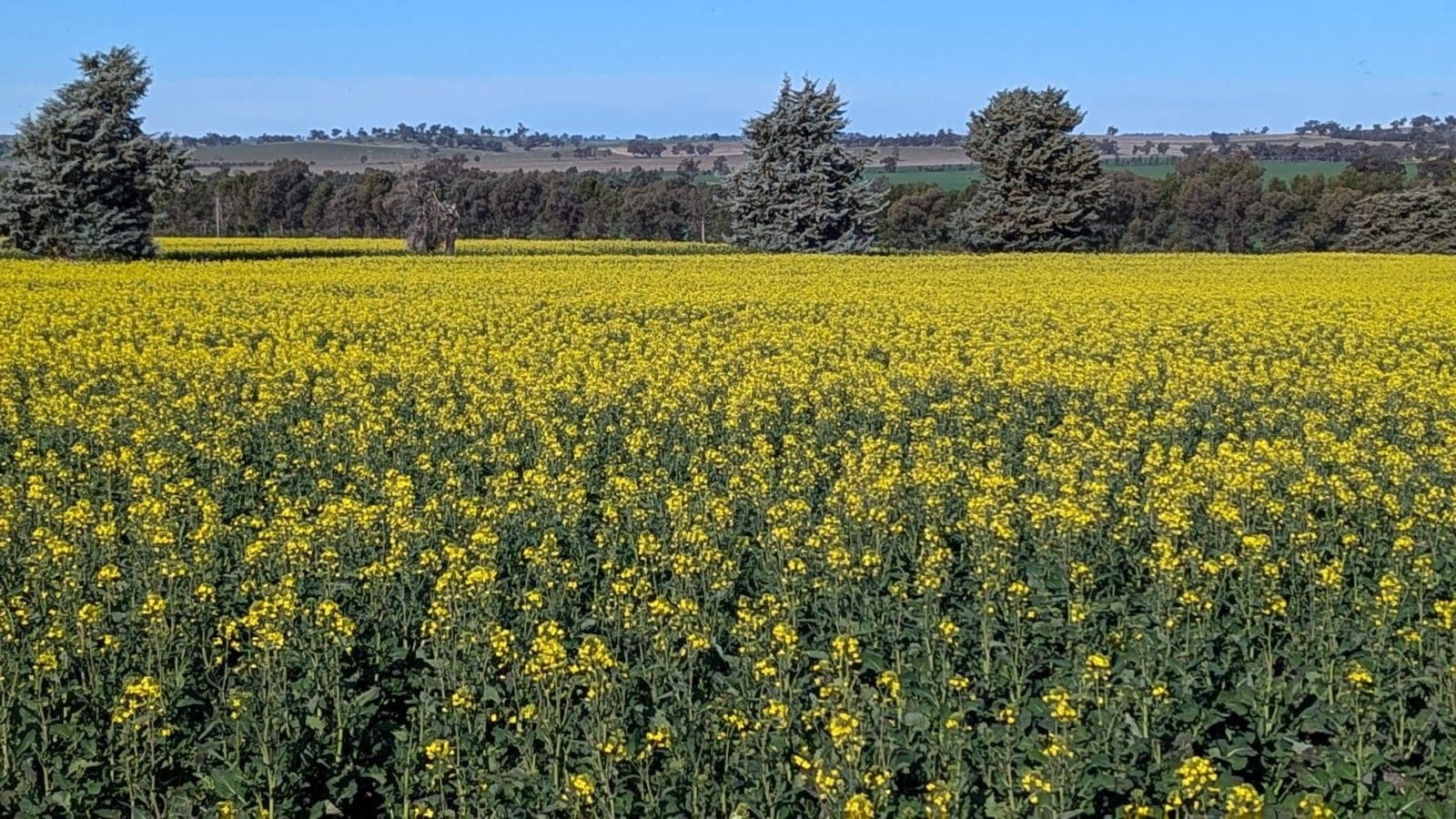
A crop of canola in southern NSW coming into flower. Photo: Michael McCormack MP
GRAIN Producers Australia is pressing ahead with calls for an Australian-owned certification scheme, despite a GRDC-commissioned report finding the costs of a local ISCC-style program would outweigh its benefits.
A 2024 report by L.E.K. Consulting Australia, obtained by Grain Central, estimated that establishing a homegrown certification scheme would cost between $17 million and $33M over a decade.
By contrast, the ISCC program was expected to cost certificate holders just $1.8M in audit fees over the same period, with CBH Group and the Australian Oilseeds Federation together spending about $1M a year to run and administer it.
The report said the ISCC had “performed well for the Australian oilseeds industry” and enabled growers to access “a broad range of benefits”.
It said growers could achieve “a $5-$25 per tonne higher canola price for ISCC certification”, which gave them access to the important EU canola market and incentivised them to “adopt best farm operational and management practices”.
Overall, the report found the “investment may be better deployed equipping growers to capture sustainability related data”.
Report review
After seeing the findings of this report, GPA commissioned market analysis company Episode 3 to conduct further research on L.E.K Consulting’s findings with a focus on the costs and barriers to establishing an Australian scheme tailored to domestic production conditions.
The August 2025 report titled Options for certification in the Australian Grain Industry ultimately refrained from providing an overall recommendation, commenting that “both have merits”.
It said the ISCC scheme was “overly onerous” and had a “large degree of over-reach compared to the objective of meeting the requirements of the Renewable Energy Directive”.
Episode 3’s analysis found that establishing an Australian scheme would cost approximately $4-6M over two-three years to establish with “ongoing administration” fees pegged at about $1-2M annually.
The report said the initial costs would involve: “the development of standards, IT traceability systems, stakeholder consultation, governance structures, and the process of securing EU recognition”.
The ongoing costs included a “a central workforce of 4-6 full-time equivalent staff…required to manage scheme governance, regulatory liaison, and system maintenance”.
Overall, Episode 3 estimated the costs at $14-26M over a decade to set up and maintain an Australian scheme, below L.E.K. Consulting’s forecast of $17-33M.
For context, according to ABARES, Australia exported $4.9 billion worth of canola in 2024-25, with $3.17B of that sent to the EU.
Episode 3 found an Australian scheme was “technically feasible” and would need “strong industry coordination, upfront capital, and ongoing engagement with EU regulators to maintain recognition”.
“The key benefit is greater sovereignty and potential long-term cost control, weighed against the risk of duplicating existing international systems,” the report said.
If Australia was to continue with the ISCC scheme, the report outlined ways to work with the program’s provider to make it more grower-friendly.
Suggestions included developing Australian-specific paperwork, subsidising certification costs through group models or government support, expanding grower support services, improving incentives, and giving growers a stronger voice in the process.
Industry concerns
GPA chief executive Colin Bettles said members had “consistently raised serious concerns about the ISCC certification scheme” and had, since 2018, sought to develop an alternative domestic program.
He said an ISCC Technical Working Group was established in 2022 to work through these concerns.
“However, this group has not met on a regular and consistent basis, to proactively manage and co-ordinate responses to the legitimate concerns raised by growers, especially about flaws in the scheme’s certification and subsequent auditing processes,” Mr Bettles said.
“These concerns have also been raised directly with [AOF] and Sustainable Grain Australia, which was established to co-ordinate auditing of growers to manage oversight of compliance with the scheme.
“While this process was used for GPA to raise growers’ concerns about the ISCC…definition of a waterbody, in 2023, and others such as categorisation of local chemical use and application, and subsequent consequences for grain export market access, the group’s role and purpose has not been maintained, by the local proponents, despite repeated requests.”
Grains Australia-led program
Mr Bettles said GPA had developed a draft sustainability policy with a preliminary view of the ISCC scheme in the Australian context.
“GPA’s discussions, to update and further refine GPA’s draft ‘sustainability’ policy, will be guided by the Episode 3 research.
“[T]his will focus on considering optimal ownership structures and models, to operate a national certification scheme and how it can be funded to deliver industry-good benefits that ultimately increase national productivity, while optimising returns to growers.”
This draft policy supports the development of an “Australian-owned and controlled certification scheme that can protect the sovereign interests of Australian grain producers and capture optimal commercial value and recognition from local farm production methods”.
It says that Grains Australia would be the “logical home for such a scheme to be managed and controlled”.
“This scheme must be guided by sound science, be backed by independent regulation – not populist opinion – and reflect the unique climate and requirements of Australian farming systems,” the draft policy said.
“This scheme needs to encapsulate the provenance story of Australian grains and optimise potential commercial returns to growers.”
Grain Central: Get our free news straight to your inbox – Click here
HAVE YOUR SAY