
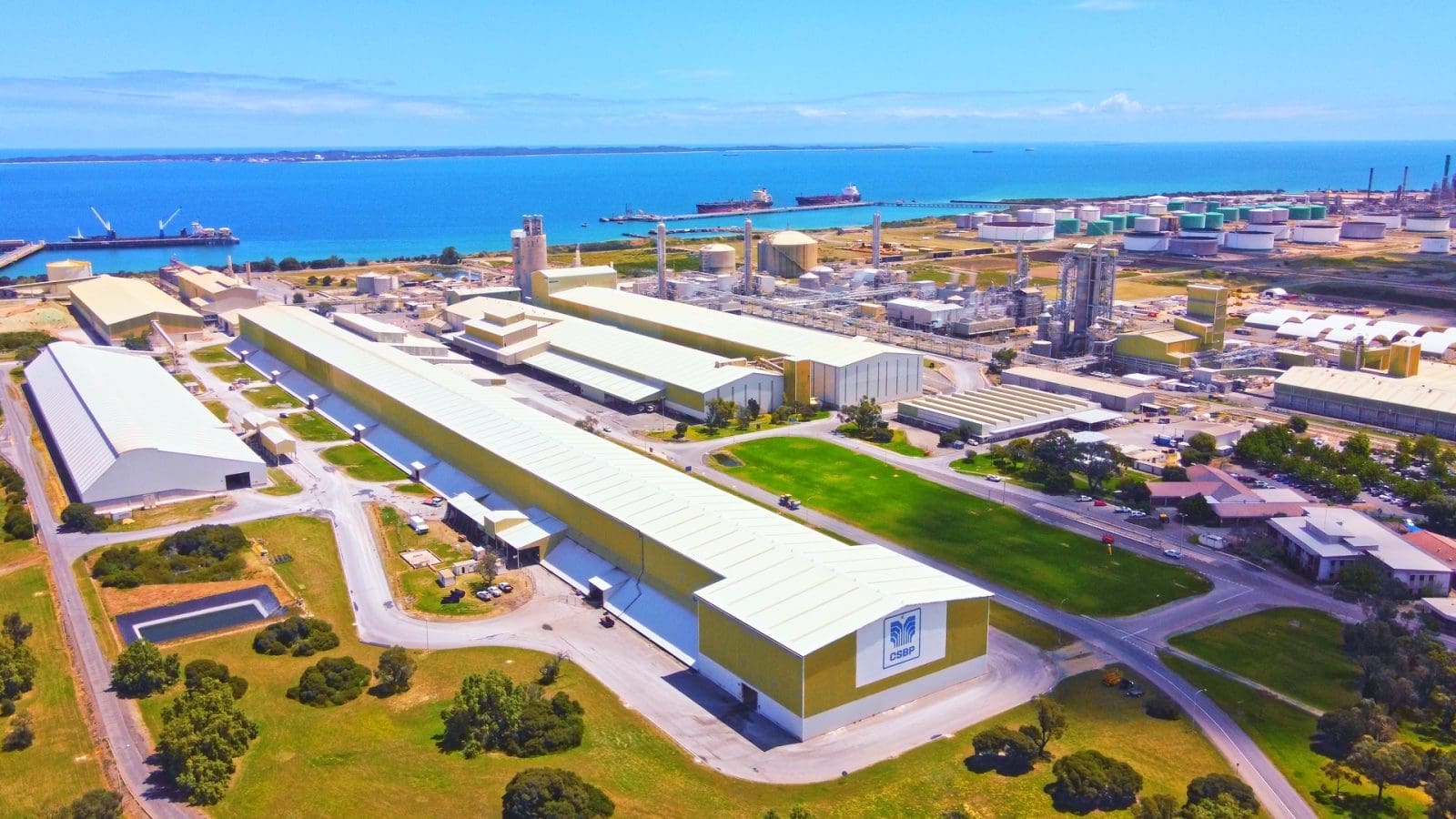
Aerial of CSBP Fertilisers Kwinana works, where the Granulation Plant is located. All photo credit: CSBP Fertilisers.
WESFARMERS’ chemicals, energy and fertilisers division, WesCEF, recorded higher earnings and revenue for the year to June 30 compared with FY25.
Earnings from its fertiliser segment increased on the back of higher nitrogen fertiliser prices, while chemical segment earnings fell as ammonia prices rose, with both movements attributed to the conflict in the Middle East.
Among WesCEF’s portfolio of eight businesses is CSBP Fertilisers, which manufactures, imports and distributes fertilisers for the Western Australian market.
The effective closure of the Strait of Hormuz made for a difficult final third for WesCEF’s FY26, disrupting urea and ammonia imports and pushing prices significantly higher.
This resulted in CSBP declaring force majeure on May and June contracts of urea-ammonium nitrate (UAN) in early April.
The company reversed the decision about two weeks later as additional supply came on board from alternative sources.
Along with Incitec Pivot and Summit Fertilizers, CSBP was granted access to the Federal Government’s Fuel and Fertiliser Security Facility in response to the fertiliser price hike caused by the US-Iran War.
CSBP reportedly entered into “contracts for difference” with the government to secure four fertiliser cargoes under FFSF, which buffered them from losses in the correcting market.
WesCEF made no reference to either development during the investor meeting or in its financial documents.
Despite supply disruptions caused by the Middle East conflict, revenue for WesCEF increased 5.9 percent during the year to $3.14 billion, “driven by higher prices for fertilisers and spodumene concentrate”.
Wesfarmers chief financial officer Anthony Gianotti said this result was replicated in the earnings before interest and taxes.
“WesCEF’s earnings increased 18.5pc to $473 million for the year, driven by higher prices for nitrogen-based products and spodumene concentrate,” Mr Gianotti said.
“[I]n fertilisers, earnings increased on the prior year, which was supported by a strong end to the 2025 season, partly offset by increased import costs in the second half of the financial year, again due to the Middle East crisis.

Wesfarmers CFO Anthony Gianotti.
“In chemicals, earnings decreased on the prior year due to the rapid rise in ammonia index pricing following escalation of the Middle East conflict.
“Given the price lag in sales contracts, this significantly impacted earnings in the second half but will provide a benefit as index prices normalise into the 2027 financial year.”
He said the overall Wesfarmers’ group operating cash flow finished 6.5pc lower than the previous year “due to deliberate investments in working capital in WesCEF and health”.
“These investments were temporary decisions our divisions made to strengthen availability to customers.
“[I]n WesCEF, investment in additional fertiliser inventory at elevated prices to minimise the impact of supply chain disruptions from the conflict in the Middle East adversely impacted operating cash flows.”
The Wesfarmers 2026 Annual Report noted the additional work undertaken in the second half of FY26 to maintain fertiliser supplies to WA growers.
“To minimise supply disruptions to Western Australian farmers, CSBP responded quickly by increasing local manufacturing and sourcing product from alternative regions,” the report said.
“WesCEF worked with industry and government to support additional supply to WA farmers and increased inventory held to minimise supply chain impacts.”
During FY26, WesCEF produced 269,000 tonnes of ammonia, up 2.3pc or 6000t on the previous year, and 863,000t of ammonium nitrate, up 1.5pc or 13,000t on FY25.
Outlook positive
WesCEF managing director Aaron Hood said despite the ongoing uncertainty in the Middle East, there was “a positive outlook for us for FY27”.
He pointed to the normalisation of ammonia prices as a positive sign for earnings in the coming year.
“Obviously, as ammonia prices are kind of retracing and normalising after the Middle East situation, we’re going to get that benefit in FY27.
“We’re already seeing that in the first quarter of this financial year that will start to drop into the earnings.
“There’s also been an increase in ammonium nitrate margins; that’s been something that the wider industry’s been talking about for a few years, as the supply-demand imbalance has kind of normalised.
“So really on that core chemicals portfolio within WesCEF, FY27 is really a year where we start to harvest a lot of the benefits of capacity expansions and work that’s been under way for the last few years.”
Grain Central: Get our free news straight to your inbox – Click here
HAVE YOUR SAY