
AFTER months of sustained advocacy by the grain lobby, the New South Wales Government has agreed to delay implementation of tightened workplace exposure limits to phosphine until July 2028.
NSW Farmers president Rebecca Reardon said the decision provided much-needed certainty for growers and valuable time to develop practical, evidence-based approaches to managing phosphine exposure.
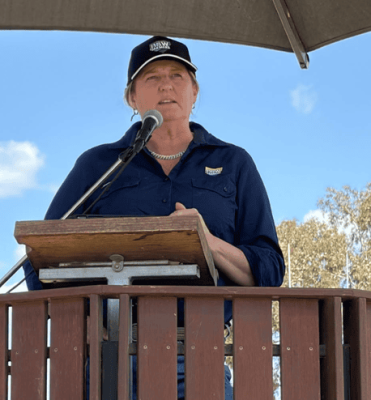
NSW Farmers president Rebecca Reardon speaking at the 2026 Henty Machinery Field Days. Photo: NSW Farmers
“This has been a genuine whole-of-industry effort, with stakeholders across the country…working collaboratively with NSW Farmers to secure this result,” Ms Reardon said.
“Introducing these changes on 1 December would have created enormous uncertainty in the middle of harvest, when millions of tonnes of grain are expected to move off farms and towards ports across NSW.
“For growers who have already endured a tough year, the consequences could have been significant.
“While industry has consistently called for a three-year extension, this delay provides much-needed certainty during harvest and an opportunity to work with government, regulators, industry and the Grains Research and Development Corporation on a practical pathway forward.
“Worker safety is paramount, and growers take it extremely seriously.
“This additional time must be used to build a robust Australian evidence base and develop clear, practical guidance to support the revised exposure limits.”
Essential for grain production and market access
NSW Farmers Grains Committee chair Adrian Roles said phosphine remained an essential tool for protecting stored grain, maintaining quality and meeting domestic and international market requirements.
“Phosphine plays a critical role in keeping stored grain free from insect pests, maintaining grain quality and protecting Australia’s biosecurity and export market access,” Mr Roles said.
“Many international markets require grain to meet strict phytosanitary standards, and phosphine treatment is an important way of achieving those requirements.
“The reality is there is currently no practical alternative capable of doing this job at the scale required on farms and across the Australian grains industry.
“This delay gives us the opportunity to ensure the revised requirements are supported by sound Australian research, reliable exposure measurement methods and practical controls that can be implemented safely throughout the grain supply chain.
“Industry is already working with the Grains Research and Development Corporation on research into phosphine exposure, its behaviour in stored grain, exposure monitoring and the operational practices needed to meet the revised limits.
“The priority now must be turning that research into practical solutions that protect workers while ensuring growers can continue to safely store, protect and market Australian grain.”
The move by the NSW Government makes Queensland the only mainland state which has not postponed the introduction of tougher laws around phosphine WELs from 1 December 2026 as slated by Safe Work Australia.
The Western Australian Government has deferred the changes until December 2029, putting it in line with Victoria’s timeframe, while the South Australian Government has deferred its implementation until July 2028.
Call for three-year timeframe
The announcement out of NSW has been welcomed by Grain Trade Australia.
Its chief executive officer Pat O’Shannassy said the decision showed what can be achieved when government and industry work through difficult technical issues together, with worker safety as the shared priority.
Mr O’Shannassy has thanked NSW Minister for Work Health and Safety and for Industrial Relations Sophie Cotsis and SafeWork NSW Commissioner Janet Schorer for their willingness to engage with industry on “a complex issue”.
“The Minister’s office and SafeWork NSW engaged directly with industry and technical experts and took the time to understand how phosphine is managed in practice.”
“Industry has been clear from the outset that this is not about avoiding safety obligations; it is about having a standard that can actually be measured, monitored and complied with in a real-world environment.
“At present, that is not the case.”
Industry has maintained its call for introduction of the stricter WELs after three year in order to ensure measurement, monitoring and compliance can be achieved.
In a statement, Ms Cotsis said the extension for phosphine and the staged approach for diesel particulate matter is about “ensuring industry is in the best possible position to plan for changes in exposure limits”.
“Industry and stakeholders have raised a number of concerns about the implementation of the new exposure limit and the impact it could have on the upcoming harvest,” Ms Cotsis said.
“We have listened to the concerns raised by industry and stakeholders and this extension will ensure those concerns can be properly considered, and businesses have sufficient time to prepare for and implement the necessary changes.
Source: NSW Farmers, GTA, NSW Government
HAVE YOUR SAY