
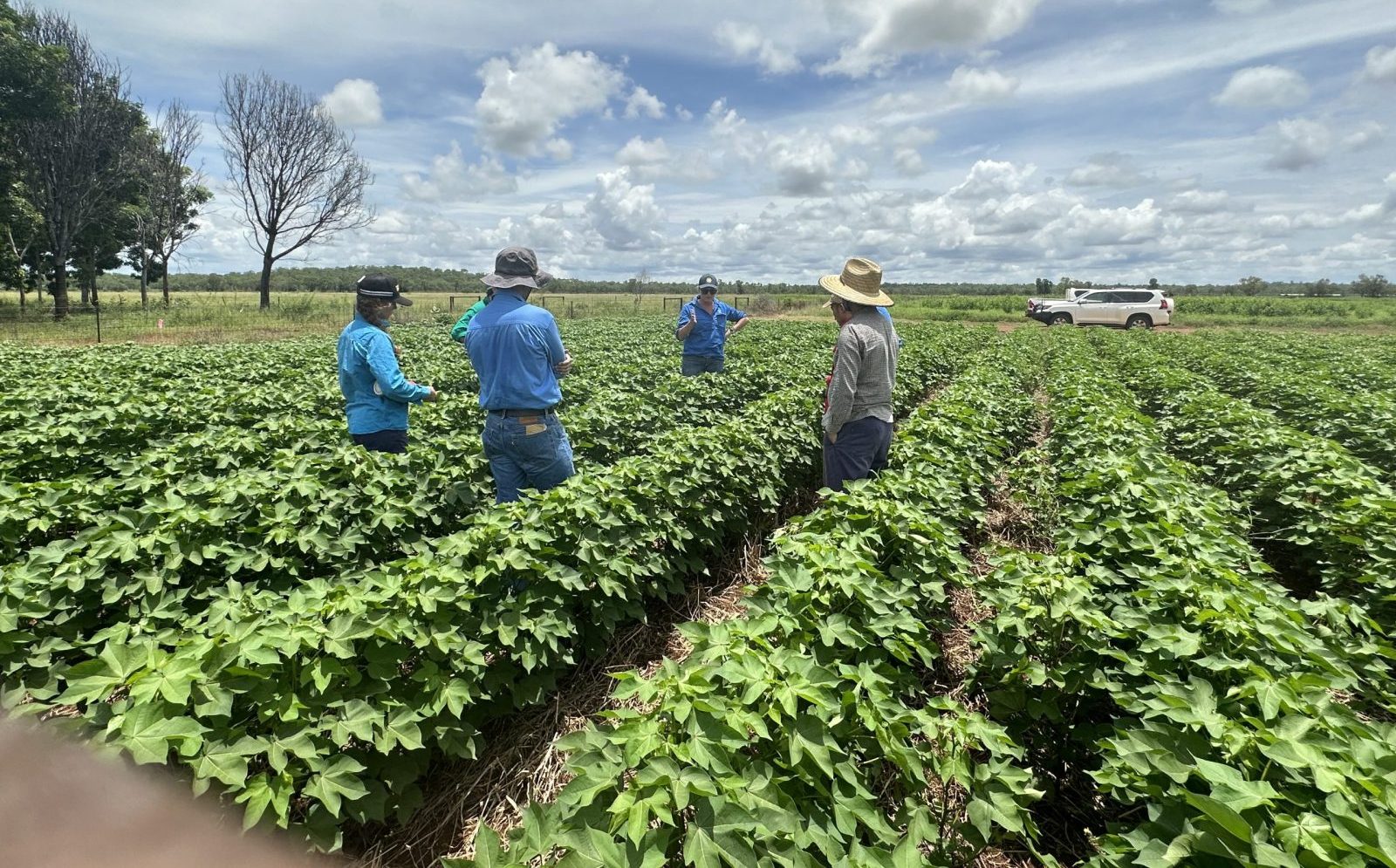
Cotton growing on the NT Government’s Katherine Research Station last year. Photo: Edward Mwando, NT Government
THE Australian Agronomy Conference is heading for the Top End in a first for the event which since 1980 has been bringing together agronomists, researchers, advisors, and industry professionals.
The program kicks off on Monday, August 24 in Darwin with masterclasses and a cotton event, followed by the two-day conference program, and a choice of two field trips on August 27 which offer delegates the chance to see cropping, grazing and horticulture.
Hosted biennially by Agronomy Australia, the 2026 event’s theme is Agronomy for a Diverse Future.
“This theme speaks to the growing need for diversity in all facets of agronomy, from the crops we grow and the systems we manage, to the landscapes we steward and the technologies we adopt,” Agronomy Australia president Muhammad Sohail Mazhar said.
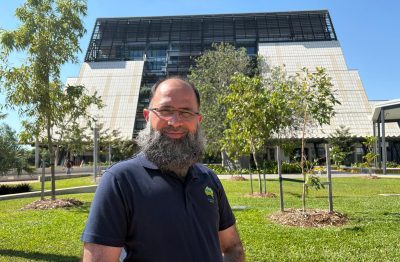
Dr Sohail Mazhar at Charles Darwin University’s Danala precinct in the Darwin CBD.
“With subthemes ranging from crop and farming systems diversity to the integration of Indigenous knowledge, emerging technologies, and multidisciplinary science, this conference invites us to think expansively and act collaboratively.”
Dr Sohail Mazhar has lived and worked in Darwin since 2020 with the Northern Territory Governmetn, and is also an adjunct professor working in biosecurity and regional development at Charles Darwin University.
The university’s Danala precinct in Darwin’s CBD is the official host and venue for Monday’s events, and the conference.
Broad perspective
The Agronomy Australia Conference is once again bringing together a range of experts to share their latest thoughts and research on topics including soils, crop nutrition, pests and diseases and farming systems.
Among the international speakers is Kansas State University researcher and co-chair of the global Wheat Initiative’s agronomy working group Romulo Lollato, who was GRDC’s visiting research fellow in 2024-25.
Dr Lollato’s attendance is being supported by CSIRO and the topic for his keynote address is From Kansas to Australia: What diverse wheat systems teach us about future productivity.
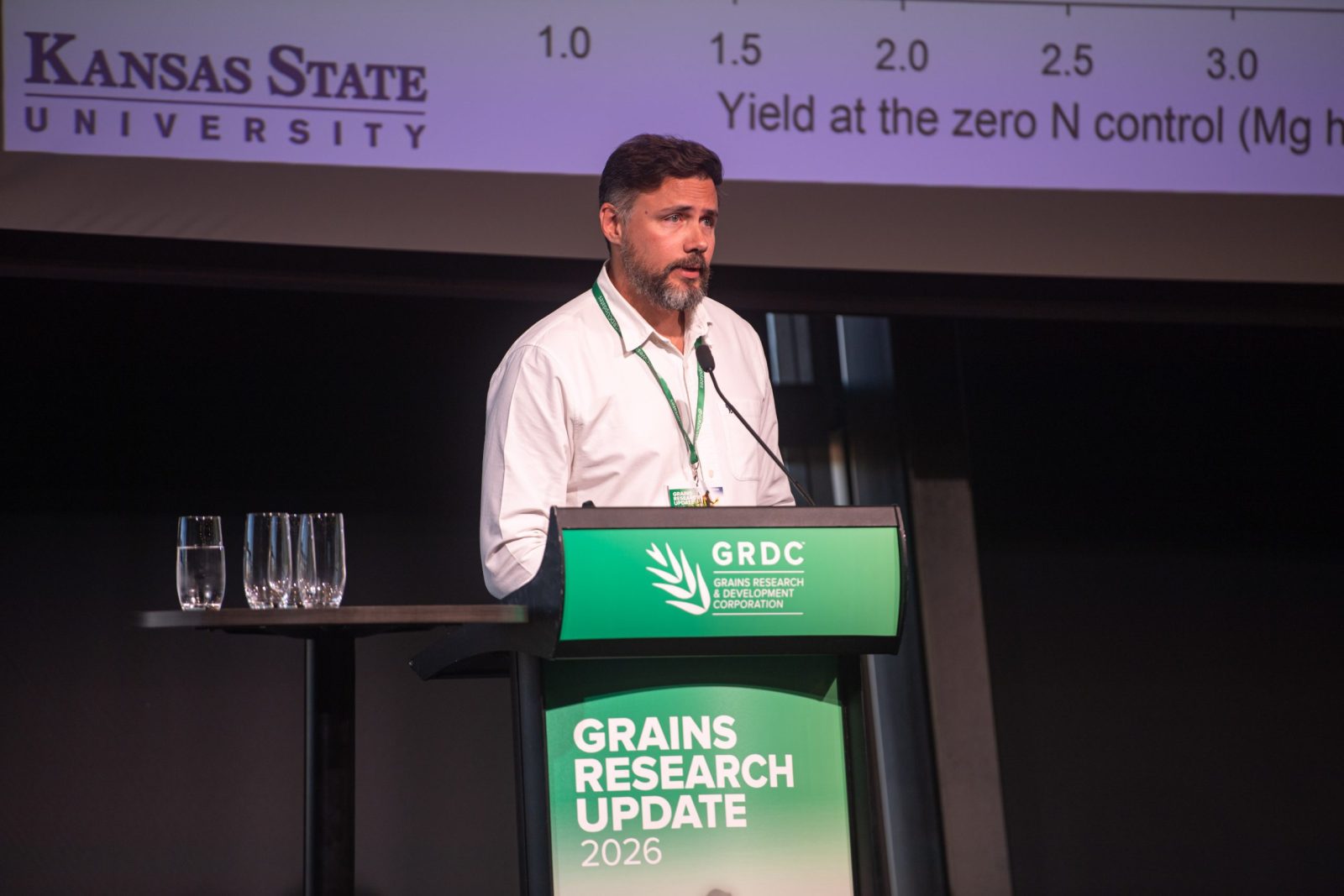
Dr Romulo Lollato speaking at the GRDC Update in Perth in February. Photo: Lumens Photography/GRDC
Darwin’s location as a hub for northern Australian agriculture and land management has made this year’s program distinctive, and will include a look at work supported by the Australian Centre for International Agricultural Research in Timor Leste.
This will come from University of Western Australia researcher Rob Williams, who started out in rice research at Yanco in New South Wales.
Mr Williams went on to lead Seeds of Life, a program which benefitted more than 65,000 families in the fledgeling nation, and his keynote address is entitled Partnerships in the Paddock: Collaborative agronomic research in Timor-Leste.
Seven Emu Station owner Frank Shadforth, a former stock and station agent who this year received an Order of Australia Medal for his work with at-risk young people, will be delivering a keynote address on sustainable agricultural management.
Other keynote addresses will come from Plant Health Australia chief executive officer Sarah Corcoran on biosecurity, Zero Net Emissions for Agriculture CRC CEO Richard Heath on reward pathways from lower emissions agriculture, and NT Farmers Association president Simon Smith.
Adding to the conference’s international flavour will be a keynote address from The University of Queensland agriculture engineer Dr Jeff Tullberg on Conservation Grain Cropping in China and Australia: The ACIAR legacy.
As always, the conference program will include presentation of the CM Donald Medal, and an oration on day one from its recipient.
The medal honours the late Professor Colin Malcolm Donald, whose agronomy research transformed pasture development in Australia.
Wednesday’s program includes the Howard oration from the recipient of the AW Howard Medal, which commemorates the contribution of Amos William Howard, who identified the potential for subterranean clover in Australian pasture systems.
Changes in north
At least two-thirds of the conference’s sessions will focus on the mainstays of Australian temperate cropping, namely wheat, barley, canola, winter pulses, and pastures.
However, the conference includes sessions around summer crops, including cotton, which grows into the winter in northern Australia.
Northern Australia Crop Research Alliance research manager Jack Daniel is based in Kununurra, in Western Australia’s Ord region, and has been involved in planning the conferences two field trips, which take place concurrently on Thursday, August 27.
“The Coastal Plains field trip highlights diversity in a small geographic area; it looks at businesses that started small and have built up,” Mr Daniel said.
The trip will visit an irrigated turf farm and a tropical fruit producer, as well as the Coastal Plains Research Station at Middle Point, east of Humpty Doo.
The trip south will visit the Douglas Daly Research Farm, a commercial farm growing crop and pasture, a cattle station growing cotton, and a tropical citrus operation.
“We’ve had outstanding interest, and we’ve had to order another bus,” Mr Daniel said of the Douglas Daly trip.
“Douglas Daly will be more about fodder and how…cropping can enhance cattle systems.”
Veteran to share insights
The conference’s long-lens look at NT agriculture will come from Fergal O’Gara, who spent 20 years with the NT’s primary industries department, then worked for a grower organisation, a reseller, and a consultancy before going out on his own in 2019.
As Northern Tropical Agriculture principal, Mr O’Gara now works mostly with corporates in the NT and in WA’s Kimberley region, with incorporation of dryland cropping into large-scale cattle operations their common challenge.
“In a nutshell, it’s an extremely challenging environment to grow annual crops, especially dryland ones,” Mr O’Gara said of the NT’s Top End.
While cropping in the Kimberley relies on irrigation from the Ord River scheme, the Top End has no publicly stored water available to agriculture, so its cropping relies on the rain during the wet season, perhaps with limited irrigation from aquifers.
Cropping allows the NT to be largely self-sufficient on fodder, with Jarra grass and the pasture legume Cavalcade key varieties.
“Forage and hay production is a vibrant industry, and it goes hand in hand with the live cattle trade; it’s the biggest broadacre industry there is,” Mr O’Gara said.
Mr O’Gara said in the past 20 years, the NT’s focus on fodder quality has increased considerably, with improved varieties and attention to agronomy helping.
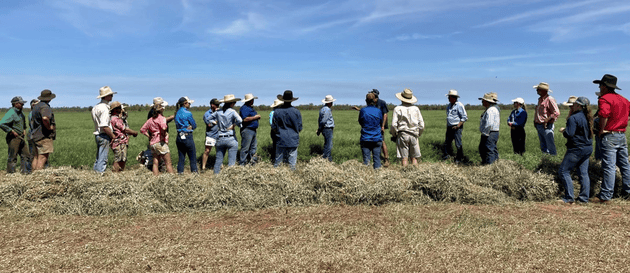
Field day participants looking at a Cavalcade hay crop on the NT’s Sturt Plateau. File photo: UNE
“Years ago, a bale of hay was a bale of hay; now, digestibility, energy and protein are the parameters.
“It’s a false economy feeding and freighting lower-quality hay.”
Pastoral operations primarily use hay at weaning, and to get cattle to live export weights, with fodder grown largely in the Douglas Daly and on the adjoining Sturt Plateau for use in-house, or sale to pastoral operations with a feed deficit.
Forage sorghum and corn for silage have also worked their way into rations that counter the seasonal feed gap, and cotton has found a place on some farms.
“The Territory does need a cash crop, a risk-mitigation strategy against solely relying on the live cattle trade.
NT cotton can now be ginned locally, and Mr O’Gara said this could make it a stayer where others have failed.
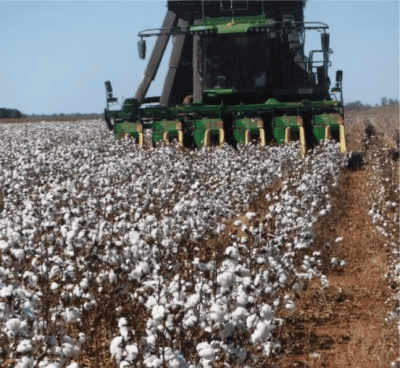
Picking cotton at the Douglas Daly Research Station in 2024.
“Mungbeans, peanuts, sesame, sorghum and corn all grow very well in the territory, but there is no real local market for them in terms of volume.”
Mr O’Gara said the cottonseed component, which offers a valuable feed source to cattle, has added to the crop’s appeal.
“Lots of cattle people are looking to cotton for protein in terms of cottonseed.”
Mr O’Gara said the NT now had some “very successful businesses” focused on fodder cropping.
“Some have taken on the cotton challenge as well, and they’re getting good average viable yields.”
Social, learning events aplenty
Wrapped around the two days of the Australian Agronomy Conference are events which give agronomists, consultants, producers, and stakeholders the opportunity to learn and interact.
The conference week will open on Monday with the third annual NT Cotton Industry Stewardship Forum, organised by the NT Government.
Running concurrently will be two masterclasses:
Masterclass 1: The Craft of Scientific Writing with SARDI crop ecophysiologist Professor Victor Sadras and CSIRO WA-based farming systems scientist Dr Andrew Fletcher;
Masterclass 2: How to be a trusted advisor with UQ extension and innovation specialist Dr John James and New Zealand’s Denise Bewsell, who has many years of extension and extension management behind her.
Social events include Monday afternoon’s Early Career Meet-up and the welcome reception at NT Parliament House.
The conference dinner, including the awards presentation, is being held on the Tuesday evening, with a sundowner even scheduled for Wednesday evening.
Registration for the Australian Agronomy Conference is open, with discounted rates available to students, primary producers, and retired agronomists.
HAVE YOUR SAY