
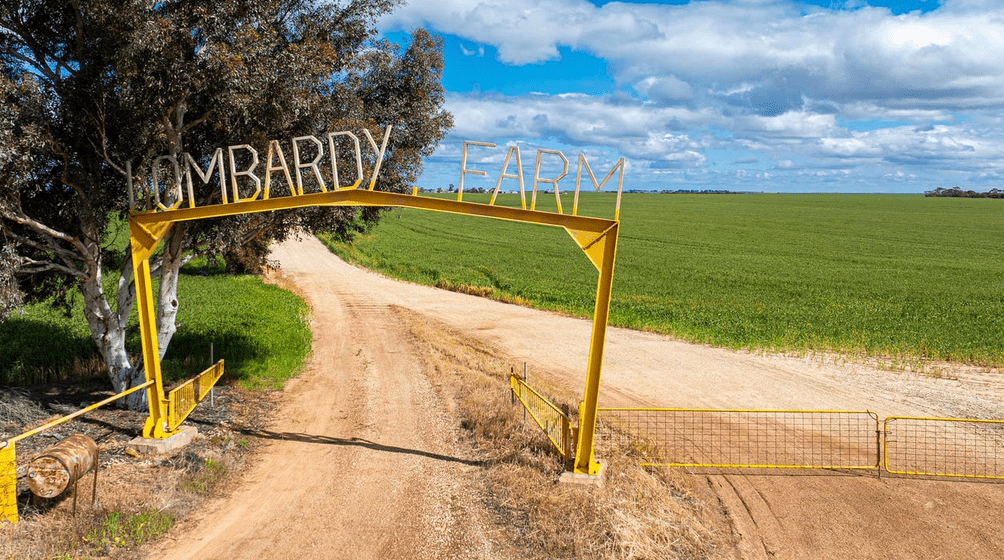
Lombardy forms part of the Marchagee Farms offering in WA’s Central Midlands. Photo: Elders
ELDERS is negotiating with several corporate and institutional investors for a Western Australian Central Midlands aggregation offering highly productive soils for grain and oilseed production, as well as potential for diversified income streams.
The 5497ha Marchagee Farms is located 24km from Coorow and 65km from Moora and comprises two holdings, the 4870ha Lombardy and the 625ha Wandallah.
The aggregation is close to CBH bulk grain-handling facilities at Geraldton, Watheroo and Moora.
Marchagee is situated on the rail line linking Geraldton and Kwinana and has access to both ports, which Elders agent Courtney Keeffe said is a key advantage.
“This means grain can be sold at whichever port offers the better price,” Mr Keeffe said.
“The Grain Trade Australia location differential for Marchagee to Geraldton is $29.86; by comparison, Moree in New South Wales has a location differential to Brisbane and Newcastle of $47.75.”
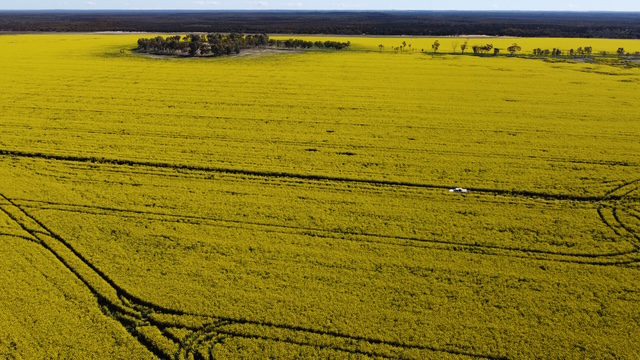
Marchagee Farms has grown canola successfully for many years. Photo: Michael O’Callaghan
The property was offered to the market in September last year, with interest renewed after an exceptional start to the season and federal and state government discussion about domestic ethanol supply.
Vendor Michael O’Callaghan, who farms 13,000ha locally, is selling Marchagee Farms as part of succession planning.
Mr O’Callaghan said Marchagee is well positioned to take advantage of biofuel opportunities.
“We have grown canola every year since 1998 and watched the yields increase,” Mr O’Callaghan said.
“GM canola has been magnificent and now there are improvements in TT canola.
“Marchagee Farms would also be a suitable site for someone to construct a canola-crushing plant.”
In October last year, the WA Government injected $1.2 million into developing an Advanced Biofuels Strategy to help position WA reduce emissions and capture new market opportunities in renewable diesel and sustainable aviation fuel.
The Federal Government is also delivering a $1.1 billion Cleaner Fuels Program to stimulate domestic production of low-carbon liquid fuels.
Running over 10 years, the initiative provides production-linked incentives to help Australia replace imported fossil fuels with home-grown biofuels derived from feedstocks including canola.
Across the aggregation, 4225ha is arable and used to grow wheat, barley, canola and lupins with variable-rate technology, sound nutritional management, advanced in-crop chemistry and controlled-traffic systems.
Well-ameliorated soils underpin the operation.
Quartz-based cherts, red loams, sand over clays and gravels, yellow sandplain and high-pH limestone-based loams are considered easy-working and have exceptional water-holding capacity.
Marchagee Farms receives an estimated annual rainfall of 390mm and has a Mediterranean climate, with hot, dry summers and mild, wet winters.
Mr Keeffe said the standalone, high-yielding cropping enterprise also offers potential for future income streams.
“The successful purchaser could obtain extractive-industry licences and/or develop renewable-energy projects, subject to feasibility and approvals, with several developers identifying the area as suitable for wind-turbine development.”
Mr O’Callaghan said six renewable-energy companies had expressed interest in the property after it was assessed as a high wind-generation location.
WA’s primary electricity network, the South West Integrated System, passes through the property, with government assessment being made regarding its upgrade.
“These suppliers estimate Marchagee could run 61 wind turbines, which could create significant passive income flows,” Mr O’Callaghan said.
Lombardy
Lombardy is 22km south of Coorow and 66km north of Moora, and is adjacent to the Marchagee CBH facility, which Mr Keeffe said is another advantage.
“This means significantly shorter truck delivery turnaround times, which improves harvest efficiency,” Mr Keeffe said.
“It also reduces the need for large, short and long term mother-bin storage on farm during harvest.”
Lombardy has three bores, two of which are equipped, as well as freshwater soaks.
It also has a significant deposit of high-quality lime suitable for neutralising soil acidity.
Previously mined commercially, the deposit is estimated by the vendor at 850,000 tonnes.
Most infrastructure is on Lombardy and includes a four-bedroom home, a shearing shed, numerous sheds and eight silos with a total of 256t of grain storage.
Wandallah
The nearby 625ha Wandallah complements Lombardy.
Around 409ha is considered arable, with the higher-pH soils suited to canola, cereals, particularly barley, lentils.
It is watered by an equipped bore and infrastructure includes two sheds.
The block also offers extraction opportunities, with large deposits of high-neutralising dolomitic lime estimated at around 10 million tonnes, and three deposits of bentonite clay totalling 10,000t.
Marchagee Farms is offered for sale as a whole or in separate parcels.
Biofuel potential considerable: Barber
Elders general manager Farmland Agency and Agribusiness Investments Mark Barber said Marchagee highlighted the current and future benefits of investing in the WA grains industry.

Elders’ Mark Barber.
Over recent years, Western Australia has demonstrated it is a reliable grain powerhouse, capable of growing an enormous amount of canola,” Mr Barber said.
“With growing interest in biofuel production and rising demand for canola seed, Marchagee offers the incoming purchaser an opportunity to benefit enormously from biofuels.”
Mr Barber said investment in WA was also attractive because of CBH’s substantial investment in grain storage and handling infrastructure, which is improving efficiency across the network.
CBH Group is executing a multi-billion-dollar network investment strategy to increase receival speed, storage capacity and port export capability across the state.
The co-operative has said the improvements will help it handle record-breaking harvests and move grain efficiently.
The main focus areas for the upgrades are:
Site upgrades: Major infrastructure improvements are adding hundreds of thousands of tonnes of permanent storage, including new open bulkheads, dual-sampling facilities, modern weighbridges and upgraded conveyors to speed truck turnaround times.
Rapid rail outloading: CBH is constructing and commissioning rapid rail-loading facilities and sidings at sites including Broomehill, Cranbrook and Moora, allowing faster and more efficient loading direct to trains to help meet peak export targets.
Rail-fleet expansion: To complement the infrastructure upgrades, CBH has added new narrow-gauge and standard-gauge locomotives, along with hundreds of custom-built wagons, to transport grain from country bins to ports.
Further reading on WA canola and biofuels:
HAVE YOUR SAY